
(Kitco News) - The U.S. consumer continues to support economic growth, but beneath resilient headline spending, new data point to mounting financial stress for many households.
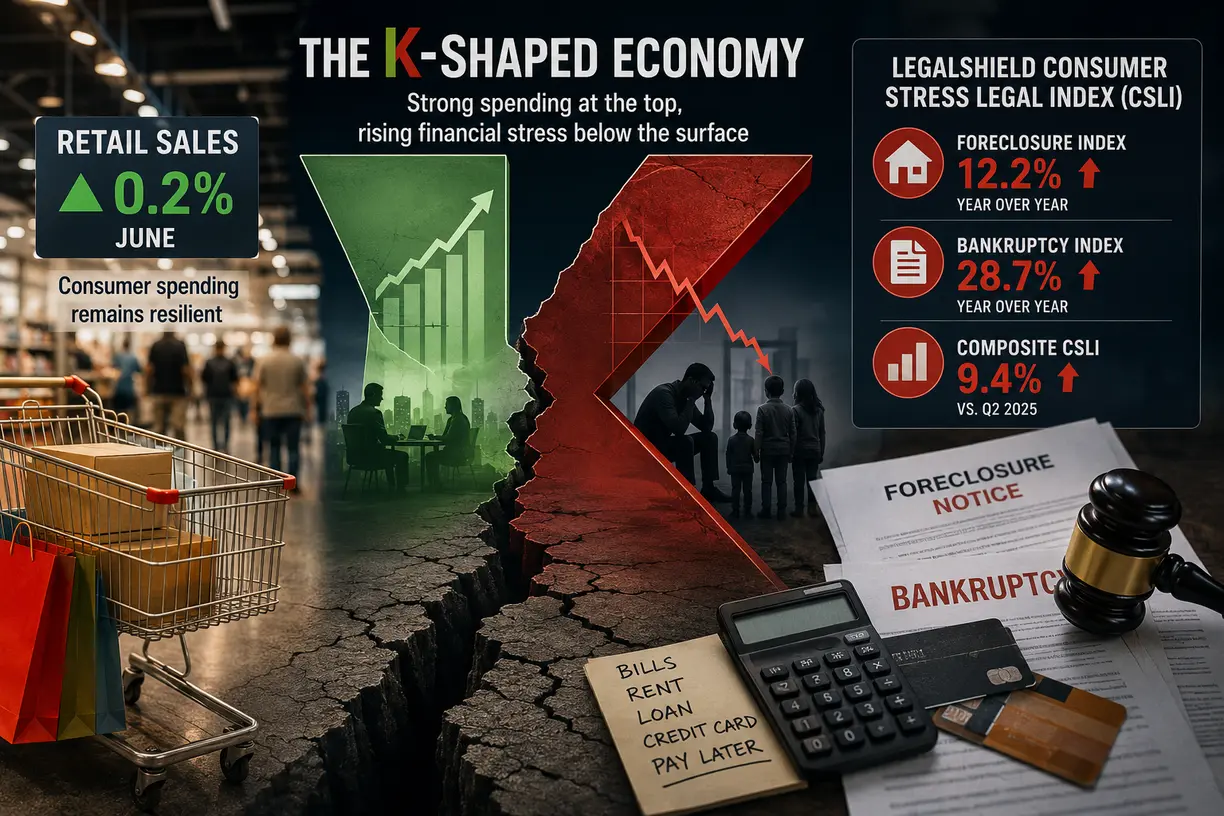
Retail sales rose 0.2% in June, matching economists' expectations after May's revised 1.0% increase, according to the Commerce Department. Economists said the report shows consumer spending remains resilient despite elevated inflation and higher borrowing costs, reinforcing expectations that the Federal Reserve still has room to prioritize price stability.
However, LegalShield's latest Consumer Stress Legal Index (CSLI) shows financial stress continuing to build as more Americans seek legal assistance for foreclosures, bankruptcies, and consumer finance issues.
According to the report, the Foreclosure Index climbed to its highest level since March 2020, rising 12.2% from a year earlier, while the Bankruptcy Index jumped 28.7% year over year. Overall, the composite Consumer Stress Legal Index increased 9.4% compared with the second quarter of 2025. The company said its foreclosure and bankruptcy indices have historically served as leading indicators of official government data.
In an interview with Kitco News, Matt Layton, LegalShield's Senior Vice President of Consumer Analytics, said the disconnect between the appearance of resilient consumer spending and rising financial stress continues to define what is becoming an increasingly K-shaped economy.
"I think there's enough people at the top of the economy that are fine and continue spending," Layton told Kitco News. “They're kind of masking the concern or the stress that the lower 75% of Americans are feeling.”
LegalShield provides subscription-based legal services, giving consumers access to legal advice and representation. Layton said the company's indices have historically served as leading indicators because they tend to signal changes in financial conditions before they appear in official bankruptcy, foreclosure, and consumer sentiment data.
He added that the latest readings show no evidence that financial conditions are beginning to improve.
"Our data suggests things are going to continue to get worse. There's nothing here that shows us that it's going to get better."
Layton said the June retail sales report also highlights one of the challenges facing economists. While spending remains healthy, the data do not reveal how consumers are financing those purchases.
He questioned how much recent spending growth is being supported by increasingly popular ‘buy now, pay later’ financing and other forms of inexpensive consumer credit, rather than stronger household finances.
"Retail sales might be the wrong metric to properly gauge the health of the economy," he said, because spending alone does not capture the financial pressures building beneath the surface.
He noted that while macroeconomic data continue to portray a relatively healthy economy, the firm's legal inquiries suggest many households are experiencing growing financial pressure.
"The macro numbers don't seem like the sky's falling," he said. "But if you look just one level under, there's an entire population of America where the sky kind of is falling."
Layton said the firm's data indicate financial stress is becoming more widespread across income groups. While lower-income households continue to experience the greatest financial hardship, he said rising stress is being felt across virtually every segment of society.
"I'm not ready to dismiss the argument that everyone isn't feeling stressed to some level, because our membership base is a really good cross-section of income across North America," he said. "Of course, folks at the lower end are going to feel that stress more acutely because they're out of money. But even the folks at the top, while they may have the funds to float their way through it, they're still stressed."
The trend also extends across geographic regions.
Layton said the South continues to experience the highest levels of financial stress, but the Midwest and the West are also seeing conditions deteriorate.
"Across all regions of the United States and across all income levels, we're seeing stress continue to increase," he said.
LegalShield said another factor contributing to rising financial strain is the expiration of pandemic-era relief measures, which had helped keep foreclosure and bankruptcy activity subdued in recent years.
"We've washed out all the COVID pandemic protections. We've hit where we were previous to the pandemic, and we're continuing to increase," Layton said.
"We don't see anything in our data that would suggest it's going to improve anytime in the short term.
