
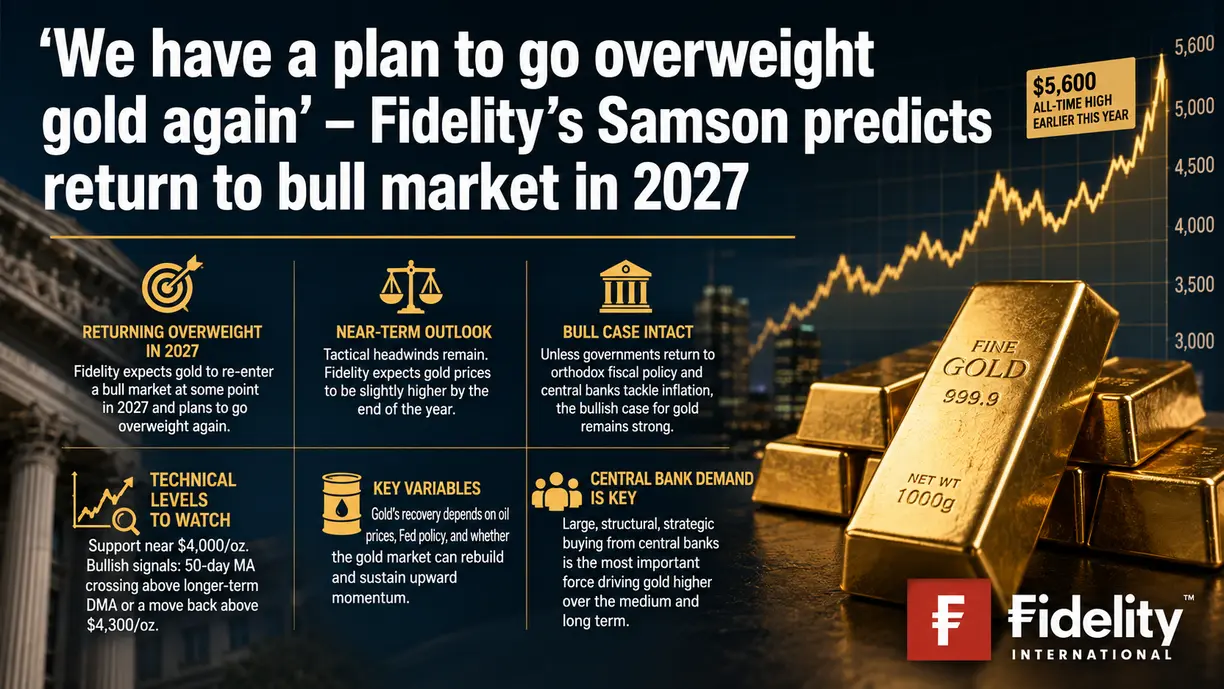
(Kitco News) – The key trends that drove gold to an all-time high of $5,600 per ounce earlier this year remain in place, and the yellow metal will resume its bull market run in 2027, justifying a move from neutral back to overweight gold in investor portfolios, according to Ian Samson, multi-asset portfolio manager at Fidelity International.
“We have a plan to go overweight gold again,” Samson said in a recent interview. “The question now is when to act.”
Despite gold enduring its worst quarterly performance in over a decade, Samson said the core logic underpinning gold's long-term trajectory has not been invalidated.
Earlier this year, he made the decision to downgrade Fidelity's gold position from overweight to neutral. Samson said this adjustment was made between January and February, just before gold's multi-year bull run was interrupted. Gold prices began retreating from a record high near $5,600 per ounce in late January, and the decline accelerated a month later when the Iran war began.
Fidelity doesn’t expect gold to resume its previous upward path right away, however. “From a tactical perspective, there are as many headwinds as tailwinds right now,” Samson said. “I expect gold prices to be slightly higher by the end of the year than they are now.”
But despite the near-term price performance, Samson said Fidelity has not abandoned its conviction about gold's long-term trajectory. He said the firm expects gold will re-enter a bull market at some point in 2027.
As long as the global macro environment does not undergo a fundamental shift, unless “governments return to orthodox fiscal policy and central banks make a genuine effort to bring inflation down, the bullish case for gold will not be undermined,” he said. “But I don't think that's the world we're currently living in.”
As for the precise timing and the degree of gold’s price recovery, Samson said this will depend on several key variables, including the future trajectory of oil prices, the Federal Reserve's interest rate policy, and whether the gold market itself can rebuild and sustain upward momentum.
From a technical perspective, Samson thinks gold prices could continue to find support near the $4,000 per ounce area in the near term, but he’s looking for a clear signal of strength. He said that the first moderately bullish signal would be the 50-day moving average crossing above a longer-term DMA, or gold prices climbing back above $4,300 per ounce. “That would mean some upside pressure is emerging,” he said.
And in terms of fundamentals, Samson pointed to central bank demand as the most important structural force supporting gold prices over the medium and long term. “If you have these large, structural, strategic buyers, it's almost inevitable that the gold price will be pushed higher,” he said.
