(Kitco News) – Gold prices saw another disappointing week, as softer U.S. inflation data and falling Treasury yields provided only limited support while renewed U.S.-Iran hostilities, surging oil prices, and resilient economic data kept pressure on the precious metal.
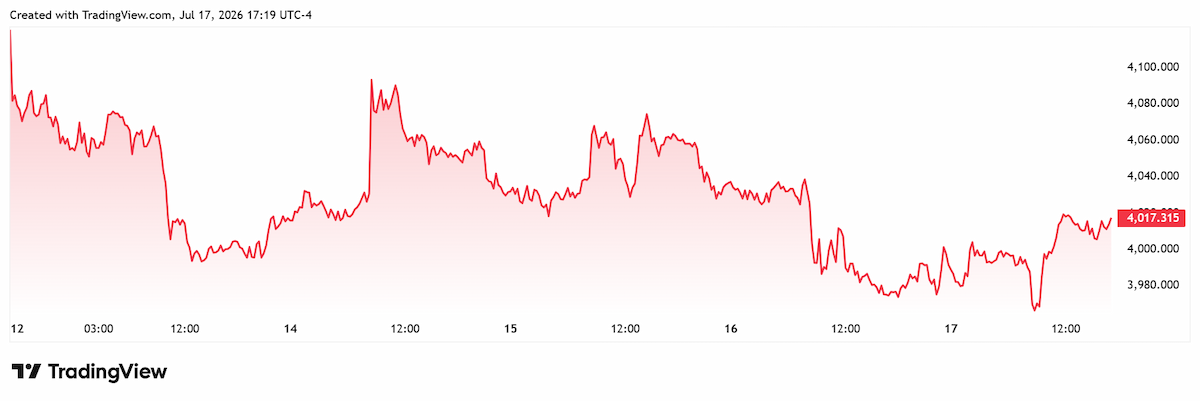
Spot gold kicked off the week trading at $4,108.18 per ounce on Sunday evening, but the yellow metal quickly came under pressure as escalating tensions around Iran and the Strait of Hormuz drove oil prices sharply higher and revived concerns that energy inflation could keep the Federal Reserve cautious. Gold briefly pushed to its weekly high at $4,122.63 per ounce on Monday, but the rally faded quickly as the U.S. dollar held firm and traders remained reluctant to chase safe-haven demand.
The metal found some support Tuesday after June CPI cooled to 3.5%, below expectations, helping ease concerns about an imminent Fed rate hike. Gold rebounded back above $4,050, but the move stalled Wednesday after producer-price data and broader risk-off trading kept yields elevated and prevented a sustained recovery.
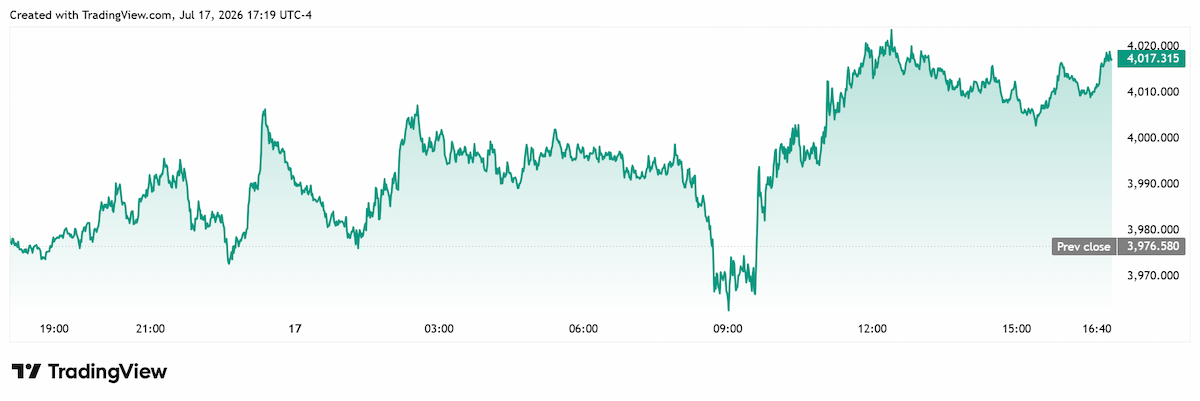
Selling accelerated Thursday after stronger U.S. retail sales reinforced expectations that the Fed would keep policy restrictive, while the latest U.S.-Iran escalation pushed crude prices higher and added to inflation concerns. Spot gold broke below the $4,000 level and ultimately set its weekly low at $3,959.37 per ounce on Friday before bargain-hunting helped prices recover modestly.
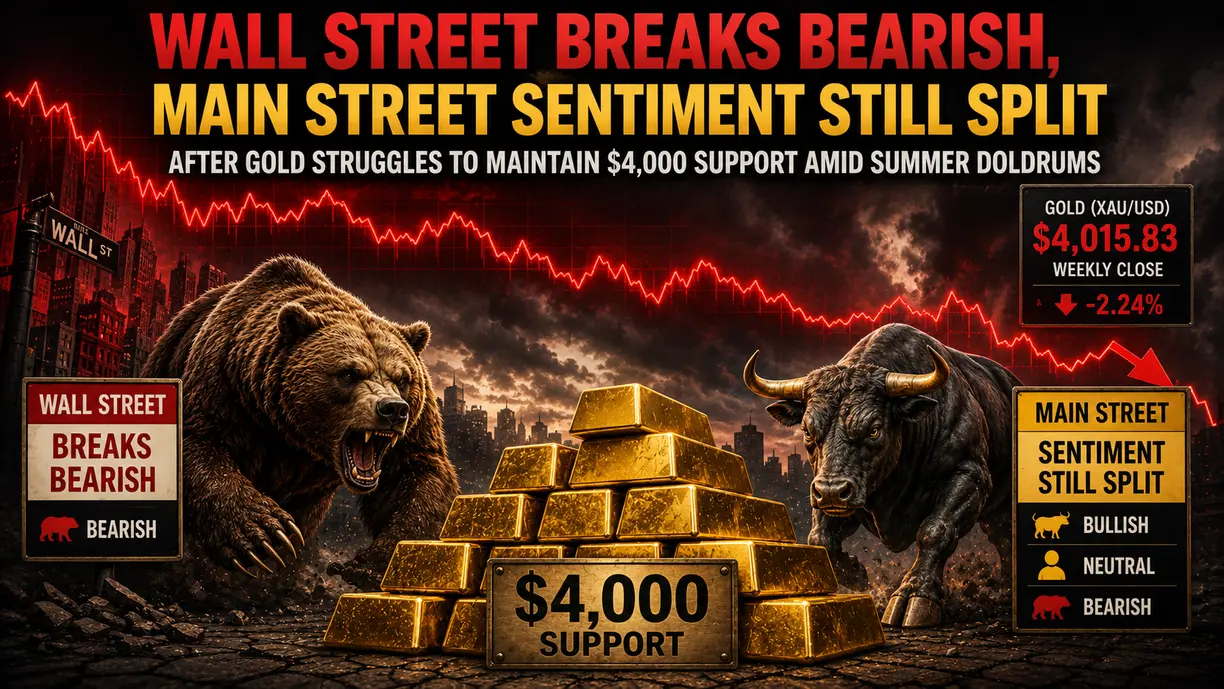
After failing to reclaim $4,050, spot gold closed the week at $4,015.83 per ounce, leaving the metal with another weekly loss heading into the weekend.
The latest Kitco News Weekly Gold Survey showed Wall Street overwhelmingly bearish on gold’s near-term prospects, while Main Street sentiment remained divided and indecisive after the yellow metal repeatedly tested the $4,000 support level.
“Unchanged… though the gold price is unlikely to be unchanged, it will likely be volatile within a range,” said Adrian Day, president of Adrian Day Asset Management. “We are unlikely to see a breakout to the upside until the sentiment clearly changes to a ‘no-hikes’ Federal Reserve, while there appears solid central bank buying at these levels, supporting prices.”
“Up,” said Rich Checkan, president and COO of Asset Strategies International. “We have tested support at $4,000 several times over the past couple months. It continues to hold. I believe it will again. We see renewed buying interest at that level on a regular basis. We may not be ready yet for a sustained move higher, but off this support, I do see higher prices.”
“Negative,” said Adam Button, head of currency strategy at investingLive. “The tech rout is accelerating and there's a growing risk it could swallow up everything and lead to a broad 'sell everything' move.”
"In the short term, further upside potential is likely to remain limited,” said Thu Lan Nguyen, head of FX and commodity research at Commerzbank. “With the ongoing escalation of the Middle East conflict and the resulting risk of another sharp spike in energy prices, expectations of interest rate hikes are likely to persist for some time.”
Paul Wong, managing partner and market strategist at Sprott Inc., told Kitco News that gold tends to find support when prices fall to 90% of the 200-day moving average – and we've well overshot that at this point – but there are other reasons to expect a rebound by late summer.
“It looks pretty remarkably similar [to previous pullbacks],” Wong said. “The percentage below the 200-day moving average, that's just a technical measure. Internally, I have five or six other measures that show minus two or minus three standard deviations oversold. I tend to think about things more in terms of probabilities: where are you on the distribution curve probabilities? Are you oversold? Give me a number. According to this measure, it's minus two standard deviations. According to this measure, it's minus two and a half, minus three, whatever. Add them all up, and what does it mean? It means that it's harder and harder to push down the gold price of gold. That's what the probability says.”
Wong said gold prices will still need a catalyst to break higher. “What is it going to get to spark it back up? That's the whole thing,” he said. “But in terms of selling action, minus two standard deviations oversold positioning, CTAs have gone to flat; CFTC positioning in terms of longs is back at the 2018 levels. In terms of ETF holdings, they sold off a little bit, but not a lot. If you look at China ETF holdings, all the ETF [holdings] that came out of Europe and North America have been more than absorbed by the ETF growth in China.”
“I've built up all these indicators over the years, so I fire them all up, and if all of them are saying minus two standard deviations or lower, then chances are it's oversold,” Wong said. “It doesn't mean it's the low, it just means the bulk of the selling is probably done. And now you're switching to look for an entry point, or if you're a massive fund, you just start buying, and on down days when it drops 1% or 2% on some news or whatever, you just buy a little bit more.”
Gold’s seasonal weakness can actually be viewed as an advantage from this perspective. “Usually gold bottoms in the summertime, usually around early August is the average seasonal low,” he said. “It can be late, last year was at end of August with Jackson Hole, when the market realized the Fed's not going to raise rates in the face of any inflation.”
“Next thing, gold runs from $3,600 up to around $4,500 before it crashed.”
Wong said the same dynamic is likely to play out again this year. “Probably sometime in August, whether it's Jackson Hole or something sooner, or something blows up in the Middle East, or the bond market goes bonkers,” he said. “There'll be some sort of event, a catalyst, that all of a sudden sparks gold up again.”
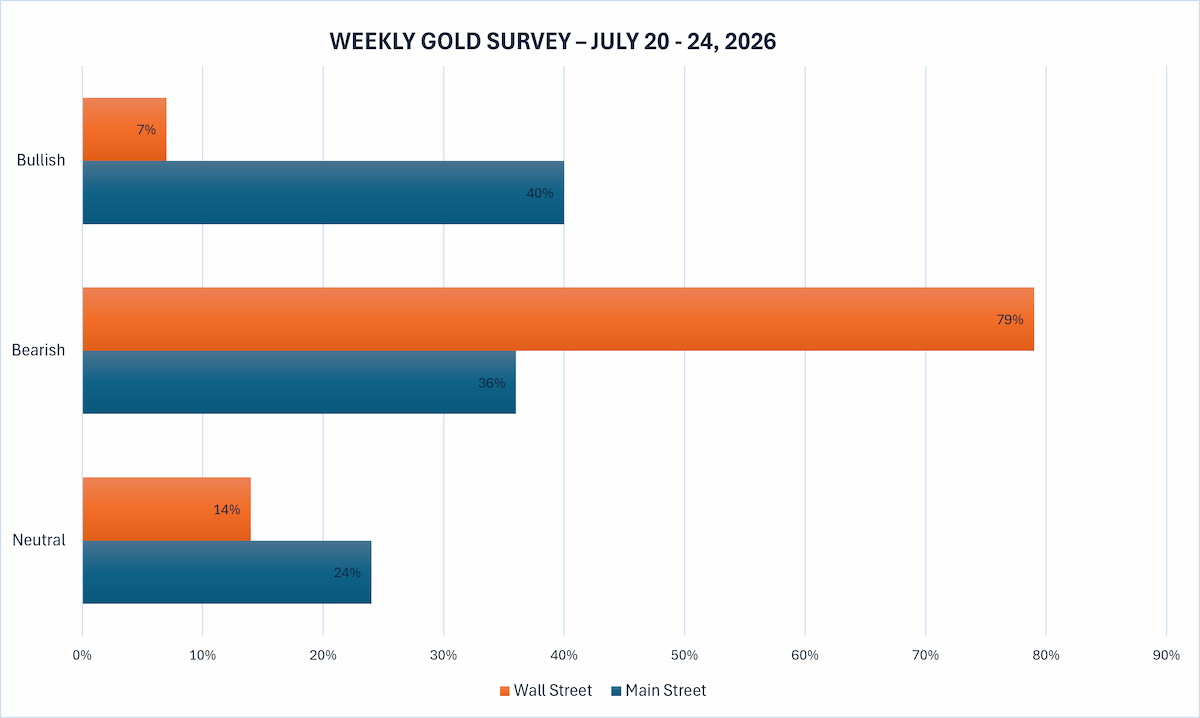
This week, 14 analysts participated in the Kitco News Gold Survey, with Wall Street sentiment breaking bearish after gold’s failure to rally on a raft of positive economic data. Only one expert, or 7%, expected to see gold prices gain ground during the week ahead, while 11 others, representing 79% of the total, predicted a price decline. The remaining two analysts, or 14%, saw the yellow metal trending sideways next week.
Meanwhile, 169 votes were cast in Kitco’s online poll, with Main Street investors turning slightly more bearish following another down week for gold prices. 68 retail traders, or 40%, looked for gold prices to rise next week, while 61 others, or 36%, predicted the yellow metal would lose ground. The remaining 40 investors, representing 24% of the total, expected to see consolidation during the coming week.
After a busy week filled with key indicators and Fed testimony, next week will be among the sparsest of the summer, leaving markets potentially more sensitive to news headlines and geopolitical developments.
Traders will have to wait until Thursday morning for a major economic news event, when the European Central Bank will deliver its monetary policy decision, followed by ECB President Lagarde’s press conference, with markets pricing in a hold this month. Markets will also receive weekly jobless claims data.
Then on Friday, traders will be watching for July’s S&P Global Flash PMI, followed by New Home Sales for June.
“Gold has failed to inspire,” said Marc Chandler, managing director at Bannockburn Global Forex. “It ground lower in recent days and looks poised to challenge the year’s low recorded near $3943 basis spot at the end of June. This past week, gold was capped at the 20-day moving average, which is near $4071 now. There is some fear that a new disruption from the Middle East war will spur more official gold sales, while retail appears to be exiting the ETFs.”
Jesse Colombo, independent precious metals analyst and founder of the BubbleBubble Report, told Kitco News that while gold will remain sensitive to oil prices as long as the Iran conflict continues, the recent attacks have had limited impact on precious metals prices.
“The escalation is already priced into precious metals because they've been slammed since late January,” he said. “There's so much negativity priced in, and every type of proxy you can imagine for sentiment right now is down in the dumps when it comes to gold. And yet what I find very interesting is over the past 24 hours or so, there have been multiple attempts from sellers to push gold below $4,000 – really the support is just below that, around $3,980 to $3,960 – there were multiple attempts, including really early this morning, and it looked like this is it, it's going to break down. And all of a sudden, it sprung back up.”
“That's a sign that buyers are coming in at these levels,” Colombo said. “My hope is that the selloff is reaching exhaustion. It's a good sign; it's definitely encouraging. You can see for the past month, going back to mid-June, it kept on testing $4,000, and it would bounce back above.”
Colombo said a triangle pattern has formed on the daily gold chart.
“What this represents is a squeeze,” he said. “There's a volatility squeeze where the volatility, the average true range, the ATR, has actually been dropping over the past month. It's not as volatile as it was in the spring. Usually, volatility goes in cycles, so there's probably going to be another volatility breakout soon.”
Colombo said he’s waiting to see which way gold breaks out from this triangle. “If it breaks to the upside, then there's a very good chance that might be the start of a rebound,” he said, “whereas if it were to break down decisively below four thousand then we could see further downside.”
“We're at a make-or-break point right here with gold, so I'm keeping a very close eye on it,” Colombo said. “But I'm cautiously optimistic.”
Alex Kuptsikevich, senior market analyst at FxPro, expects gold prices to fall further next week.
“Over the past week, gold’s rebounds have been getting lower and lower, continuing a downward trend that became particularly evident in May but actually began with the peaks seen at the end of January,” he noted. “The key factor now is the flight from equities, which is undermining demand for risky assets. A combination of relatively mild inflation (CPI, PPI) and very impressive retail sales figures, whilst not driving up expectations of a rate rise by the Fed, has nevertheless dampened interest among those seeking alternatives outside the US.”
“On the other hand, repeated dips below $4,000 have not yet resulted in a full-scale capitulation, as traders have moved their stop-loss orders further away from the gradually declining market,” Kuptsikevich said. “It was in this very region that buying intensified last November, reversing the correction and kick-starting the final leg of the rally above $5,500. We should also be prepared for decent demand from gold bulls on dips towards this key round figure. Nevertheless, we are more inclined to forecast a further decline in the price towards $3,300 by September, albeit with short-term rebounds.”
“A risk that could accelerate the price decline is growing disappointment with the returns from AI-related companies and the increasing supply of their shares and bonds on the market,” he added.
Analysts at CPM Group issued a Sell recommendation on Thursday when gold was trading near $3,980 per ounce, with an Initial Target Price of $3,820 per ounce between July 17 and 31 and a Stop Loss at $4,090.
“Gold prices have been making lower lows and lower highs overall since late January this year,” they noted. “On a temporary basis, prices are in a downward trend for the short term and ultra short term. Economic conditions are faring better than expected, inflation eased at least temporarily in June, and there is a supposed ‘ceasefire’ between the U.S. and Iran, although there continues to be on and off fighting between the two countries.”
“Politically, conditions supportive of gold in the longer term (beyond August) continue to expand,” the analysts added. “While prices are on a current downtrend, the trend could reverse quickly. Following the trend may make sense for now. This should be done in a way where gains are not reversed, therefore CPM has suggested a stoploss relatively not too far from current prices, given the volatility.”
Michael Moor, founder of Moor Analytics, expects to see gold prices rise next week.
“Lower, UNLESS we break decently above 40190 (+2 tics per/hour starting at 11:20am)—above which I would look for a rally for days—a 'decent' penetration is $27 until the close,” he wrote. “In a Higher timeframe: cautioned on 8/16/18 the break above $1,183.0 warned of renewed strength. We have seen $4,443.1. This is ON HOLD. We held exhaustion with a 56268 high and rolled over $1,651.1. This is ON HOLD. On a medium timeframe basis: The trade below 52554 projected this down $740 (+)—we attained $1,300.0. The trade below 52036 brought in $1,248.2 of pressure. The trade below 51606 brought in $1,205.2 of pressure. These are OFF HOLD. We held exhaustion with a 49177 high after a pullback and rolled over $962.3. The break below 48185 projected this down $185 (+)—we attained $863.1. The trade below 47923 projected this down $205 (+)—we attained $836.9. The break below 47420 brought in $786.6 of pressure. On 5/15 we left a medium bearish reversal—we have come off $597.8 from 45532. We held exhaustion with a 44036 high and rolled over $448.2. On 6/18 we left a minor bearish reversal—we have come off $323.9 from the 42793 open. These are OFF HOLD. We held macro exhaustion at 39741-357 with a 39554 low and bounced $260.1—if this holds and we start a bona fide bullish correction, the minimum target is 49636. This is ON HOLD.”
“On a lower timeframe basis: We held exhaustion at 41795-2324 with a 42155 high and rolled over $252.5,” Moor said. “The trade below 40922 (+6.2 tics per/hour) projects this down $40 minimum, $165 (+) maximum—we attained $129.2. We may be in the last stretch of the move down from 42155, with possible exhaustion at 39734-574—we are holding this currently with a 39630 low and have bounced $61.6. If we trade below 39553, this will suggest continued weakness.”
At the time of writing, spot gold last traded at $4,017.31 per ounce for a loss of 1.80% on the week but a gain of 1.02% on the day.