

(Kitco NewsWire) - Spot gold and silver prices are modestly higher in late-afternoon U.S. trading Monday, as short covering helped metals stabilize after last week’s selloff, while higher Treasury yields, a firmer U.S. dollar and elevated crude oil prices capped the rebound. At the time of writing, spot gold was trading near $4,007.10 an ounce, down 0.25% on the session, while spot silver was trading near $56.27, up 0.80%.
Gold’s session range was $3,982.20 to $4,040.90, leaving the metal above Friday’s low but still below the $4,020 to $4,040 resistance band that has capped the latest recovery attempt. Silver’s session range was $55.40 to $57.60, with the metal rebounding from the lower end of last week’s breakdown but still below the $58.53 to $59.44 trader-reaction zone.
North American equities closed lower as rising bond yields, oil-price pressure and lingering Middle East risk offset early strength in AI-linked shares. The S&P 500 fell 14.41 points, or 0.2%, to 7,443.28, the Nasdaq Composite slipped 12.17 points, or less than 0.1%, to 25,508.07, the Dow Jones Industrial Average declined 307.16 points, or 0.6%, to 51,839.26 and the Russell 2000 lost 19.79 points, or 0.7%, to 2,942.43. In Canada, the S&P/TSX Composite fell 194.35 points, or 0.55%, to 35,069.50.
European equities finished mostly lower as higher oil prices pressured airlines and broader risk appetite, while energy shares limited the decline. The STOXX Europe 600 fell 1.93 points, or 0.30%, to 639.60, London’s FTSE 100 lost 75.61 points, or 0.71%, to 10,524.76, Germany’s DAX added 15.71 points, or 0.06%, to 24,846.69 and France’s CAC 40 gained 1.30 points, or 0.02%, to 8,340.11.
Positioning after the latest economic data remains less dovish than the early-July inflation prints suggested. Softer CPI and PPI data initially reduced pressure for another near-term Fed move, but stronger retail sales, lower jobless claims, a sharp Philadelphia Fed manufacturing rebound and firmer University of Michigan sentiment have kept traders from pricing a clean policy pivot.
The latest rates setup shows the market still expecting the Fed to hold at the July meeting, while September remains live, with one 25-basis-point hike still priced as a meaningful risk. The 2-year Treasury yield settled above 4.22%, the 10-year yield moved above 4.60% and the dollar firmed, leaving gold supported by defensive demand but capped by the higher-for-longer trade.
The Strait of Hormuz situation is best characterized as open but highly stressed transit under active military and shipping pressure. The U.S.-Iran conflict continues to feed oil-market volatility, while the Houthis’ threat to impose a maritime blockade on Saudi Arabia has added a second chokepoint risk around Red Sea and Gulf flows. Crude pulled back from early highs after reports of a proposed 10-day ceasefire, but Brent remained near the high-$80s and WTI stayed close to the $80 area.
For gold, the impact remains two-sided: geopolitical risk supports defensive demand, but higher oil prices reinforce inflation risk, lift yields and limit the upside for non-yielding bullion. For broader markets, the trade remains oil bid, bonds under pressure, the dollar firmer and equities vulnerable to rate-sensitive selling.
Traders are watching Fed communication, September rate-hike pricing, second-quarter earnings from major technology companies and any further disruption to Hormuz or Red Sea shipping lanes. A sustained move back above $4,040.90 would improve gold’s short-term setup, while a break below $3,982.20 would put last week’s support back under pressure.
The key outside markets see Nymex WTI crude oil prices lower and trading near the $80.00 area, while Brent crude was near the $86.90 area after pulling back from an intraday high above $91.00. The U.S. dollar index is firmer. The yield on the benchmark 10-year U.S. Treasury note is trading above the 4.60% area.
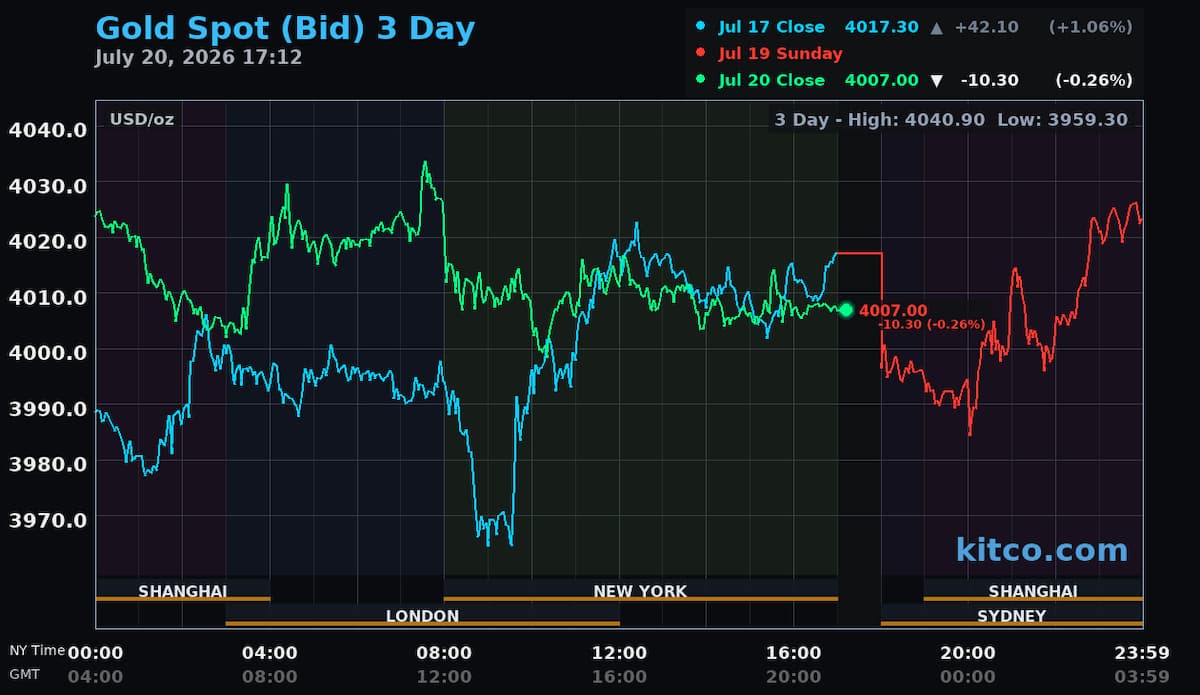
Technically, spot gold bears have the overall near-term technical advantage as prices remain below the $4,020 to $4,040 resistance band and continue to struggle near the $4,000 level. Bulls' next upside price objective is to push prices back above $4,040.90, with a sustained move targeting the $4,180 to $4,200 resistance area and then the 50-day moving average near $4,277. Bears' next near-term downside price objective is a break below $3,982.20, with deeper downside targets at the $3,930 to $3,950 support zone and then $3,886.46. First resistance is seen at $4,020 and then at $4,040.90. First support is seen at $3,982.20 and then at $3,950.
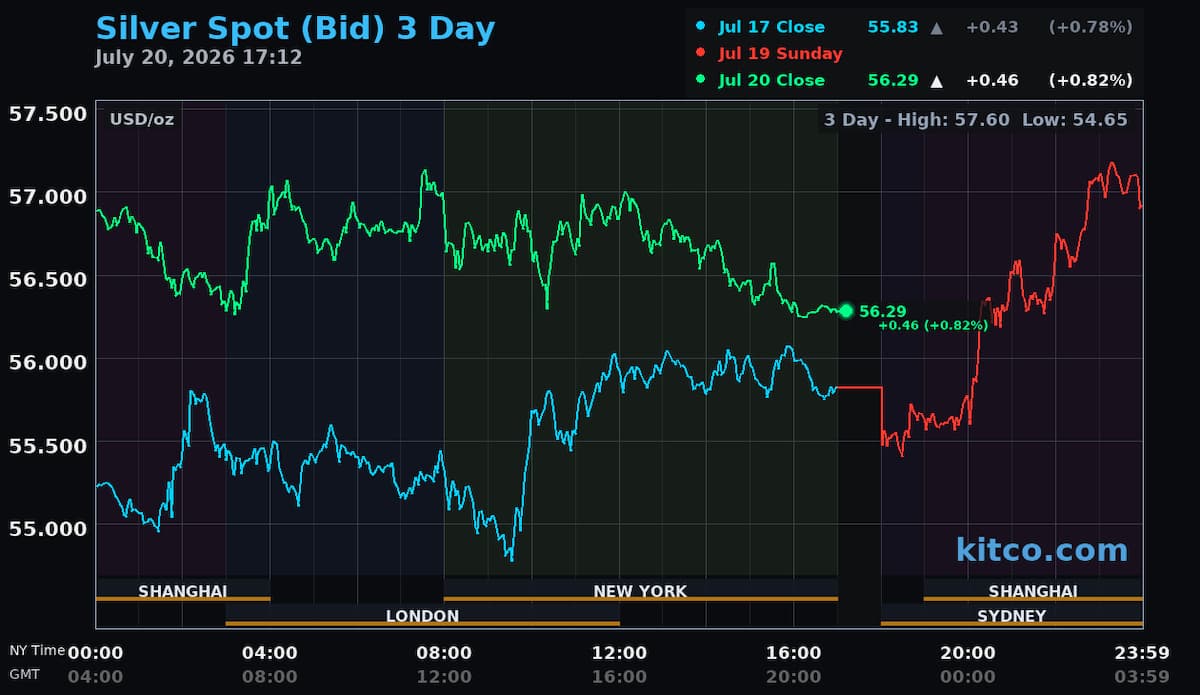
Spot silver bears have the overall near-term technical advantage despite Monday’s rebound, as prices remain below the $58.53 to $59.44 trader-reaction zone and the latest recovery stalled at $57.60. Silver bulls' next upside price objective is to drive prices back above $57.60, with a move above that level targeting $58.53 and then $59.44. The next downside price objective for the bears is a break below $55.40, with deeper downside targets at $54.80 and then $53.42. First resistance is seen at $57.60 and then at $58.53. Next support is seen at $55.40 and then at $54.80.