
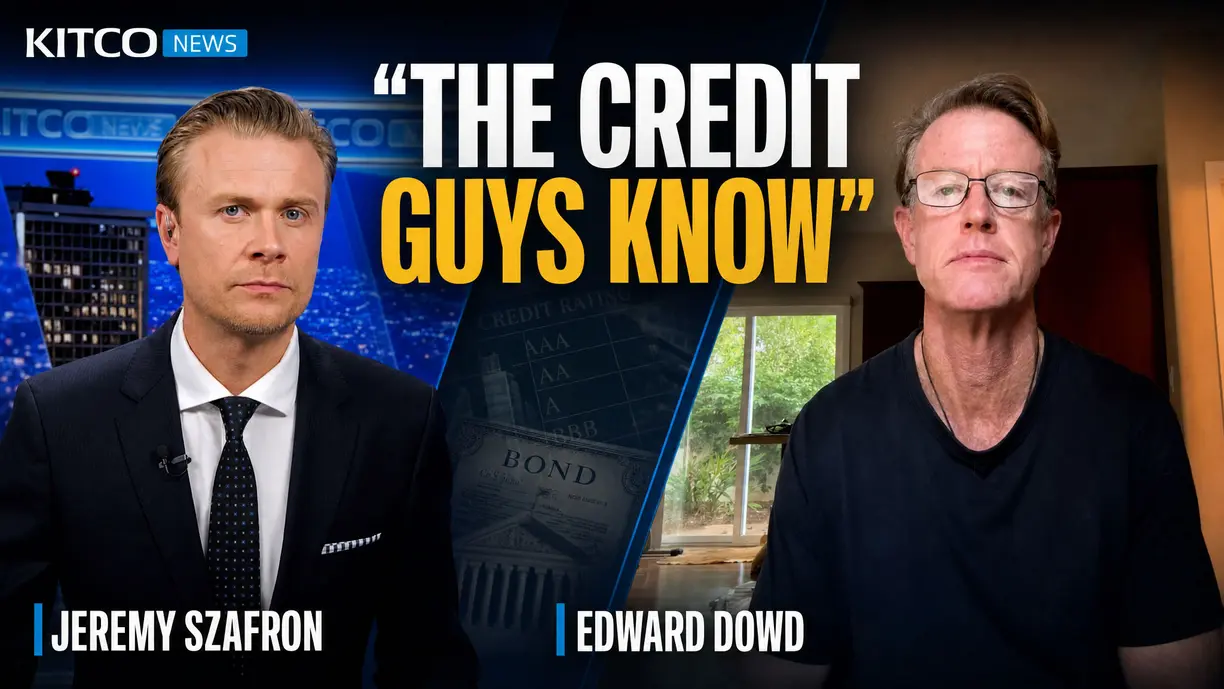
(Kitco News) - The former BlackRock money manager says the credit-default cycle has already begun, that he's cautious on gold right now, and that he still sees the price reaching $10,000 on the other side of the crisis.
By Jeremy Szafron, Kitco News
(Kitco News) - The credit-default cycle has already started, and Wall Street is still celebrating an artificial-intelligence boom that is about to run into it, according to Ed Dowd, a former BlackRock portfolio manager and founding partner of Phinance Technologies.
Dowd, a contrarian macro voice known for putting his calls on the record, told Kitco News he would be "cautious on gold here a little bit" at current levels, but that he still expects the metal to reach $10,000 an ounce later this decade once a credit crisis forces the Federal Reserve and governments to reflate. Gold has fallen roughly 27% from its January record and briefly dipped below $4,000 last week before rebounding.
"When we're in the teeth of this global slowdown, there'll be policy responses from the Fed and fiscal policy responses," Dowd said, describing a move that he expects to set up "the next leg" toward $10,000 into 2030. For now, he said, "the mainstream media and investors at large are still celebrating the AI bubble and think everything's hunky-dory."
'The credit guys usually end the party'
Dowd's central argument is that the credit markets, not the stock market, are where this cycle turns first, and that the turn is already underway. He pointed to bond investor PIMCO, which he said warned a couple of months ago that markets are "at the beginning of the credit-default cycle," and to signs of stress in private credit and in individual names.
"Oracle's credit-default swaps are exploding. The stock has been getting hammered," he said. "The credit guys always inevitably end the party in any kind of capex cycle. They did it in the dot-com bubble. The equity guys will figure it out eventually."
Private credit, he argued, was "the marginal credit producer for the last two years," a lightly regulated corner of finance that, by some estimates, grew 50% to 75% across 2024 and 2025 as commercial banks lent to non-bank financial institutions. That growth, he said, has now stalled, with some funds limiting withdrawals as investors ask for their money back. "The flows have paused," he said. "It's a black hole of information."
How private credit reaches ordinary savers
The part of Dowd's thesis aimed most directly at Kitco's audience is how those private-credit risks can travel into ordinary retirement savings. He described Wall Street firms packaging private-credit funds into securities with an insurance wrapper to sell to insurers, a structure he said "smells an awful lot like the great financial crisis."
He illustrated it with a story from his own BlackRock days. The head of the firm's small collateralized-debt-obligation desk, he recalled, used to boast that he could turn worthless assets "into gold." "That's alchemy," Dowd said. "That didn't end up well."
The losses, when they come, land on "insurers, asset managers, high-net-worth, and pension and endowment balance sheets," he said, with commercial banks sitting on top and first in line for recoveries. "The ultimate investors are the ones who lose the most." The whole space, he added, "is going to be stress-tested," and he suspects the losses will be larger than the industry is projecting.
Housing is frozen
Dowd said the strain is already visible in the real economy, particularly housing, which he estimates is about 30% overvalued and accounts for a fifth of the economy. "The real estate market is essentially frozen," he said, citing a record-wide gap between homes for sale and homes sold. "Seventy-five percent of all real estate agents haven't made a sale in a year," Dowd said, describing a buyer strike and roughly nine months of new-home inventory, a level he likened to the period "right before the great financial crisis."
Independent data broadly support a market in stall. New single-family homes sat at a 10.3-month supply in May at a sales pace of 580,000, according to the U.S. Census Bureau, more than double the roughly 4.5-month supply of existing homes for the same period. The share of builders cutting prices topped 40% for the first time on record, at an average discount of about 6%, with close to two-thirds offering incentives such as mortgage-rate buydowns, according to the National Association of Home Builders. Analysts attribute the freeze to a rate-lock effect: the average outstanding mortgage rate sits near 4.3% while new borrowers face about 6.5%, according to industry data, leaving existing owners reluctant to sell.
Dowd also pointed to an unusual signal, new homes selling for less than existing ones, which he attributed to older sellers, many of them baby boomers with second homes, who have yet to cut prices. That reversal is both real and historic. In the first quarter, the median new-home price was $403,200, about $1,400 below the $404,600 median for existing homes, the fourth straight quarter new homes have come in cheaper and, by several accounts, the first such stretch since at least 1974, according to National Association of Home Builders data. Signs of distress are also building at the margin, as Dowd suggested: the foreclosure inventory rate reached 0.4% in the first quarter, a six-year high, with active foreclosures up about 34% from a year earlier, according to the Mortgage Bankers Association and property-data firm Cotality.
A market that is 45% AI
Dowd tied the credit strain to what he called a dangerously concentrated stock market. "The market cap of the S&P 500 is 45% AI and AI-adjacent," he said, comparing it to the narrow leadership that preceded the dot-com bust and the 2008 crisis. When the semiconductor industry becomes "19% of the S&P 500, notoriously boom and bust, that doesn't bode well," he said, adding that at current valuations, 10-year forward returns are "projected to be zero, including dividends, which implies a big drawdown."
He described four forces he believes are about to pause the AI capital-spending boom: commodity-style pricing from low-cost Chinese models such as Moonshot's Kimi; enterprises pausing after overspending earlier this year; credit markets demanding evidence of returns; and a shortage of electricity to power new data centers. Told during the interview that Moonshot, the company behind Kimi, was seeking funding at a $50 billion valuation, a figure Bloomberg reported, Dowd said the economics still point to a shakeout: "Commodity-like pricing is going to leave a lot of the investment stranded." He stressed he is "negative on AI investments" but "positive on AI as a technology," comparing it to the internet and the railroads, "long-term beneficial, but short-term pain."
Several of the specific figures Dowd cited are his own characterizations and could not be independently confirmed by Kitco News, among them his estimate that housing is 30% overvalued, his claim that three-quarters of real estate agents have not closed a sale in a year, and his assertion that Warren Buffett and David Tepper are each sitting on 40% cash.
Why he wants a strong dollar, and $10,000 gold
Dowd's outlook contains a tension he addressed directly: he is bullish on gold over the long run, yet also expects a strong U.S. dollar, a headwind for the metal. His resolution is that a global slowdown creates "a scramble for dollar liquidity," which he said is already showing up in a dollar that has climbed to new 52-week highs. He pointed to China, which he said is in "the acute phase of its real estate crisis," as the trigger for that liquidity squeeze. "The higher the dollar goes, the worse it is for risk assets long term," he said.
On the path for gold itself, Dowd said the metal's January peak had "discounted that war was coming," and that recent selling reflected countries raising cash, "Turkey sold many tons of gold." Any further risk-off drop, he argued, is a buying opportunity, "because we know the Fed and the governments of the world are going to print and spend, and that will re-inflate." In a crisis, he said, he expects the Fed under Chair Kevin Warsh to restart quantitative easing "bigger than COVID," which "will set up gold for the next five to seven years."
Inflation now, deflation next
Dowd laid out a sequence in which an oil-driven inflation shock gives way to demand destruction, recession and ultimately "a deflation scare, because the monetary authorities will print, print, print." He argued that rents and home prices, which he said make up more than 40% of the consumer price index, are already rolling over, and that the Fed "is jawboning that they're going to hike, but we ultimately believe they're going to end up cutting rates once the global slowdown starts to manifest." Holding rates at current levels, he added, is "a de facto tightening" that only deepens the credit squeeze.
What he tells ordinary savers
For families, Dowd drew a line between inflation in the things people need and deflation in the things they own. Those without many assets, he said, should protect their income: "Make yourself as important to your employer as you can. You wanna be the person they don't lay off." Those with assets, he said, should raise cash, pointing to big investors doing the same. "Warren Buffett's at 40% cash. David Tepper of Appaloosa is at 40% cash, the largest amount of cash he's ever had. Jamie Dimon's out today cautioning people on stocks."
On silver, Dowd was constructive but cautious, noting it is "an industrial metal, so in an economic slowdown it'll get sold," and is likely to underperform gold. He said precious metals should be "only 5 to 10% of your overall portfolio," and framed them as a buy-and-hold position: "If you're young, just stack it."
Dowd said his own portfolio reflects the call. "No stocks. I eat what I cook," he said, describing a book of cash, gold and long-dated Treasuries positioned for the deflation and growth slowdown he expects. He acknowledged being early, saying the S&P 500 rose another 17% after he began warning last year, but argued that drawdowns are what make the math work: "In a 40-to-50% drawdown, that's when the investment math works the other way."
Ed Dowd's work can be found at eddowd.com and on his Substack, "Beyond the Narrative." Watch the full conversation with Ed Dowd in the video at the top of this page.