

(Kitco News) – Gold's recent 25% pullback reflects shifting macro conditions, but persistent inflation, geopolitical risks and lower real interest rates should support gold prices, while gold stocks have attractive cash flow, margins and valuations, according to Imaru Casanova, Portfolio Manager at VanEck.
Casanova noted that the gold price saw elevated volatility in the first half of 2026 as it fell from the edge of $5,600 per ounce in late January to a low of $3,943 at the end of June.
“The gold stocks lagged the metal, as expected during a period of declining gold prices,” she wrote. “The MarketVector Global Gold Miners Index (MVGDX) fell 15.54% in June, down 12.41% year to date.”
Casanova said gold prices have been pressured by a stronger U.S. dollar and expectations for higher interest rate expectations since the start of the Iran war.
“The dominant macro narrative has become self-reinforcing: higher oil prices keep inflation expectations elevated, elevated inflation expectations keep the Federal Reserve (“Fed”) on hold, a Fed on hold keeps real yields elevated, and elevated real yields support the U.S. dollar, weighing on gold,” she said. “However, gold stocks remain one of the best-performing asset classes over the past year, while gold continues to outperform most other major asset classes.”
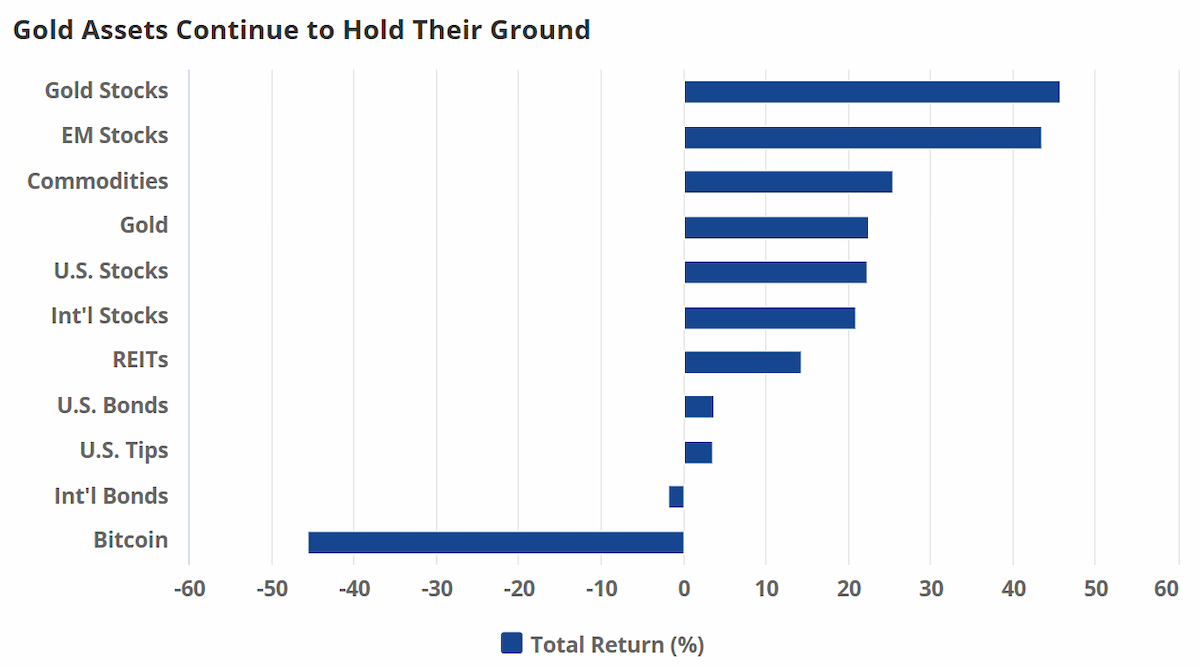
Casanova said that while gold’s recent decline and elevated volatility are weighing on investors, they need to look past near-term noise. “The continued strength in equity markets suggests a degree of optimism that could be tested,” she wrote. “Geopolitical tensions, the prolonged effects of the Middle East conflict, and the outlook for inflation remain key considerations in the current environment.”
And the yellow metal doesn’t necessarily need the resumption of rate cuts to begin rallying once again.
“A prolonged ‘Fed on hold’ environment could contribute to lower, or even negative, real rates over time, a backdrop that has historically been among the most favorable for gold,” Casanova said. “In that scenario, gold has often played a prominent role as a diversifier and potential hedge for investors seeking portfolio protection and diversification. Gold stocks may also play a role in a diversified allocation.”
“There is no guarantee this backdrop will persist, however,” she cautioned. “[R]eal rates could rise, gold pays no income and can experience sharp or prolonged price declines, and it may not act as an effective hedge or diversifier in any given period.”
But even Fed rate hikes aren’t always negative for gold prices. “According to World Gold Council data covering 44 Fed hikes from March 1997 through July 2023, gold positively surprised on hike days more than 50% of the time,” she noted.
Meanwhile, elevated and sustained central bank gold demand is providing a floor for the price action.
“Strong, regionally diversified central bank buying and resilient investment demand from Asia continue to underpin gold demand at current levels,” Casanova said. “A return of Western investor participation, similar to what happened in 2025, could provide additional support and may contribute to further upside in the gold market.”
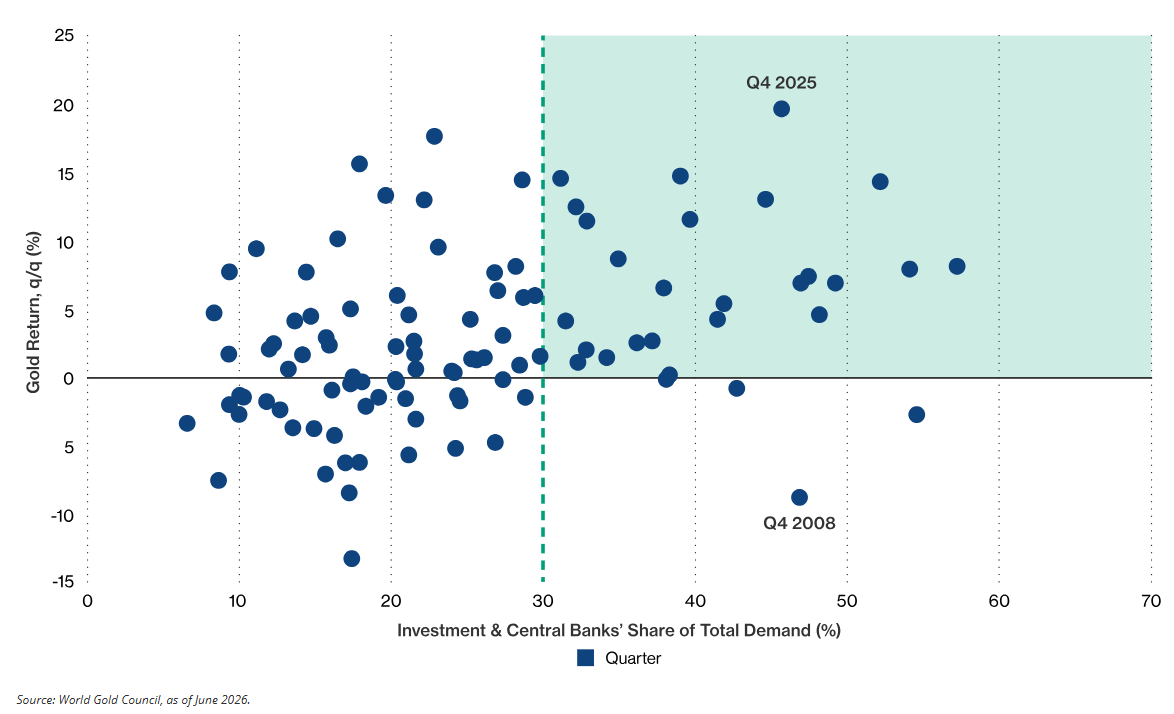
And once gold prices begin to move decisively higher, gold mining equities could provide the greatest upside for investors.
“Gold stocks have historically outperformed the metal itself in rising gold price environments,” she wrote. “Notably, the current gold price environment has already proven supportive of strong company fundamentals, with Q1 2026 earnings reflecting record cash flow.”
“Gold has traded at an average price of approximately $4,700 per ounce so far in 2026,” she added. “With all-in sustaining costs for the sector estimated to average below $2,000 per ounce in 2026, margins remain very strong even at $4,000 gold. This gives companies the ability to finance growth, pay dividends and repurchase shares.”
Casanova said gold stocks are currently trading at relatively low valuations by historical measures, even as the sector enjoys strong financial and operational health. “Current equity prices appear to reflect more conservative assumptions than those implied by prevailing gold prices.” She noted, however, that gold stocks can overshoot the precious metal to the downside as well during price declines.
“If investors rotate capital away from sectors with much richer valuations, particularly against a backdrop of rising pullback risk, gold stocks could be beneficiaries.”
