
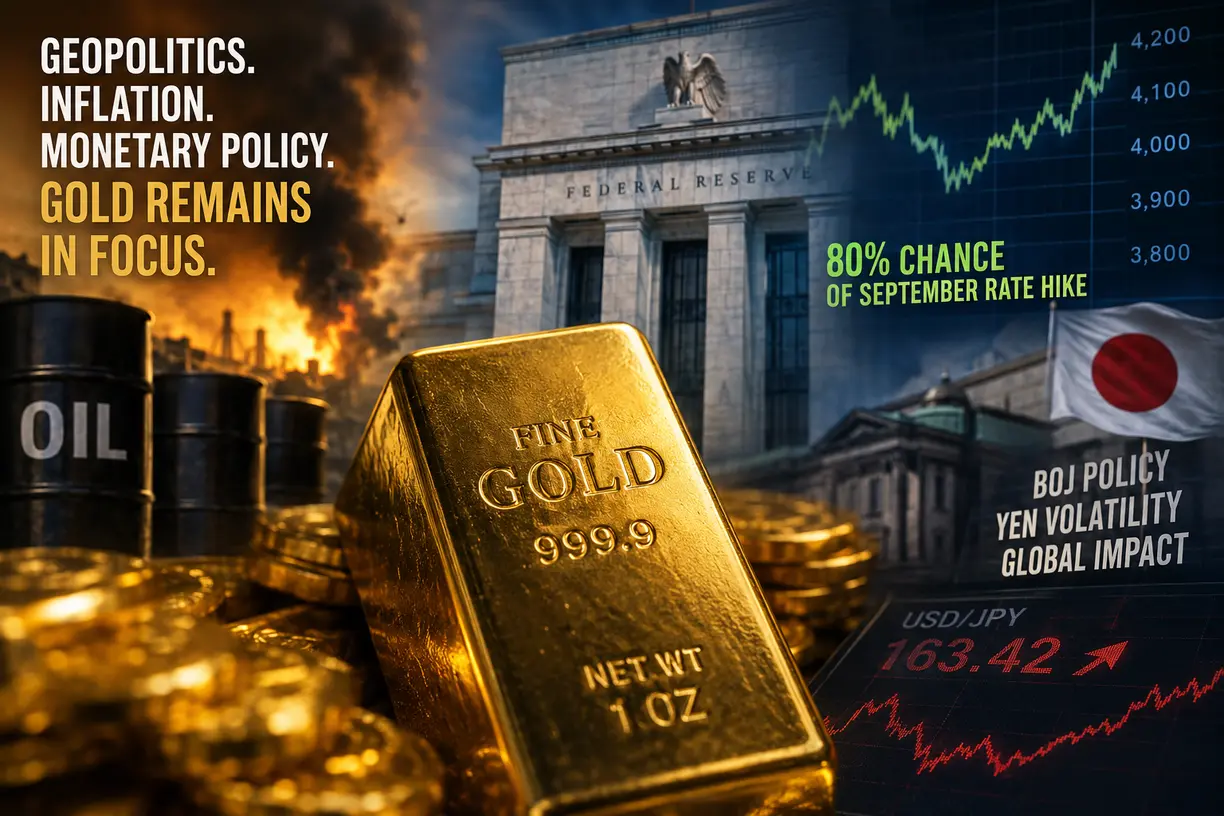
(Kitco News) - Gold has managed to hold critical support near $4,000 an ounce for the past five consecutive weeks, and although significant downside risks remain, some analysts see growing potential for a bullish shift in the market.
Analysts note that although gold has been unable to hold gains above $4,100 an ounce, it has faced only limited selling pressure despite significant headwinds. The precious metal has held critical support even as oil prices climbed to their highest level in nine weeks.
Oil prices moved higher this week as the war in Iran intensified, with the ongoing global energy crisis continuing to fuel inflation fears, forcing central banks around the world to adopt more hawkish policy biases.
The Federal Reserve's monetary policy meeting will be the main economic event next week; however, some analysts say the decision could have only a limited impact on gold as the central bank continues to navigate a difficult path between persistent inflation and fragile economic growth.
Although markets are not expecting the Federal Reserve to raise interest rates next week, policymakers could lay the groundwork for a rate hike before the end of the year. At the same time, analysts note that markets are still adjusting to Federal Reserve Chair Kevin Warsh's approach of providing less forward guidance.
Lukman Otunuga, Senior Market Analyst at FXTM, said that with so much uncertainty surrounding U.S. monetary policy, much will depend on inflation data.
"Markets are now pricing a 34% probability of a July hike, leaning heavily towards a September move. Fresh US tariffs of 10%–12.5% on imports from major trading partners add another layer of uncertainty, threatening second-round inflation effects that give the Fed even less room to stand down. The week ahead is loaded with more geopolitics, the Fed decision and PCE price index which may influence how gold ends July. A hot print may pour fuel on September hike bets and put $4,000 firmly back in play as a downside target. Any signs of cooling price pressures could offer gold a potential lifeline. However, with oil lingering around $100, the window for sustained relief is narrow," he said. "Ultimately, the $4,000 level remains the structural floor to watch. A clean break below opens the door toward $3,950 and $3,900. If this level holds, gold may rebound toward $4,100 and $4,200."
Although rising interest-rate expectations could weigh on gold, some analysts believe the ongoing conflict in the Middle East is creating a potential inflection point for the precious metal.
"If higher oil prices continue to fuel inflation while simultaneously weighing on economic activity and labor market conditions, concerns about slowing growth may eventually outweigh inflation fears," said Simon-Peter Massabni, Head of Business Development at XS.com. “At that stage, investors are likely to rotate back toward defensive assets, with gold standing to benefit, particularly if markets begin pricing in a future easing cycle from the Federal Reserve.”
"In the short term, U.S. Treasury yields and the dollar will continue to dominate price action,” Massabni added. “Over the medium to long term, however, a broader structural shift is unfolding, driven by sustained official-sector demand, the rising influence of Asian markets, and a gradual evolution in the global price-discovery process. In that environment, I view any meaningful price corrections, provided these structural drivers remain intact, not as the beginning of a prolonged bear market, but as potential opportunities for long-term investors to rebuild strategic positions."
Thu Lan Nguyen, Head of Commodity Research at Commerzbank, also sees the potential for a shift in the gold market as the precious metal continues to show resilience.
"If fears grow of a sustained escalation of the conflict in the Middle East, and thus a prolonged closure of the Strait of Hormuz and, in the worst case, also the Strait of Bab al-Mandab, a massive energy crisis would be likely, which in turn could trigger a global economic crisis. In such an extreme scenario, gold could benefit, as central banks would ultimately have to switch to cutting interest rates in order to counteract a recession," she said. "In the short term, however, the risks for gold in the event of further escalation are clearly skewed to the downside, because higher energy prices immediately lead to higher inflation and central banks would initially focus on containing it."
Waleed Said, Technical Analyst at GivTrade, said that although safe-haven demand is providing some support for gold, it is not enough to reignite a sustained rally.
"A dovish surprise or a dollar crack are the two things that would actually reignite the bull case, with central-bank buying acting as a floor rather than a catalyst in the meantime," he said.
While optimism is beginning to build, some analysts remain bearish on the precious metal, arguing that rising real interest rates are difficult to ignore even as the global economy shows signs of slowing.
"There are no fundamental reasons to think that the U.S. rate and FX environment will be conducive to increasing long gold exposure anytime soon," Bart Melek, Head of Commodity Strategy at TD Securities, wrote in a recent note. "Concerns that the recent inflation reduction will be undone by higher energy prices will most likely prompt the Fed to signal that it has little tolerance for uncontrolled and persistent price increases, which should lift carry costs and opportunity costs to hold gold. In fact, the higher rate environment suggests that the yellow metal may again be destined to drop back to support at around $3,900/oz before any new highs occur some twelve months from now."
Although many investors remain focused on the Federal Reserve's monetary policy because it sets the tone for the global economy, some analysts have warned that markets also need to pay close attention to next week's Bank of Japan policy meeting.
This week, the Japanese yen fell to a 40-year low against the U.S. dollar, raising concerns about the stability of the global yen carry trade. Although markets expect the BoJ to leave interest rates unchanged next week, some analysts warn there is a risk policymakers could adopt a surprisingly hawkish tone.
"With dollar-yen currently well above 163, there is a chance that the BOJ will adopt a significantly more hawkish tone at its July 31 meeting," Dayeon Hong, Asia-Pacific Strategist at Natixis, said in a Friday note. "Looking past this month's meeting, the market could potentially price in a faster trajectory of rate hikes."
Analysts note that higher Japanese interest rates would strengthen the yen while putting pressure on the global carry trade, which is built on borrowing cheaply in Japanese currency.
A stronger yen could force investors to unwind carry-trade positions, creating liquidity strains across global financial markets. In that scenario, some investors could be forced to sell gold to raise cash.
The gold market experienced significant selling pressure in early August 2024 after the Bank of Japan surprised markets with an unexpected interest rate hike.
Looking beyond global central bank monetary policies, the gold market could be sensitive to U.S. consumer confidence data and the first look at U.S. growth estimates for the second quarter.
Economic data to watch next week:
Tuesday: US Consumer Confidence
Wednesday: Federal Open Market Committee meeting
Thursday: Bank of England monetary policy meeting, US Q2 Advance GDP, US PCE, US weekly jobless claims, Bank of Japan monetary policy meeting
Friday: Revised University of Michigan Consumer Sentiment
