
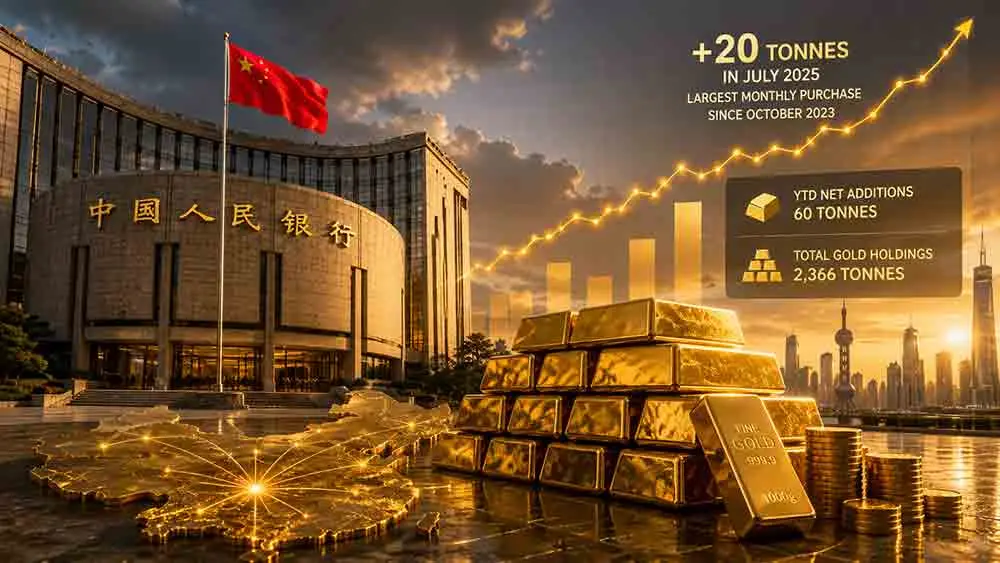
(Kitco News) - Not only has the People’s Bank of China bought gold for 21 straight months, but the central bank has also continued to make solid tactical moves as prices have dropped nearly 30% from their all-time highs at the start of the year.
According to the central bank’s latest reserve data, the PBOC bought 20 tonnes of gold in July—the largest monthly increase since October 2023. Since March, the central bank has increased the pace of its monthly purchases.
“This lifts YTD net additions to 60 tonnes, and total gold holdings to 2,366 tonnes,” said Krishan Gopaul, Senior Analyst, EMEA at the World Gold Council (WGC), in a social media post on Friday.
While China continues to dominate the marketplace, Gopaul noted that it is not the only central bank increasing its official reserves. In comments on social media, he said that the Czech National Bank increased its reserves by 1.7 tonnes last month. He added that the central bank is another step closer to its 100-tonne target.
“YTD net purchases total 12 tonnes, with gold holdings now 84 tonnes,” he said.
Gopaul also said that National Bank of Kazakhstan increased its reserves by over 1 tonne last month. He also noted that
Analysts have said that central bank demand has been a key factor in gold’s ability to hold critical support above $4,000 an ounce.
In a note published in late July, commodity analysts at BMO Capital Markets said that they expect growing Chinese demand to be the biggest factor pushing gold prices higher in the second half of the year. They added that most of China’s growing stockpile has gone unreported.
“Our new analysis suggests China has accumulated ~30kt of gold above ground, higher than official data, and is now driving ~1/3 of global demand flows,” the analysts said.
At the same time, they added that even with its massive undeclared stockpile, China's appetite for gold is likely to remain insatiable for the foreseeable future, eventually surpassing U.S. reserves.
They pointed out that if China wants to achieve its goal of making the yuan an international reserve currency to rival the U.S. dollar (Kitco Global Index shows how much of today's gold move is the dollar versus the gold market itself.), it needs to buy significantly more gold in the next five years.
Although there is no definitive target for China's gold holdings, BMO analysts said the country's money supply provides a useful benchmark. They pointed out that, at current prices, the Federal Reserve's gold stockpile represents roughly 5% of the U.S. M2 money supply. If China were to achieve the same ratio, its central bank would need to hold about 18,000 tonnes of gold, compared to the roughly 5,222 tonnes it held at the end of last year.
“Unsurprisingly, China hasn't disclosed its ultimate gold accumulation targets, but given its stated ambitions for economic expansion and RMB internationalisation, our view is that achieving the U.S.'s level of holdings is an absolute minimum target, implying another ~2,500-3,000t of purchases, achievable in two to five years depending on method,” the analysts said. “Yet aspirations are likely higher still given the need to establish RMB credibility globally.”
See live precious metals prices for gold, silver, platinum and palladium — in USD, CAD and 12 more currencies.
