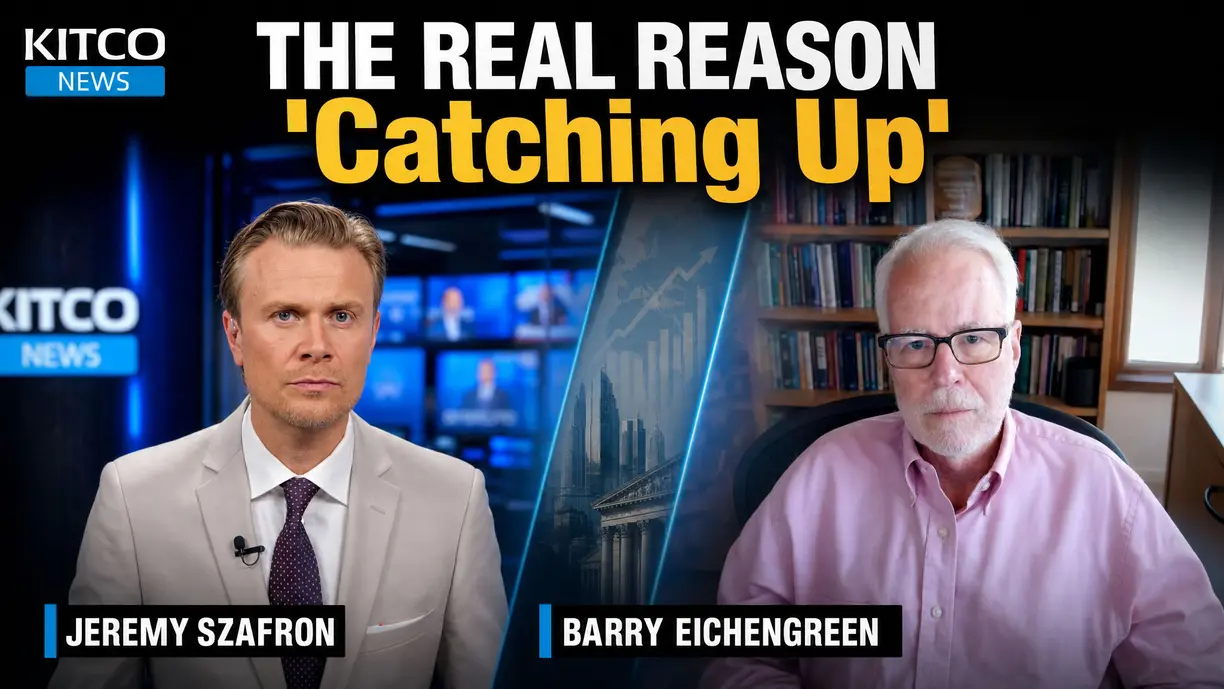
(Kitco News) - Barry Eichengreen tells Kitco News he has changed his mind about how fast the dollar could break, explains where its losses have actually gone, and makes a case for trimming bonds anyway.
Gold closed the week above $4,600 an ounce, with the dollar at its weakest since May and the US Treasury moving to hold down its own borrowing costs.
Central banks have been buying more than a thousand tonnes of gold a year for several years now. That is close to a quarter of everything mined on earth.
Barry Eichengreen doesn't think most of that is a vote against the dollar.
"I for one do not think that gold will come back as an integral function of the international monetary and financial system," the Berkeley economist, who wrote the standard history of how money moves between countries, told Kitco News.
He has changed his mind about something else, though. And he can tell you the day it happened.
"I've become much more worried about an abrupt change where confidence in the dollar is lost before there has been time for these alternatives to step up," he said. "And I've been worried about that since, to put a date on it, April 2nd, 2025, Liberation Day."
That matters because Eichengreen has spent most of his career as the calm one in this argument. While others called the dollar finished, he kept pointing at the same slow number. Its share of world reserves has been slipping about half a percentage point a year, from a little over 70% at the turn of the century to a little under 60% now.
Where the money actually went
The IMF doesn't break out the currencies that have picked up the slack, so Eichengreen and his co-authors went and dug it out themselves, from the annual reports of roughly 80 central banks.
"Of the ground the dollar has lost in the 21st century as a reserve currency, the euro has gained zero of that ground," he said. "The renminbi, about a quarter, and the other three quarters have been gained by these non-traditional reserve currencies."
He means the Australian, Canadian, Singapore and New Zealand dollars. The Nordics. The South Korean won.
"They are the currencies of small, open, well-managed, generally inflation-targeting countries."
The euro has gone nowhere for a simple reason. There is almost nothing to buy. Eichengreen counts three euro area governments carrying triple A ratings from all the major agencies, with maybe $4 trillion of bonds between them, against $40 trillion of US debt.
"German banks hold German government bonds, Dutch insurance companies hold Dutch government bonds. These markets are siloed."
So why the gold
Eichengreen traces the buying back to the financial crisis rather than to any quarrel with Washington. Emerging market central banks mostly didn't inherit gold, he points out, and had very little of it to start with.
"I think it was very much structural catch-up until recently."
Recently is doing some work in that sentence.
"I don't know quite how to interpret the most recent wave of gold buying. I think there now may be a combination of continued structural catch-up and growing worries about the greenback… We hear stories of unusual US Treasury interventions in that market."
And bringing the metal home isn't always about sanctions either. France, Germany and the Netherlands all repatriated gold under pressure that was political rather than financial.
"Marine Le Pen famously wrote a letter to the governor of the Bank of France, like 10 years ago, saying, in effect, what in the world are you doing vaulting our gold in London and New York? It should be here in Paris."
It costs them something, though.
"What they give up, of course, is the ability to use that gold as collateral in financial transactions, to lend it and earn interest on the loan, which they can do if it's vaulted in London or New York."

Which is why the countries doing it tend to be the ones sitting on more reserves than they expect to need. "Central banks are going into that, contemplating that bargain with their eyes open."
Two Russian jets from Caracas to Tehran
I asked him to make the hardest version of his case rather than a soft one. He did.
Money has to do three jobs. It has to price things, pay for things, and hold its value. Gold manages one of them.
"Would you want your salary at the end of the month to be denominated in ounces of gold, which may turn out to be worth 10% less than you thought it would be at the grocery store?"
Then he told the story he uses to finish the argument. It's in his new book. Venezuela, under sanctions, needed to pay Iran, also under sanctions, for oilfield equipment and repair work.
They paid in gold bars. Then they hired a couple of Russian jets to fly the metal from Caracas to Tehran.
"That kind of epitomizes the difficulty of making normal payments using gold."
Then he turned
Ray Dalio said on Friday that investors should hold 10% to 15% of a portfolio in gold, ahead of a US debt crisis he thinks arrives inside three years. Ole Hansen of Saxo Bank told Kitco News earlier in the week that hard assets belong at 5% to 10%.
Eichengreen's first answer was dry. "People like Ray Dalio have been predicting a fiscal and financial crisis for some time now. And they'll keep predicting it until they're right."
His second answer was not.
"It is true that the US now appears to be on an unsustainable fiscal trajectory, where the debt-to-GDP ratio is continuing to spiral upward, where investors in US Treasuries are more worried now than they have been in the past."
And then the part that lands on anyone with a retirement account.
"Treasuries have been viewed as the safe bedrock of 60/40 portfolios. If they are now less safe and more highly correlated with equities, that is an argument for trimming one's bond portfolio and looking not to equities but to other assets, where gold is an example of what falls under that other asset category."
He wouldn't put a number on it. "Giving you a number like 5% or 10% of your portfolio is above my pay grade… If it was, I wouldn't be a professor, I'd be a hedge fund manager, and I'm not."
He also thinks gold already sits inside the system rather than outside it. "It is the respectable commodity play for central bank reserve managers. All widely diversified global investors ought to have a commodity play in their portfolios."
"If we saw central banks beginning to invest in rare earths or Bitcoin or who knows what, people would sit up and wonder what had gotten into them."
Does he own any himself?
"I own a little bit of gold that my wife and I inherited from my late mother, who passed away a couple of years ago. So it's in the form of jewelry that we treasure. But to give you the complete answer, no, we have not gone out and actively purchased gold."
What this week actually signalled
The sharpest thing Eichengreen said had nothing to do with the metal.
Washington helped prop up the yen last month, and it paid using euros rather than dollars. It also pushed the Federal Reserve to widen a facility so the Bank of Japan could pledge its Treasuries for cash instead of selling them. Days ago, the Treasury doubled its own buybacks of long-dated debt.
He doesn't think any of it worked the way it was meant to.
"I don't think that trick, or the more recent trick of the Treasury upping its purchases of longer-term bonds, fools the market. Both operations are signals that there is concern inside the Treasury Department, maybe inside the White House as well, about the fragility of the US Treasury market."
Then he made a connection nobody else has.
"If there is a reluctance on the part of the US government to see foreign authorities actually use their dollars, that's a signal that their dollars are not as liquid as had been thought previously, and investors, official and private, are going to take note."
I asked what history says happens when a treasury runs out of room and the central bank ends up buying the debt instead. He didn't hedge.
"Nothing good came next. In other words, financial repression, force-feeding government bonds to banks and other financial institutions, forcing the central bank to keep interest rates artificially low. Those kinds of operations clearly do not reassure international investors in a currency."
The bet America may be losing
Eichengreen also suspects the United States has backed the wrong technology.
The GENIUS Act, signed into law in July 2025, is the first federal statute covering payment stablecoins. Issuers have to back every token one for one with cash, deposits and short-dated Treasury bills, publish their reserves monthly and open the books to an independent accounting firm. In other words, Washington has handed the dollar's digital future to private companies and told them to hold Treasuries.
Europe and China are going the other way, building digital versions of central bank money.
"My own view is that the arrow of history points away from competitive currencies, from private monies, toward the public authorities providing the public good of stable money," Eichengreen said. "Meaning that the Europeans and the Chinese who are betting on central bank digital currencies may have it right in the long run. And the United States, which since the Genius Act has been betting on private label stablecoins, maybe we have it wrong."
"And if we have it wrong and stablecoins don't enjoy a lot of take-up, that will be bad for the continued role of the dollar in the global system."
There's a question underneath all this that regulators haven't answered. In March 2023, Circle disclosed that $3.3 billion of the cash reserves behind its USDC stablecoin were trapped at the failed Silicon Valley Bank, about 8% of the total. The token fell as low as 87 cents before US regulators stepped in and guaranteed the deposits. Next time, the reserves might be sitting in Treasuries instead.
"Will the Fed then feel compelled to act as lender of last resort to a non-member stablecoin issuer, and how would that work?… We're in the early, early days. We don't know."
"I was wrong"
I asked what would have to happen for him to decide he had this wrong. He answered by describing a time he already did.
"I wrote an earlier book in 2011, Exorbitant Privilege, where I said the dollar will give way to the euro and the Chinese renminbi. I was wrong. I thought that would happen more quickly than it did. I was wrong because I didn't realize the movement was not toward the euro and the renminbi, but toward these other non-traditional reserve currencies."
Then he reached for Keynes.
"What do you do when you're contradicted by the evidence? He said, I change my mind. What do you do, young man?"
Kevin Warsh gives his first Jackson Hole keynote as Fed chairman on Friday. The symposium's theme this year is financial innovation and payments rather than interest rates, which puts Eichengreen's subject directly in front of the Fed.
Barry Eichengreen is a professor at the University of California, Berkeley. His new book is Money Beyond Borders, published by Princeton University Press.
See live precious metals prices for gold, silver, platinum and palladium — in USD, CAD and 12 more currencies.