
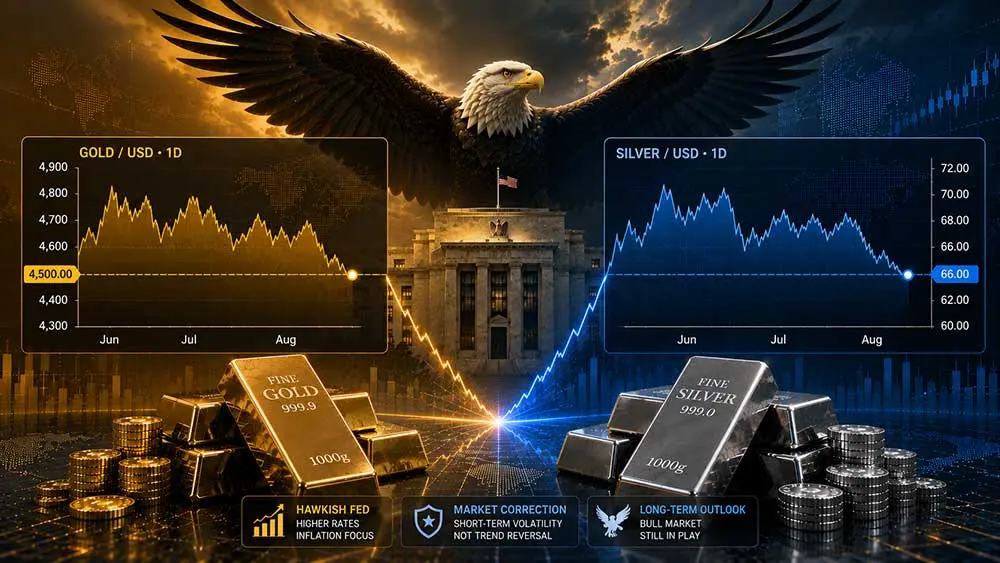
(Kitco News) - Federal Reserve Chair Kevin Warsh’s renewed focus on inflation has injected fresh volatility into precious metals, with gold prices dropping below $4,500 and silver testing support near $66 an ounce, but one market analyst says the hawkish shift in monetary policy expectations does not necessarily spell the end of the broader bull market in gold and silver.
In comments to Kitco News, Simon-Peter Massabni, Head of Business Development at XS.com, said gold and silver are entering a potentially important corrective phase as investors reassess the outlook for U.S. interest rates following Warsh’s speech at the Federal Reserve’s annual central bank symposium in Jackson Hole, Wyoming.
During Friday’s speech, Warsh reiterated his commitment to price stability. His comments pushed markets away from expectations for easier monetary policy and revived the possibility that the Federal Reserve could raise interest rates again if inflation remains stubbornly above its 2% target.
“We must be confident that underlying inflation is moving to our objective, clearly and at sufficient speed. Otherwise, we have work to do. That's our job . . . our mandate . . . and our charge to keep,” Warsh said in his speech.
Massabni noted that following Warsh’s remarks, markets were pricing in nearly a 57% chance of a September rate hike.
The shifting rate outlook has created a significant near-term headwind for precious metals, which tend to struggle when real yields and the U.S. dollar rise. (Kitco Global Index shows how much of today's gold move is the dollar versus the gold market itself.)
However, Massabni said investors should distinguish between a short-term repricing of monetary policy expectations and a fundamental reversal of the broader precious metals rally.
“What we have seen so far is primarily a repricing of interest-rate expectations rather than a complete reversal of the fundamental forces that have supported gold throughout the broader rally,” he said.
Although higher interest rates, rising Treasury yields and a stronger U.S. dollar are bearish for gold in the near term, Massabni said growing U.S. debt, fiscal sustainability concerns, geopolitical uncertainty and broader economic risks continue to provide important long-term support.
In particular, he said the Federal Reserve faces a potentially difficult contradiction: maintaining restrictive monetary policy long enough to contain inflation while higher borrowing costs place increasing pressure on the government’s already strained fiscal position.
“The Federal Reserve may want to maintain a restrictive monetary policy to contain inflation, while concerns about government debt, fiscal sustainability, and financial conditions could eventually limit how far and how long rates can remain elevated,” he said.
Massabni said this dynamic makes it dangerous to assume that rising Treasury yields automatically represent a long-term bearish development for gold.
He described gold as being caught in a “genuine tug-of-war” between monetary policy and economic uncertainty.
“My core view is that Warsh’s speech could temporarily stall gold’s advance, but it does not necessarily signal the end of the medium-term bullish trend,” Massabni said.
His base case is for gold to remain under short-term pressure as markets reassess the possibility of a September rate hike, potentially generating additional profit-taking, consolidation and volatility.
However, if Treasury yields stabilize or move lower and fiscal concerns return to the forefront, Massabni said gold investment demand could strengthen again.
“If gold manages to preserve its broader bullish structure and buyers step back in at key support levels, the correction could represent an opportunity to rebuild long positions rather than the start of a new bearish trend,” he said.
While gold faces a broad battle between fiscal and monetary forces, Massabni sees a more defined technical test developing in silver.
Silver climbed above $70 an ounce before Warsh’s comments, reaching its highest level in roughly two months before reversing sharply as interest rate expectations shifted.
Massabni said the subsequent decline toward $66 should not necessarily be interpreted as the end of silver’s broader uptrend. Instead, the selloff could represent a combination of profit-taking, long liquidation and a technical correction following the metal’s strong rally.
“From my perspective, silver’s decline toward the $66 area does not necessarily signal the end of the broader uptrend,” he said. “Instead, it could represent a repricing phase and a technical correction following a strong rally.”
At the same time, he warned that silver remains particularly sensitive to rising real yields and a stronger U.S. dollar. Stronger-than-expected inflation or employment data could reinforce expectations for further monetary tightening and push prices lower before the market establishes a new equilibrium.
Massabni said the $66 level will be an important test of whether buyers remain willing to support the market.
If silver can establish a base above $66 and subsequently reclaim $68 and $70, he said the recent weakness would look increasingly like a healthy correction within a broader bull market. A sustained move back above $70 would provide stronger evidence that the correction has largely run its course.
However, a break below $66 accompanied by rising bond yields and continued U.S. dollar strength would increase the risk of a deeper correction.
Adding another layer of uncertainty is the geopolitical situation in the Middle East. Massabni noted that tensions between the United States and Iran, alongside oil prices approaching $90 a barrel, could have a two-sided impact on silver.
Higher energy prices could reinforce inflation pressures and encourage the Federal Reserve to maintain tighter monetary policy, creating another headwind for precious metals. At the same time, escalating geopolitical uncertainty could strengthen safe-haven demand.
Ultimately, Massabni expects volatility to remain elevated in both metals until investors get greater clarity on inflation, employment and the direction of Federal Reserve policy.
For gold, he said the critical question is whether the U.S. economy and government finances can withstand elevated interest rates for an extended period.
For silver, the immediate focus is whether buyers can defend $66 and eventually push prices back above $70.
Massabni said neither market has provided enough evidence to suggest that its broader bullish cycle is finished.
“I believe the market has entered a phase where patience is more important than chasing price,” he said of gold. “If gold experiences a controlled correction without breaking its broader bullish structure, I would view that weakness as a potential opportunity rather than automatically interpreting it as the beginning of a new bear market.”
He expressed a similar view on silver, arguing that sharp weakness could ultimately create another entry point if the structural drivers supporting precious metals remain intact and investors receive confirmation that the correction has ended.
