

(Kitco NewsWire) - Spot gold and silver prices are seeing significant selling pressure Monday morning as rising bond yields and surging energy prices strengthen expectations that the Federal Reserve will raise interest rates this week, overwhelming safe-haven demand generated by escalating geopolitical uncertainty in the Middle East.
Spot gold last traded at $4,269.90 an ounce, down 1.80% on the day. Silver is also seeing significant selling pressure, with spot silver last trading at $62.75 an ounce, down 2.50% on the day.
The precious metals continue to struggle as markets digest Friday's hotter-than-expected inflation data. The Consumer Price Index rose 0.4% in August, while annual inflation held at 3.4%. At the same time, core CPI rose 0.3%, slightly hotter than economists' expectations for a 0.2% increase.
The latest inflation data, combined with elevated energy prices, have caused markets to significantly increase their expectations for tighter monetary policy. Markets are now pricing in roughly an 87% chance that the Federal Reserve will raise interest rates by 25 basis points Wednesday. At the same time, markets are pricing in more than 90 basis points of tightening during the next year. The shift in rate expectations has kept U.S. Treasury yields near multi-year highs, creating a significant headwind for non-yielding gold.
The latest inflation data also come against a deteriorating consumer backdrop. The University of Michigan's Consumer Sentiment Index fell sharply to 47.8 in September from 51.7 in August. At the same time, one-year inflation expectations jumped to 4.6% from 4.0%, while longer-term expectations rose to 3.4% from 3.3%. The combination of weakening sentiment and elevated inflation expectations is creating a challenging environment in which economic uncertainty supports defensive assets, but persistent inflation keeps upward pressure on interest rates.
Waleed Said, technical analyst at GivTrade, noted that gold is being pulled between two competing forces. Escalating geopolitical uncertainty and concerns about energy security are supporting safe-haven demand; however, higher oil and diesel prices threaten to keep transportation, production and consumer costs elevated, strengthening the case for restrictive monetary policy.
The geopolitical situation remains extremely fluid as renewed fighting threatens critical energy infrastructure and shipping routes in the Middle East. Plans for Gulf nations to discuss a potential temporary shipping corridor through the Strait of Hormuz have been postponed, while fresh attacks on commercial shipping have kept concerns over global energy supplies elevated. At the same time, Saudi Arabia has shut its strategically important East-West crude pipeline following drone attacks, eliminating for now a major route that can bypass the Strait of Hormuz.
The latest escalation has pushed oil prices sharply higher, adding another layer of inflation uncertainty ahead of the Fed's monetary policy decision. Brent crude pushed above $108 a barrel Monday, while West Texas Intermediate remained above $100 a barrel. The surge in energy prices is proving to be a double-edged sword for gold: geopolitical uncertainty is supporting safe-haven demand, but higher oil prices are simultaneously strengthening the argument for higher interest rates.
Said noted that continued tensions involving Iran, oil-shipping routes and global diesel supplies could provide structural support for gold. However, he warned that further increases in Treasury yields or the U.S. dollar could generate additional consolidation as investors receive greater compensation for holding interest-bearing assets instead of bullion.
The bond market remains one of gold's biggest near-term headwinds. The benchmark 10-year Treasury yield was last trading around 4.97% after touching 4.992%, its highest level in nearly three years. The yield is now within striking distance of the psychologically important 5% level.
The rise in long-term yields is becoming increasingly important beyond its immediate impact on gold. U.S. sovereign debt has surpassed $40 trillion, and persistently elevated borrowing costs threaten to dramatically increase the government's debt-servicing burden. A sustained move above 5% in the 10-year yield would increase borrowing costs throughout the economy while putting additional pressure on federal finances. For gold, that creates a complicated environment: higher yields increase the opportunity cost of holding the non-yielding metal in the short term, while concerns about America's deteriorating fiscal position remain an important pillar of its long-term investment case.
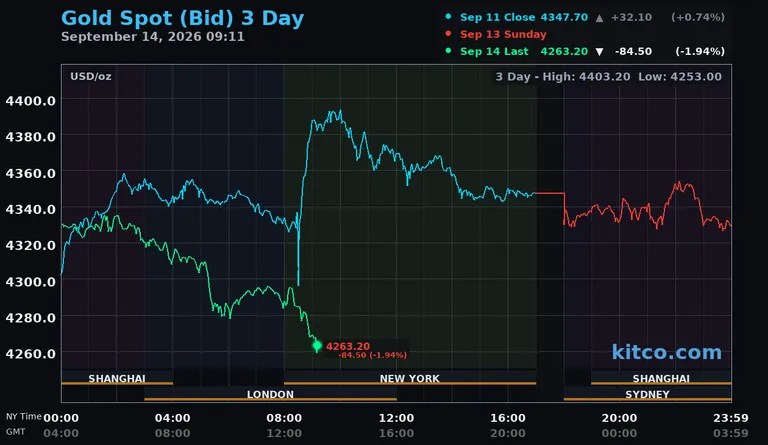
From a technical perspective, gold's near-term momentum has deteriorated sharply as prices have fallen through several important support levels. FXEmpire's latest analysis identifies resistance at $4,319.60, followed by $4,353.92 and $4,396.78. With gold now trading around $4,275, attention has shifted to support around the 50-day moving average near $4,266.76. A sustained break below that level would reinforce the bearish momentum and expose deeper support. On the upside, gold needs to recover above $4,319.60 before buyers can begin challenging the stronger resistance zone between $4,353.92 and $4,396.78.
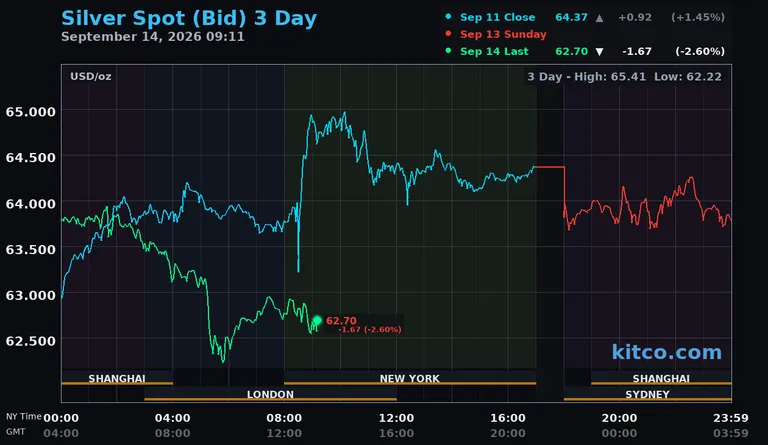
Silver's technical outlook also remains under pressure, with FXEmpire identifying $62.98 to $61.04 as an important support zone. The 50-day moving average near $62.58 sits within that range, making it an important level for traders to watch. A decisive break below this support area would expose $60.835. On the upside, initial resistance is seen at $65.59, followed by $67.01. Silver would need to push above $68.33 to materially improve its near-term technical outlook.
With the U.S. economic calendar relatively quiet Monday, geopolitical developments, oil prices and Treasury yields are likely to dominate trading ahead of Wednesday's Federal Reserve decision. With a rate hike increasingly priced in, the bigger catalyst for gold could be Fed Chair Kevin Warsh's guidance on the path of monetary policy and whether policymakers view the latest energy-driven inflation shock as requiring additional tightening.
See live precious metals prices for gold, silver, platinum and palladium — in USD, CAD and 12 more currencies.

