
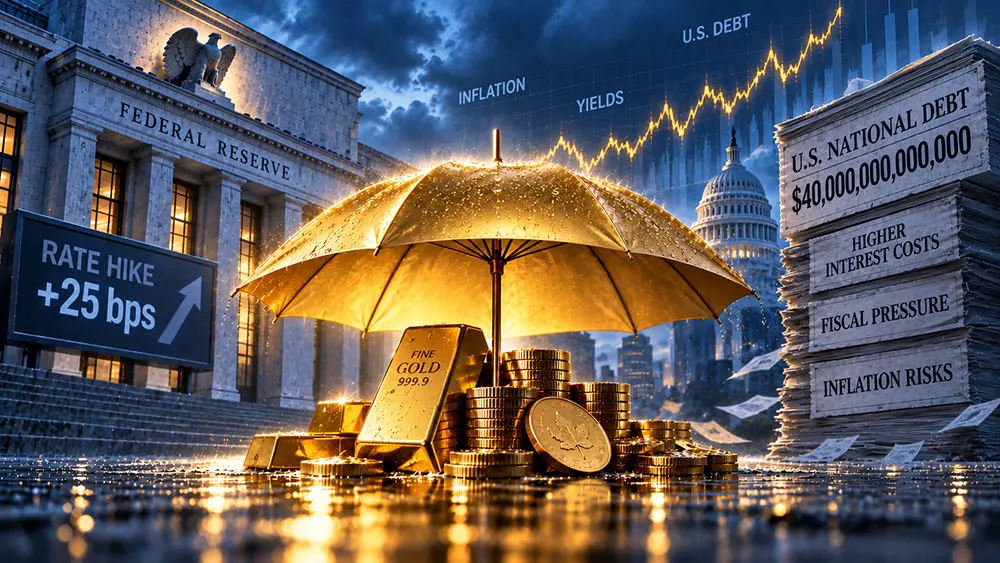
(Kitco News) - Last week we argued that gold investors should stop obsessing over limited US monetary policy moves and start paying attention to the next $1 trillion of U.S. debt.
The Federal Reserve raised interest rates by 25 basis points Wednesday and Chair Kevin Warsh made it clear that policymakers remain committed to bringing inflation back under control. Despite this hawkish rhetoric, the gold market did not break.
Instead, gold is holding critical support above $4,300 an ounce while snapping a three-week losing streak.
That resilience matters. Investors are starting to recognize that the Federal Reserve can raise interest rates, but it cannot fix America’s fiscal problems.
In some respects, higher interest rates only make those problems more difficult.
Higher rates might slow inflation, but they also increase the cost of servicing more than $40 trillion in government debt. The government is already spending more than $1 trillion annually on interest payments alone. The longer rates remain elevated, the more uncomfortable that arithmetic becomes.
This is why the traditional argument that higher interest rates are automatically bad for gold is becoming increasingly incomplete.
Gold doesn’t need loose monetary policies to justify its place in a portfolio. Investors aren't just buying gold because they expect easier monetary policy. They are buying it as protection against deteriorating government finances, persistent inflation, currency uncertainty and geopolitical instability.
Central banks appear to understand this better than most investors. Their continued appetite for gold reflects a global monetary system that is becoming increasingly fragmented. Gold provides something government bonds and currencies cannot: a reserve asset without counterparty or sovereign credit risk.
This structural demand helps explain why gold has been able to withstand conditions that historically would have generated much greater selling pressure.
Gold faced a Fed rate hike, hawkish messaging from Warsh, and a 10-year Treasury yield hovering around 5%. Yet instead of collapsing, the market found buyers and held critical support.
There will undoubtedly be more volatility. Another surge in bond yields or oil prices could pressure gold, particularly if markets begin pricing in a more aggressive tightening cycle.
But those are increasingly short-term considerations within a much larger story.
The Federal Reserve is fighting inflation. The bond market is wrestling with debt. Governments continue spending. Central banks continue diversifying their reserves. And geopolitical uncertainty isn't disappearing.
Against that backdrop, gold's refusal to break should be no surprise.
See live precious metals prices for gold, silver, platinum and palladium — in USD, CAD and 12 more currencies.
