
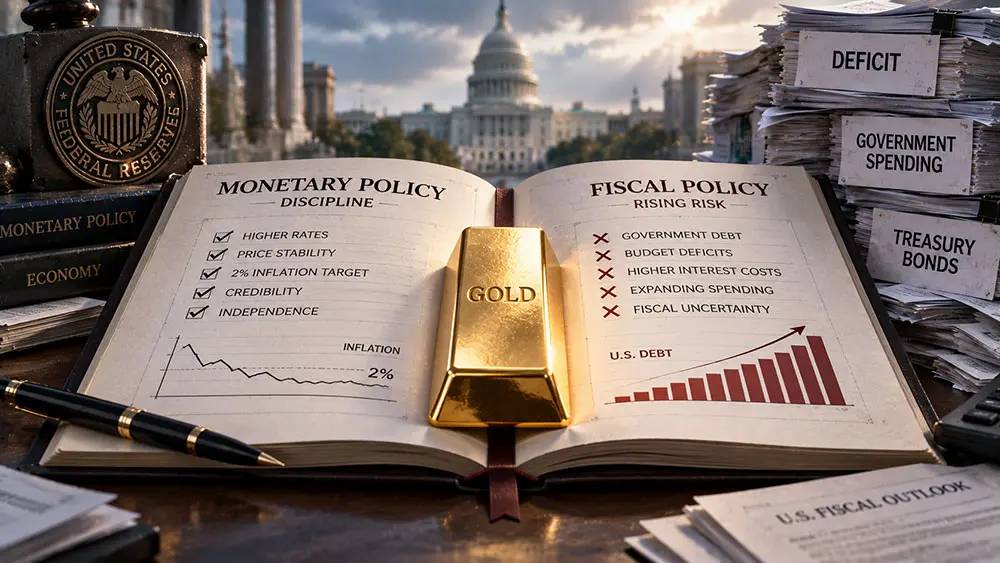
(Kitco News) - The Federal Reserve has embarked on a new tightening cycle; however, gold investors may have less to fear from a more disciplined central bank than they think, as improving monetary policy cannot fix Washington’s deteriorating fiscal position, according to one prominent fund manager.
In an interview with Kitco News, Axel Merk, founder of Merk Investments, said Federal Reserve Chair Kevin Warsh has made significant progress in restoring discipline at the central bank. However, he argued that even good monetary policy can only go so far when the government continues to show little fiscal restraint.
“If you have bad fiscal policy, good monetary policy can only do so much,” Merk said. “With bad monetary policy combined with bad fiscal policy, you can make things dramatically worse.”
That distinction is important for gold investors. Merk said his concerns surrounding U.S. fiscal policy have not diminished simply because the Federal Reserve is moving in what he sees as the right direction.
Merk said Warsh has worked to pull the Federal Reserve away from politics and return the central bank’s focus to its traditional monetary policy responsibilities, including price stability and the availability and cost of credit.
At the same time, Warsh has followed through on his commitment to bring inflation back toward the central bank’s 2% target. The Federal Reserve raised interest rates by 25 basis points last week, and Merk said the move reinforced the central bank’s credibility after Warsh signaled that policymakers would act if inflation failed to improve.
“It was time to raise rates, he raised the rates,” Merk said, adding that Warsh’s discipline is helping him build trust within the Federal Open Market Committee.
However, Merk said stabilizing monetary policy does not eliminate the structural problems facing the U.S. economy.
“At the end of the day, fiscal policy is gonna drive things, but bad monetary policy could have made things dramatically worse,” he said.
For gold, that means a more credible and disciplined Federal Reserve does not necessarily undermine the precious metal’s long-term investment appeal.
Merk said he remains concerned about persistent government deficits and the broader fiscal trajectory. In his view, higher interest rates could eventually impose greater discipline on lawmakers, but he is skeptical that elevated bond yields alone will force Washington to meaningfully address government spending.
Merk noted that ultra-low interest rates following the global financial crisis helped encourage excessive government spending by making debt relatively cheap. He added that Warsh’s singular focus on normalizing monetary policy is at least removing some of that incentive and forcing fiscal issues back into the national discussion.
“By normalizing policy, he is helping in that discussion,” Merk said. “We increasingly talk about the deficits, and that’s a good thing because most voters don’t wanna talk about the deficit.”
Merk said Warsh appears to believe that stronger economic growth and productivity gains can help stabilize the nation’s debt burden by allowing economic growth to outpace the expansion of government debt.
However, that scenario is far from guaranteed.
Merk said he also sees another potential source of support for gold emerging from the technology-driven expansion in the U.S. economy. He said much of the artificial intelligence investment boom has been financed with debt, creating the potential for lower interest rates if the boom eventually turns to bust.
“When you have a debt-financed boom that’s followed by a bust, in order to mitigate the fallout from the debt that’s left over, you tend to have lower interest rates,” he said.
Against that backdrop, Merk said gold continues to offer investors an important diversification tool.
“We got a fiscal mess. How do you diversify? And gold may well play a role in that,” he said. “I do like my gold even with a Kevin Warsh Fed.”
Merk’s conviction is reflected in his own portfolio. He said he reduced his gold exposure slightly last year as Warsh emerged as the likely successor to former Federal Reserve Chair Jerome Powell, but described the move as marginal.
Merk also remains constructive on gold-mining equities, noting that he maintains significant exposure to the sector and sees attractive margins for producers at current metal prices.
See live precious metals prices for gold, silver, platinum and palladium — in USD, CAD and 12 more currencies.
