
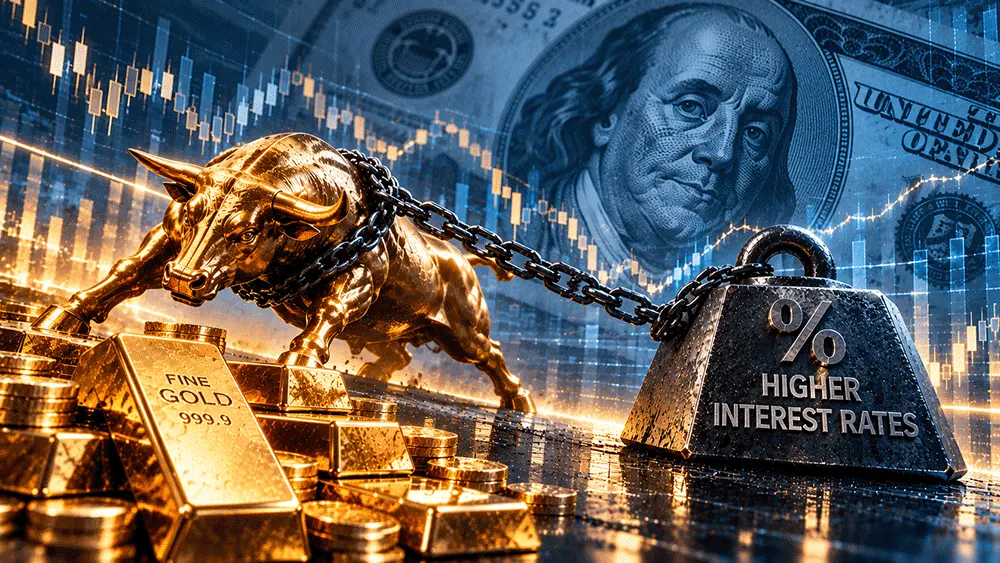
(Kitco News) - Gold prices have fallen below $3,900 an ounce, extending a sharp selloff as persistent inflation and elevated interest rates continue to weigh on the precious metal. However, according to one fund manager, the recent weakness represents more of a correction than a fundamental shift in gold's long-term bullish outlook.
In a recent interview with Kitco News just ahead of the Federal Reserve's latest monetary policy decision, David Miller, Chief Investment Officer and Co-Founder of Catalyst Funds and Portfolio Manager of the Strategy Shares Gold Enhanced Yield ETF (GOLY), said that gold continues to face significant short-term headwinds, but the underlying forces that have driven prices higher over the last several years remain firmly in place.
Miller's comments have taken on renewed significance after the Federal Reserve left interest rates unchanged Wednesday but reiterated its commitment to bringing inflation back to its 2% target. The central bank's continued focus on inflation has reinforced expectations that interest rates could remain elevated for longer, creating additional challenges for non-yielding assets such as gold.
Spot gold last traded at $3,880.30 an ounce, down nearly 3% on the week. Prices have fallen to their lowest level in roughly a year, with the latest selling pressure accelerating even as U.S. bond yields and the U.S. dollar have weakened. (Kitco Global Index shows how much of today's gold move is the dollar versus the gold market itself.)
Although gold prices have struggled because of persistent inflation pressures, Miller said investors need to put the correction into perspective, particularly in light of gold's extraordinary gains over the previous two years.
He noted that gold prices rose 26% in 2024 and 63% in 2025, making the recent weakness more indicative of a cooling-off period than a fundamental change in the market.
He explained that the gold market is supported by several distinct groups of investors, including short-term speculators, long-term retail holders and sovereign buyers. While speculative investors tend to react quickly to changing market conditions, he said official-sector demand is driven by much longer-term considerations.
Miller said one of the most important forces supporting gold remains the global movement toward de-dollarization, as countries increasingly look to diversify their reserves away from the U.S. dollar.
He explained that countries such as China, Poland and India continue to see gold as an important reserve asset. At the same time, some sovereign holders have been forced to liquidate positions to address domestic economic or geopolitical challenges.
Although official-sector selling has contributed to some of the recent volatility, Miller said the underlying demand for gold as an alternative reserve currency remains intact.
"I think that's the deep megatrend that we're going to see for the next 10, 20 years. These sovereign wealth players want a real alternative to the dollar," he said.
While central bank and sovereign demand provide long-term support, Miller said the more immediate challenge for gold remains the inflationary environment and the prospect of interest rates staying elevated for longer than investors had previously expected.
Miller warned that the ongoing conflict in Iran and disruptions to global energy markets could keep inflation elevated, forcing central banks to maintain restrictive monetary policies.
"We see pockets of demand in the market and gold really wants to rally, but it has these forces that are holding it back," he said.
See live precious metals prices for gold, silver, platinum and palladium — in USD, CAD and 12 more currencies.

