
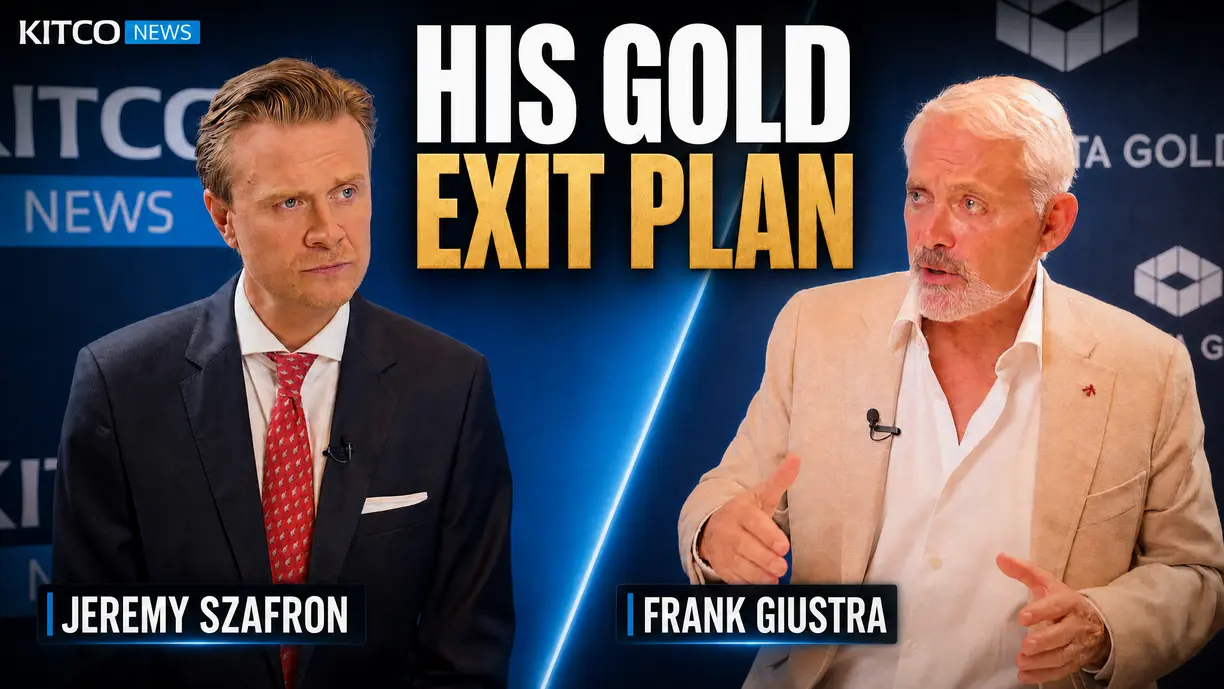
The Goldcorp founder, who was called “delusional” for buying gold in 2001, says central banks have put a floor under the price, the majors will be forced to buy juniors, and QE is coming back.
NEW ORLEANS (Kitco News) - Frank Giustra has three conditions for selling his gold.
“Give me world peace, honest politicians, and benevolent bankers,” the Goldcorp founder said. “If you can give me all three of those things, I will walk away from gold.”
He isn’t expecting any of them.
Giustra has spent more than 45 years in the business and is a longtime board member of the International Crisis Group. He spoke with Kitco News on Oct. 29 at the New Orleans Investment Conference. His memoir, “The Money Dilemma: My Unlikely Path to Wealth, Philanthropy, and Peace,” was published Nov. 3.
“There are dozens of black swans lurking in the shadows just waiting to come out,” he said. When one does, he expects policymakers to reach for easy money again. “I absolutely guarantee you’ll see a lot of QE in our lifetimes.”
‘A very dangerous game of chicken’
The nearest risk, in his view, is Iran. Brent crude traded above $110 a barrel the morning of the interview. Asked whether markets were pricing peace too early, Giustra said: “100%.”
“I’m more in the camp right now that the US is going to attack after the midterms,” he said.
If that happens, he expects Iran to hit back across the region. Oil “could potentially go a lot higher if there’s a second, a third strike,” he said, and “we could force the global economy into a deep recession or a depression if this gets out of hand.”
“I think the whole strategy of the US on this has been wrong from the start,” he said. But he also sees diplomacy moving behind the scenes. “They are actually communicating with each other, and they both are trying to come to an arrangement,” he said. He expects a diplomatic solution eventually. The question, he said, is whether there is another attack first.
“Listen, I hope I’m wrong. I really hope I’m wrong.”
Oil has whipsawed since. Brent fell 7.6% to $104.77 a barrel on Nov. 2 on hopes for diplomacy. It swung again on Nov. 3 after The Wall Street Journal reported a U.S. strike on Iran’s Qeshm Island.
‘It’s gonna be chaotic’
The midterms were days away when Giustra sat down, and he expected a rough night for Republicans. “Anything can happen and... you can’t trust polls anymore,” he said. “But it sure looks like the House is gonna be a sweep.” The Senate, he said, was “getting worse and worse for the Republicans.”
Going into the vote, Democrats needed a net gain of three seats to take the House. Prediction markets gave them about a 73% chance of winning the Senate, according to Yahoo Finance.
Giustra doesn’t expect a clean result. “I don’t think we’re gonna have a clean outcome next week when the midterms happen. I think there’ll be a lot of accusations,” he said. If Democrats win, he expects a wave of investigations and a Washington that won’t be able to “govern properly.” Voters, he said, are focused on two things: “affordability and corruption.”
‘You debase the dollar, gold goes up’
Giustra’s long-term case for gold runs through the cost of war. He pointed to the wars in Afghanistan and Iraq, which he said “probably cost $8 trillion.” In 2021, Brown University’s Costs of War project put the total for the U.S. wars that followed the Sept. 11 attacks at about $8 trillion.
“You slowly bankrupt the nation. You have to debase your currency in order to stay in the game,” Giustra said. “You debase the dollar, gold goes up. It’s that simple.” He added: “That’s math. That’s not a theory.”
He sees a floor under the price from central banks, which he said are “slowly de-dollarizing and replacing with gold.” The World Gold Council reported Nov. 3 that central banks bought a net 321 tonnes of gold in the third quarter. That’s the fastest pace since 2024, with gold well below its January record.
Gold hit a record $5,589.38 an ounce on Jan. 28 and was trading back near $4,000 at the time of the interview. Giustra’s advice for owners is to sit tight. “If you buy physical gold, you buy it to hold it,” he said. “Gold preserves generational wealth. That’s what it does. Always has, always will.”

‘No Lamborghinis in the driveway’
Giustra knows what an unloved gold market looks like. In 2001, with gold under $300 an ounce, he and Frank Holmes toured institutional investors in Toronto, New York, London and Zurich. Their case was that gold was coming back.
“We were almost laughed out of these places,” he said. “People were just shaking their heads, going, ‘You’re delusional.’”
His first raise for Wheaton River, the company that became Goldcorp, was $100 million to buy the Luismin gold and silver mines in Mexico, and it was hard to get done. A year later, raising $250 million for Argentina’s Alumbrera, “we had to actually stop the roadshow” because it was oversold, he said.
Today, he said, the mood is “hopeful, but not by any means ecstatic.” Even with gold near $5,600 in January, he didn’t see the champagne. “I don’t see any Lamborghinis parked in the driveway,” he said of a recent conference. “We’re not in the traditional bull market because the public at large has not bought into it yet.”
He said many U.S. institutions still look at gold investors and think, “Are you one of those guys?” When that money does show up, “you’ll know, ’cause the volumes will be really high.”
Miners are waiting, for now
Higher costs are hitting producers. Agnico Eagle said Oct. 28 that diesel for its Nunavut mines ran about 45% over budget. Its all-in sustaining costs rose nearly 24% from a year earlier.
Giustra isn’t selling. “I own Agnico and I would still own it, ’cause I believe that gold is not gonna go down,” he said. “If it goes down, it’s not gonna be by much.”
He also owns Aris Mining in Colombia, which says its projects support a longer-term goal of about 1 million ounces a year, pending permits.
Big producers flush with cash will eventually have to buy juniors to replace their reserves, Giustra said, in copper as well as gold. “So far, it looks like they’re waiting,” he said. “I’m saying that ultimately they’re not gonna have any choice.”
He sees the biggest prize in copper, where he expects “a very, very large supply deficit.” The majors, he said, have spent decades expanding old mines instead of building new ones.
Colombia is one place he’s betting on. The new government is “aggressively going after foreign investment in both mining and oil and gas,” Giustra said. The U.S. and Colombia signed a critical minerals framework on Sept. 8. On Oct. 9, Copper Giant, another company he’s invested in, signed a strategic mining area contract with Colombia’s National Mining Agency for ground next to its Mocoa project.
‘Okay, now what?’
The book picks up where most success stories end. At 39, Giustra left Yorkton Securities, where he was chairman and chief executive, and retired. Three months later, the Bre-X scandal hit, and the market “went dead for five years,” he said.
Retirement didn’t take. “Four months later I’m going, ‘Oh, God, I’m bored,’” he said. He launched Lionsgate in 1997.
The dilemma in the title is what comes after the money. “You exit a deal and you make a huge win. And you’re sitting there going, ‘Okay, now what?’” Giustra said. His answer, starting in 2007, was philanthropy. He said he has given about $200 million to his poverty initiative alone.
“Once you have peace, you don’t need anything else,” he said.
His father, a nickel miner in Sudbury, Ontario, never quite believed the money was real, then worried his son would blow up. Giustra told him not to worry. “I’m actually a very conservative guy,” he said. “I mean, I’m in the risk business.”
Lionsgate, he said, was the hardest thing he has ever done. What did it teach him?
“Oh, I learned a lot about cash flow.”
His book, “The Money Dilemma,” is available now. His writing is at frankgiustra.com.
Kitco News on-site coverage of the New Orleans Investment Conference is presented by Dakota Gold.
See live precious metals prices for gold, silver, platinum and palladium — in USD, CAD and 12 more currencies.
