
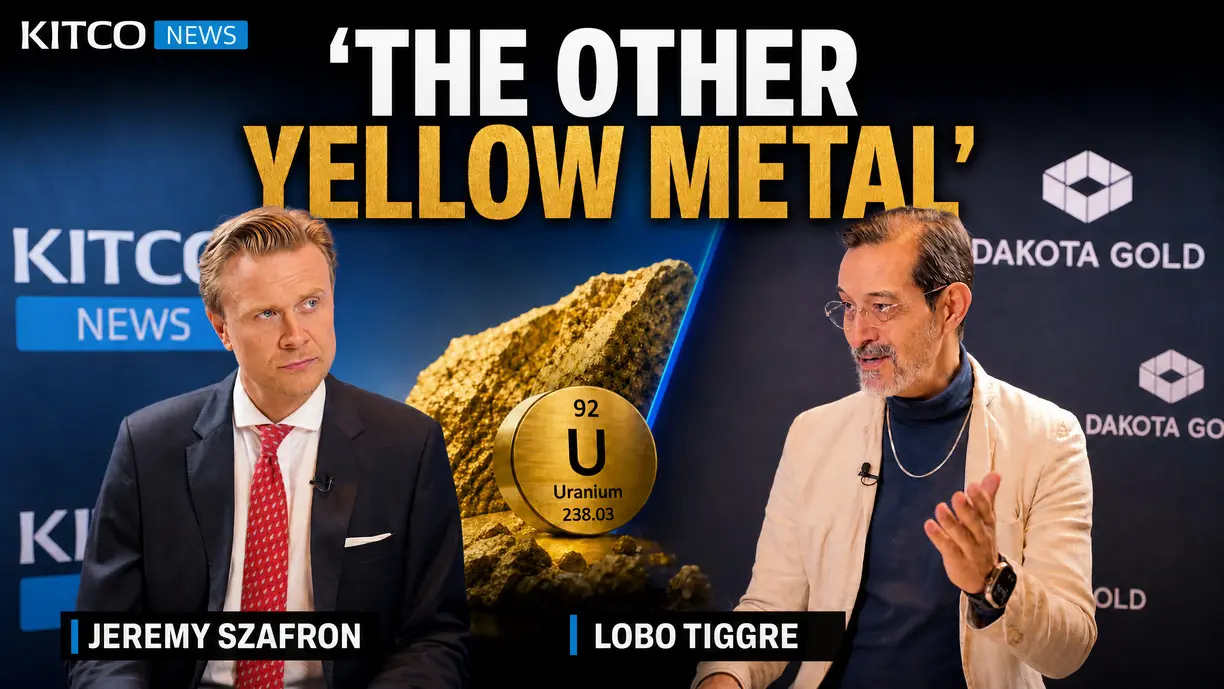
(Kitco News) - The Independent Speculator sold most of his gold and silver stocks early this year. Now he's spending cash on uranium, and says he'll "lean heavy into silver" when the time comes.
NEW ORLEANS - Lobo Tiggre sold most of his gold and silver stocks early this year, when, he said, gold was about $1,500 an ounce higher than it is now. He has been sitting on a big pile of cash since. Now he's spending some of it. Just not on gold.
"It turns out that the first opportunity since I sold this year, big opportunity, like clear, obvious buying opportunity, has been in uranium," Tiggre, founder of The Independent Speculator, told Kitco News on Oct. 29 at the New Orleans Investment Conference.
The reason is a gap that keeps getting wider. Uranium is climbing. The stocks that mine it are not.
Most uranium is sold to utilities under long-term contracts, which Tiggre calls "the real market." TradeTech's long-term price indicator, a benchmark for those contracts, hit a record $99 a pound on Oct. 31. That's the highest since the consultancy launched it in 1996.
Miners went the other way. The Sprott Uranium Miners ETF fell about 52% from its Jan. 29 peak through Oct. 23, according to Sprott, while the S&P 500 sat less than 3% below its high.
"Either I am missing something somehow that everybody else in the market knows that I don't, and nobody else that I know knows, not likely, or the market is making a mistake," Tiggre said. "I'm inclined to the latter, and I'm putting my money where my mouth is on that."
'This is that gift'
Tiggre blames two things for the selloff, and neither is uranium. Investors who bought the sector as a "picks and shovels play for AI" bailed as AI stocks fell, he said. Then tax-loss selling started early, something he said he has heard directly from investors doing it.
Sprott also blamed forces outside the uranium market. In an Oct. 30 commentary, it pointed to "liquidity pressures" rather than weaker fundamentals, and noted that money kept flowing into its miners ETF even as the price fell.
Tiggre had said a selloff in uranium for the wrong reasons would be a gift. "That is absolutely where we're at now," he said.
He won't name what he bought. "That's what people pay me for," he said. But he hinted at quality over long shots. "When the blue chips are on sale with the rest, you know, why do you need to go out on the risk spectrum of some, you know, junior that may or may not even have something, when the very best in the space are on sale?"
He expects the smaller spot market, where uranium trades for near-term delivery, to make the next move. "I think that there's a pretty good chance that we will see the spot price snap back up and overpass to the upside by the end of this year," Tiggre said. He means spot catches up to the long-term price and overshoots it. It last did that in late January, when spot hit $100.25 a pound, according to TradeTech.
The move may already be underway. Spot traded near $90 for most of October, then jumped in the final week on a burst of buying to end the month at $93.25, according to TradeTech data reported by FNArena. Uranium shares bounced that week too, FNArena said, with Australia's Paladin Energy up 8.6%.
Supply could help. Kazatomprom, the world's largest producer, needs sulfuric acid to pull uranium out of the ground. Its chief executive said in March that a new acid plant the company needs would launch in 2026 or the first half of 2027, Interfax-Kazakhstan reported.
"Bad news for Kazatomprom is good news for everybody else in this space," Tiggre said.
Gold can wait, then silver
Bullion is his savings, and he's always interested in it, he said. The stocks are another matter. "Gold stocks, I'm not ready to go there yet; therefore I'm not ready to go to silver yet."
When he does move, he plans to "lean heavy into silver." As of Nov. 2, silver was about 58% below its Jan. 29 record of $121.62 an ounce, while gold was about 29% below its Jan. 28 record of $5,589.38.
"It's sold off more than gold, so the rebound, I expect it to do better than gold," he said. "I'm not at the wealth preservation stage of my life. I'm at the wealth generation stage of my life."
He rejects the bear label. "Frank Giustra just told me I was a gold bear," Tiggre said. "My case has never been a bear case. My concern has been jumping in prematurely."
He pointed to the mood on the conference floor. Gold first topped $4,000 in October 2025, and it is back near that level. "A year ago, it was 4K on the way up, everybody's so excited," he said. "Here we are at the same price, basically, but it's on the way down."
Rising costs at the miners don't rattle him. On Oct. 28, Agnico Eagle said diesel for its Nunavut mines cost about 45% more than budgeted, even after hedging. Its all-in sustaining costs rose nearly 24% from a year earlier, to $1,648 an ounce.
"Those mines were built assuming sub-$2,000 gold. So of course your costs are gonna go up," Tiggre said. If analysts didn't guide for that, "somebody was asleep at the switch."
Gold stocks have pulled back, he said, but they aren't at 52-week lows "the way the uranium stocks are."

Oil and copper: one will blink
Tiggre is still bullish on oil, "higher for longer." But he won't chase it. "I'm always interested in buy low, sell high, not buy high and hope to sell higher," he said.
The days after the interview showed why. Brent crude fell 7.6% to $104.77 a barrel on Nov. 2 on hopes for Iran diplomacy. It swung again after The Wall Street Journal reported a U.S. strike on Iran's Qeshm Island.
"I don't wanna be a hero, I don't wanna pretend I know which way it's gonna go," Tiggre said.
Copper is his backup plan. Since the war began, he said, copper and oil have tended to move in opposite directions day to day. If the war flares and oil runs away, copper stocks should get cheaper. If peace breaks out, the reverse. "One or the other will give me an opportunity to buy at better prices," he said.
How he buys
Tiggre builds positions in pieces, a method he learned from Doug Casey at Casey Research. Buy about 20% of a full position and add another 20% on a dip. Then wait for a shock to buy the last 60%. "A gift happens to land in your lap. That's when you back up the truck," he said.
Averaging down on Skeena Resources and Energy Fuels was a big part of two of his better wins, he said.
His advice for anyone walking the conference floor is just as plain. Ask a company what it will spend this year, what that work will show, and how much cash it has. "If they don't know, they're incompetent," Tiggre said. "And if they do know and they won't answer it, they're lying."
Tiggre wore a silver necklace in New Orleans instead of copper. Asked if that was a signal, he offered another option. "Or should it be uranium? But that wouldn't be healthy."
Kitco News’ on-site coverage of the New Orleans Investment Conference is presented by Dakota Gold.
