
(Kitco NewsWire) – Spot gold and silver prices were sharply higher in early U.S. trading Wednesday, as Democrats' sweeping victories in the U.S. midterm elections sent the dollar and Treasury yields lower, encouraging renewed buying interest in precious metals. The election results handed Democrats control of both the House of Representatives and Senate, raising expectations for legislative gridlock and potentially more restrained federal spending during the remainder of President Donald Trump's term. Gold climbed back above $4,000.00 an ounce following October's sharp correction, while silver recovered more strongly as lower yields and improved precious metals sentiment encouraged buying. At the time of writing, spot gold was trading near $4,041.30 an ounce, up $111.90, or 2.85%, while spot silver was trading near $51.910, up $2.237, or 4.50%, on the session.
Tuesday's U.S. midterm elections produced a decisive shift in the balance of power in Washington, with Democrats securing majorities in both chambers of Congress. Democrats gained at least seven Senate seats and 18 House seats, including victories in states that supported Trump in the 2024 presidential election. The results significantly reduce the administration's ability to advance new fiscal, tax and regulatory legislation without congressional compromise, while raising the prospect of intensified oversight of federal spending and policies affecting artificial intelligence, energy and financial markets. However, majorities in Congress do not automatically translate into lower federal deficits, and any substantial change in the borrowing outlook will depend on the legislation ultimately enacted.
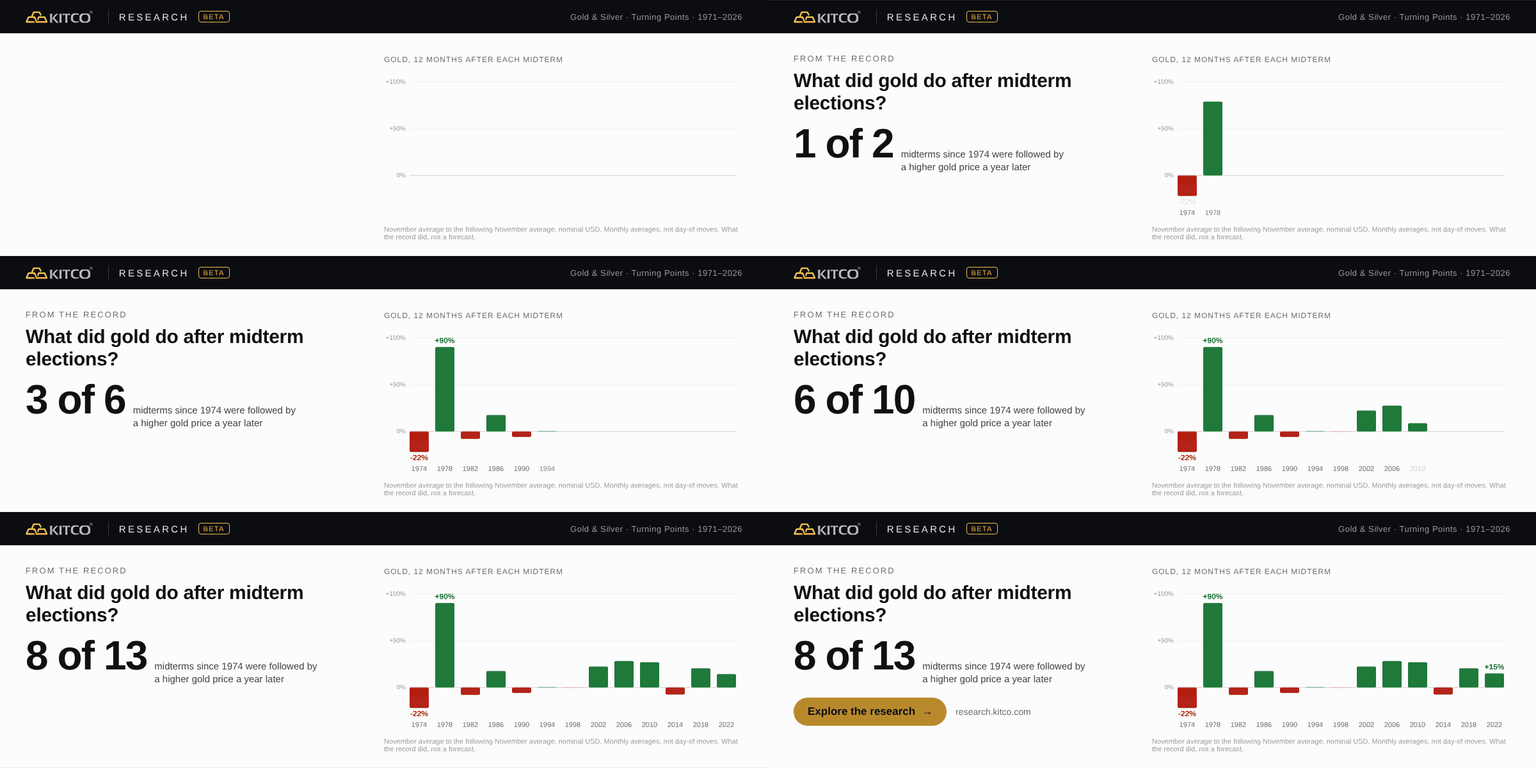
Financial markets initially responded with a rally in U.S. government bonds and a weaker dollar as investors considered whether divided government could restrain fiscal expansion and reduce future Treasury borrowing requirements. The benchmark 10-year Treasury yield declined approximately 2.1 basis points to 4.9291% in early European trading, while the two-year yield slipped to 4.6017%. The dollar retreated to its lowest level in approximately a month before recovering part of its losses. The decline in yields and the dollar provided a more favorable backdrop for gold, with lower borrowing costs and reduced expectations for fiscal stimulus potentially limiting pressure on inflation and monetary policy. (Gold prices rose an average of 14% in the 12 months following the last 13 midterm elections, according to the new midterm event study from Kitco Research.)
The election outcome also introduces competing longer-term considerations for financial markets. A Democratic Congress could slow some of the administration's proposed spending and tax measures, potentially moderating long-term Treasury yields and providing support for bullion. However, additional scrutiny of artificial intelligence investment, corporate regulation and technology-sector competition could affect equity valuations and business investment. Slower capital expenditure growth would potentially ease inflation and reduce the need for further Fed tightening, while a prolonged fiscal confrontation could increase uncertainty surrounding government funding and financial markets. The Federal Reserve's policy decisions remain independent of congressional control, with inflation, employment and economic activity continuing to determine the near-term interest rate outlook.
The latest U.S. economic reports continue to indicate resilient business activity and labor demand despite elevated borrowing costs. Tuesday's September Job Openings and Labor Turnover Survey showed vacancies increasing to 7.523 million from an upwardly revised 7.190 million in August, exceeding expectations near 7.15 million. September factory orders increased 1.8%, above forecasts for a 1.2% gain, supported by stronger transportation equipment and business investment demand. Monday's October Institute for Supply Management manufacturing index also increased to 55.5 from 54.5 in September, reinforcing the picture of continued industrial expansion. The stronger readings suggest that economic growth remains resilient enough to accommodate restrictive monetary policy, although declining energy prices and the possibility of a less expansionary fiscal stance could provide some relief from longer-term inflation concerns.
Market positioning remains divided between expectations for additional Federal Reserve tightening in December and the potentially less inflationary fiscal outlook following Tuesday's elections. The Fed left its benchmark interest rate unchanged at 3.75% to 4.00% last week, with two policymakers favoring an immediate 25-basis-point increase. Third-quarter gross domestic product grew at a 3.4% annualized pace, while September core personal consumption expenditures inflation remained elevated at 3.1% annually. Interest rate futures continue to assign a substantial probability to another increase at the Fed's Dec. 8-9 meeting, with recent market assessments placing the likelihood near 80%. However, the decline in Treasury yields following the election suggests that investors are reassessing the outlook for fiscal stimulus, inflation and future borrowing requirements. For gold, the immediate benefit from lower yields and a softer dollar is being weighed against the possibility that resilient employment and persistent inflation will keep the Fed on a restrictive policy path.
Wednesday's economic calendar began with the October ADP private-sector employment report, which showed an increase of 86,000 jobs, exceeding expectations near 75,000 and following a downwardly revised September increase of 86,000. The figures suggest that private-sector hiring remains positive, although employment growth has moderated considerably. The October ISM services index is due at 10 a.m. EST. The weekly Energy Information Administration petroleum inventory report follows at 10:30 a.m. EST. Thursday brings weekly initial jobless claims and preliminary third-quarter productivity figures at 8:30 a.m. EST, while Friday's October employment report is scheduled for 8:30 a.m. EST. The upcoming labor-market figures will be particularly important for December Fed expectations. Softer payroll growth, easing wage pressure and weaker business activity could further reduce Treasury yields and support gold, while stronger employment and persistent inflation would reinforce expectations for additional tightening.
The Strait of Hormuz and U.S.-Iran situation remains a significant source of geopolitical and energy-market uncertainty following Tuesday's U.S. midterm elections. Qatar has intensified efforts to revive negotiations between Washington and Tehran, although a senior Iranian official indicated that the two sides remain far from an agreement. The principal disputes continue to involve sanctions relief, Iran's nuclear activities, the U.S. naval blockade of Iranian ports and the conditions for restoring normal commercial shipping through the strategic waterway. Recent U.S. military strikes against targets on Iran's Qeshm Island and continuing threats to tanker traffic have reinforced concerns that further escalation remains possible. The election outcome adds another political consideration, with Democrats' control of Congress potentially increasing scrutiny of U.S. military operations and the administration's broader Iran strategy, although the president retains substantial authority over immediate military decisions.
Oil markets continued to assess the prospect of renewed negotiations against the unresolved security risks surrounding Gulf petroleum exports. Crude prices declined in early Wednesday trading despite an estimated 5.27 million-barrel draw in U.S. commercial crude inventories reported by the American Petroleum Institute for the week ended Oct. 30. The estimate awaits confirmation from Wednesday's official government inventory report. Brent crude traded near $102.95 a barrel, while WTI was around $95.25, extending the recent retreat from October's elevated levels. A negotiated reopening of normal commercial shipping through Hormuz could reduce transportation costs and the geopolitical risk premium embedded in crude prices, while renewed military action or further tanker attacks could reverse those declines.
For gold, the prospect of reduced fiscal stimulus and lower energy prices could ease inflation expectations and reduce some pressure for additional Federal Reserve tightening. At the same time, unresolved Middle East tensions continue to support underlying defensive demand. The combination of lower Treasury yields, a softer dollar and continuing geopolitical uncertainty has provided a more favorable environment for bullion following October's steep correction. Silver has benefited from the broader precious metals recovery, although its industrial exposure leaves it sensitive to the impact of restrictive monetary policy, manufacturing demand and any renewed deterioration in global risk sentiment.
Global equity markets were volatile overnight following the Democratic election victories, with U.S. stock index futures initially dropping sharply before recovering as investors reassessed the implications for fiscal spending and corporate regulation. Nasdaq-100 futures fell as much as 2.4%, while S&P 500 futures declined as much as 1.4% before reversing their losses. European equities moved higher after a volatile opening, supported by the retreat in crude oil prices and lower government bond yields. Asian markets were mixed as investors evaluated the possibility of more restrictive U.S. technology regulation, changes in fiscal policy and the implications for international trade. Investors remain particularly sensitive to the outlook for artificial intelligence investment, financing costs and corporate earnings following October's technology-sector volatility.
The key outside markets see Nymex WTI crude oil prices lower and trading near $95.25 a barrel, while Brent crude was near $102.95. The yield on the benchmark 10-year U.S. Treasury note was trading near the 4.93% area after declining following the Democratic election sweep. The U.S. dollar index was weaker, retreating toward the 101.3 area before recovering part of its overnight losses. (Kitco Global Index shows how much of today's gold move is the dollar versus the gold market itself.)
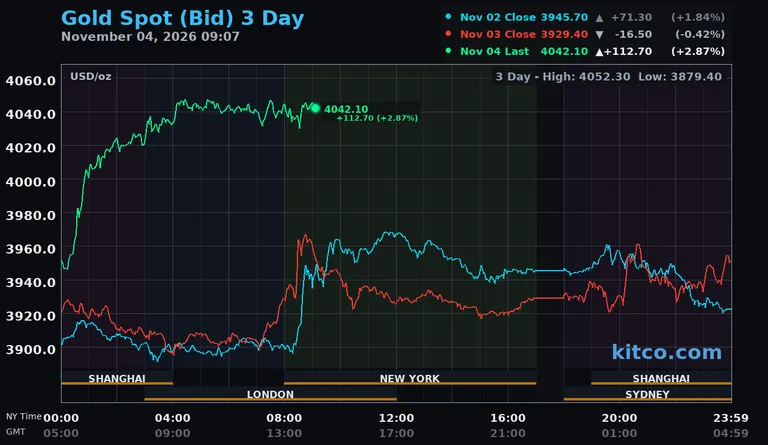
Technically, spot gold bulls' next upside price objective is to sustain the recovery above the previously identified $3,975.31 resistance level and push prices through the descending trendline, with the next published upside target at $4,068.17. Bears' next near-term downside price objective is a renewed break below $3,975.31, with deeper downside targets at $3,871.24 and then $3,797.07. First resistance is seen at $4,068.17 following the recovery above $3,975.31. First support is seen at $3,975.31 and then at $3,871.24.
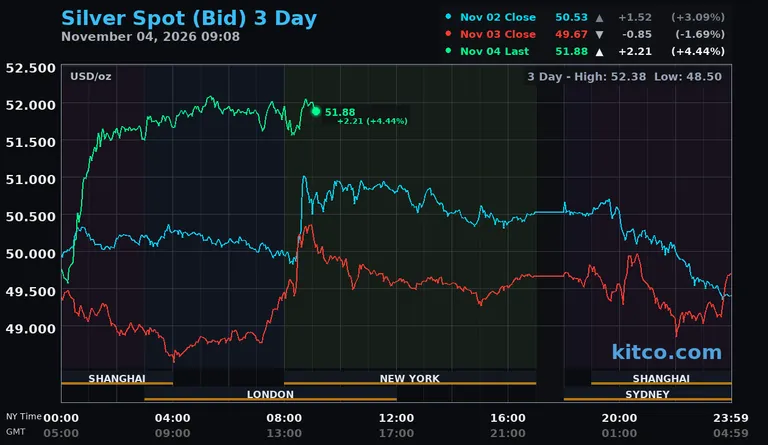
Spot silver bulls' next upside price objective is to sustain the recovery above $51.103 and push prices through the descending trendline, with the next published upside target at $52.849. The next downside price objective for the bears is a break below $48.787, with a deeper downside target at $47.057. First resistance is seen at $52.849 following the recovery above $51.103. Next support is seen at $51.103 and then at $48.787.
See live precious metals prices for gold, silver, platinum and palladium — in USD, CAD and 12 more currencies.