
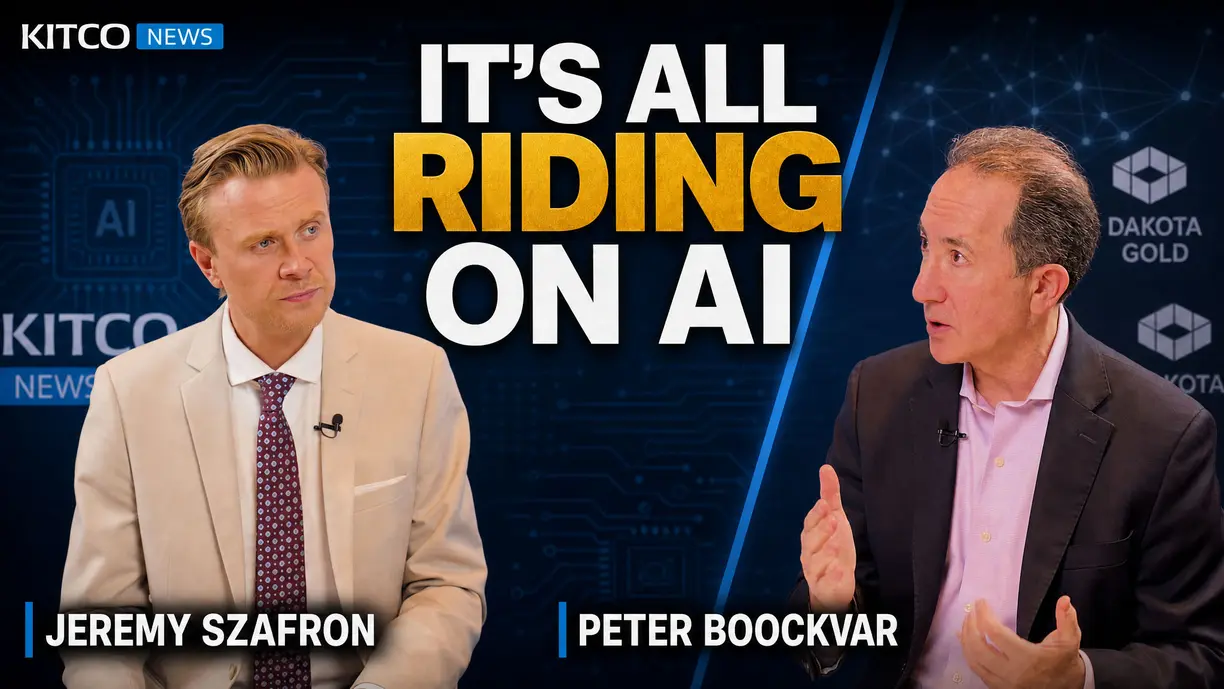
The OnePoint BFG Wealth Partners CIO said gold’s drop below $4,000 looked like forced selling. Days later, gold is back above $4,000 after the midterms, and he says investors shouldn’t count on the Fed to rescue the AI trade.
NEW ORLEANS (Kitco News) - Gold fell more than $120 an ounce on Oct. 30 and broke below $4,000. To Peter Boockvar, it didn’t look like a broken thesis. It looked like a forced seller.
“Gold’s not trading on its own fundamentals. There’s a forced seller out there, whether it’s margin-driven or whatever,” the chief investment officer at OnePoint BFG Wealth Partners told Kitco News at the New Orleans Investment Conference on Oct. 30.
In recent weeks, he said, gold had moved in an “unusual tight correlation” with the S&P 500, as if the metal were part of the tech trade. “Gold is treated like an AI stock today, which it’s not,” he said.
“This is not on a fundamental thesis at all, which tells me that this is sort of like the end of this move,” he said. For “anybody that has a time horizon more than a week, I think this is a pretty good opportunity here.”
Gold has since climbed back. It rose about $112, or 2.9%, to around $4,041 an ounce by midmorning Nov. 4, Kitco data show, as the dollar and Treasury yields fell after the midterm elections. Bloomberg called it gold’s biggest gain since August.
The number he was waiting for
One report mattered most to him: third-quarter central bank buying. “I’m looking for hopefully, another 200-plus-ton quarterly purchase by central banks,” he said. Strong buying would show they “took advantage of the lower price” to add to their holdings.
They beat that. Central banks bought a net 321 tonnes in the third quarter, the fastest pace since 2024, the World Gold Council reported Nov. 3. Holdings in gold ETFs rose 211 tonnes to a record.
The two forces that held gold back this year are turning, he said. Real interest rates “are now rolling over,” and the dollar looks “very vulnerable” because “the whole world is long US tech stocks.” If foreign investors lighten up on U.S. stocks, “that’s gonna be a weaker dollar too.”
After the Nov. 3 vote, the dollar slid against every major currency. Investors weighed whether closer scrutiny of AI investment could slow U.S. growth, Bloomberg reported.
‘That’s the wrong reason’
The bigger call is about the Federal Reserve. Even before the Fed’s Oct. 28 meeting, Boockvar argued the AI selloff could keep the central bank from raising rates again in December.
AI spending is now a large driver of growth and of stock prices, and those stock prices feed spending by wealthier households, he said. So the Fed “has no choice but to make this a factor in determining whether they should raise rates in December.”
“I’m typically an inflation hawk,” he said. “But because we’re so tethered to this AI trade, you have no choice but to pay attention.”
The Fed raised its benchmark rate a quarter point to a range of 3.75% to 4% on Sept. 16, its first increase since 2023, and held it there Oct. 28. Even if it moves again, he said, gold investors are bracing for the wrong thing.
“The September hike was not the beginning of another rate-hiking cycle. It was a tweak, and even if they do raise rates in December, it’s going to be a tweak,” he said. “So if you’re selling your gold because, oh, the Fed’s gonna go on this big rate-hiking cycle, that’s the wrong reason, ’cause it’s not gonna happen.”
The data since have cut both ways. The Nasdaq 100 closed Nov. 2 more than 10% below its Oct. 6 high, a correction. But job openings unexpectedly rose to a four-month high of 7.52 million in September, the Labor Department reported Nov. 3. That’s a labor market that still gives the Fed room to focus on inflation.
AI demand also showed few signs of slowing. AMD forecast fourth-quarter revenue of about $17 billion on Nov. 3, above the $16.3 billion analysts expected, Bloomberg reported. U.S. imports of capital goods, including computers and semiconductors, hit a record in September, according to the Commerce Department.
Politics plays a part too, he said, even if the Fed won’t admit it. “I think there’s no question that politics seeps into that room,” he said. Officials, he said, are thinking, “Why should I hike a week before the election? If I wanna hike, I can wait another six weeks. Big deal.”
With the vote behind it, the Fed’s next decision comes Dec. 9, at the end of a two-day meeting.

‘Half your retirement fund in one idea’
For stock investors, the warning is that the AI trade has quietly taken over their portfolios.
“Imagine a financial advisor walking into a room of retirees and saying: ‘I have a great idea. We’re gonna put half your retirement fund in one idea,’” he said. “They’d kick you out of the room. But that’s essentially what this trade has happened with the S&P 500. It is one idea.”
Five stocks accounted for more than half of the S&P 500’s return in the first nine months of 2026, according to figures cited by the Financial Times.
Don’t count on the Fed to bail that trade out, he said. The Fed cut rates all through the bear markets of the early 2000s and 2008 and 2009, and stocks kept falling. “I beg investors not to make their buy and sell decisions based on what they think the Fed will eventually do to save the day,” he said.
The deeper problem is cash. Most of the biggest tech spenders have turned cash flow negative as they pour money into data centers, he said. Bloomberg reported Nov. 3 that the largest four now generate a fraction of the free cash flow they once did, and that some are funding the buildout with debt.
The buildout now faces a political test as well. Voters approved at least 33 local measures restricting data centers on Nov. 3, according to Redbud Consulting. Goldman Sachs economists said new moratoriums could affect about 45% of planned U.S. data center capacity, though they expect them to be short-lived, Bloomberg reported.
“I don’t think we’re going back to the profitability and margin levels that these companies had prior to the spend,” Boockvar said.
He is “very focused on owning non-AI things right now,” including energy and consumer staples, which he called “the ultimate” non-AI trade.
Debts and deficits matter
Long-term interest rates should keep trending higher, he said. In France, yields are rising “because debts and deficits matter there.” And Japan is the largest foreign holder of U.S. Treasuries. Anyone trying to figure out where U.S. rates go, he said, has “no choice but to focus on what’s going on in Japan.”
The U.S. deficit was about $1.99 trillion for the fiscal year ended Sept. 30, according to the Treasury. If the AI trade cracks and the economy slows, he said, “that 6% US budget deficit is gonna be eight, it’s gonna be 10, and just imagine how many Treasuries are gonna need to be sold under that scenario.”
Even with divided government coming in January, Allianz economists expect the deficit to widen to 6.6% of GDP in 2027, Bloomberg reported.
The Treasury is adjusting. On Nov. 4, it dropped the words “at least” from its promise to keep note and bond sales steady. Bloomberg said the change could open the door to fewer long-dated bond sales as soon as 2027. The 30-year yield hit its highest since 2002 in October.
Foreigners now hold about 30% of Treasuries, down from 50% a decade ago, he said, so Americans are the ones financing it. “The government’s interest expense is our interest income,” he said.
That changes the math for a 60/40 portfolio. A bond fund, he said, is a bet on rates. An individual bond held to maturity pays back its principal. “If I buy a five-year Treasury today, I know I’m getting my money back in five years,” he said. “Don’t expect capital appreciation, but having income after 15 years of zero is rather nice.”
Miners stuck to the metal
The mood on the conference floor is “certainly positive,” he said, with more mining companies presenting than in recent years. “I think that there’s still a bull market here, notwithstanding the corrective phase that we’re in.”
For now, gold miners will move with the metal no matter how good their margins are. “An algo trades a gold stock with the price, and they’re just stuck at the hip,” he said. When prices stabilize, investors can reward the companies that are executing, especially those that can handle spikes in diesel costs.
He still sticks to larger producers for clients, and he doesn’t expect gold to stay down.
“I think gold still is one of those assets that will... show itself again after this correction.”
Kitco News on-site coverage of the New Orleans Investment Conference is presented by Dakota Gold.
See live precious metals prices for gold, silver, platinum and palladium — in USD, CAD and 12 more currencies.
