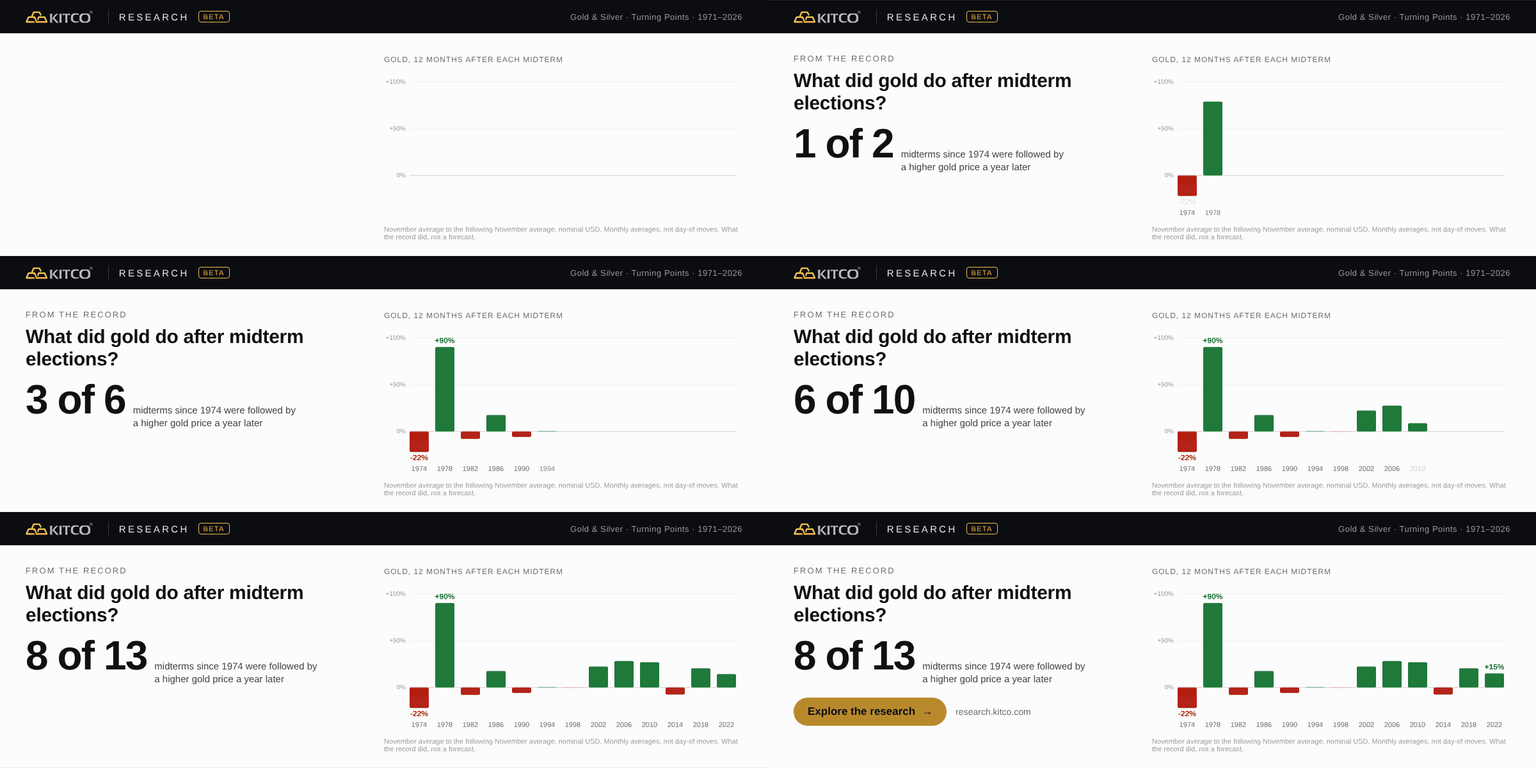

(Kitco NewsWire) - Spot gold and silver prices were sharply higher in late U.S. trading Wednesday, as Democrats' sweeping victories in the U.S. midterm elections sent the dollar, Treasury yields and crude oil prices lower, encouraging renewed buying interest in precious metals. The election results handed Democrats control of both chambers of Congress, raising expectations for legislative gridlock and potentially more restrained fiscal spending during the remainder of President Donald Trump's term. Hopes for renewed negotiations between Washington and Tehran also helped reduce the geopolitical risk premium in energy markets, providing additional relief from inflation concerns. At the latest verified afternoon quotation, spot gold was trading near $4,065.90 an ounce, up $136.50, or 3.47%, while spot silver was trading near $52.280, up $2.608, or 5.25%, on the session. Both metals recovered strongly from October's steep losses, with silver outperforming gold as lower borrowing costs and a weaker dollar supported precious metals.
Tuesday's U.S. midterm elections produced a decisive shift in the balance of power in Washington, with Democrats winning control of both the House of Representatives and Senate. The victories ended Republican control of Congress and raised expectations that the administration will face substantial obstacles in advancing additional tax reductions, fiscal spending initiatives and legislation affecting energy, technology and financial markets. Investors interpreted the outcome as potentially restraining future fiscal expansion and federal borrowing requirements, although substantial budget deficits and existing spending commitments remain important constraints. The results also increase the likelihood of congressional scrutiny of artificial intelligence investment, federal energy policy and U.S. military operations involving Iran. However, the extent of any policy changes will depend on negotiations between Congress and the White House, and the election outcome does not directly alter Federal Reserve monetary policy.
Treasury markets initially rallied sharply after the election results, with the benchmark 10-year yield falling to approximately 4.89% overnight, its lowest level in nearly two months. The yield subsequently fluctuated as traders assessed Wednesday's economic reports and the Treasury Department's borrowing plans, but finished near the 4.88% area as falling crude oil prices reinforced expectations for easing inflation pressure. The two-year yield also declined, reaching approximately 4.55%, while the dollar weakened against major currencies. Expectations that congressional gridlock could limit additional fiscal stimulus and potentially slow growth have encouraged some investors to reassess the likelihood of further Federal Reserve tightening. Lower yields and a softer dollar have provided immediate support for gold, while the broader decline in borrowing costs has also benefited silver.
Wednesday's U.S. economic reports presented a mixed picture of continued employment growth and moderating service-sector activity. The ADP private-sector employment report showed an increase of 86,000 jobs in October, exceeding expectations near 67,000 and matching September's gain. Hiring was concentrated in trade, transportation and utilities, education and health services and leisure and hospitality, while professional and business services employment declined. The October Institute for Supply Management services index slipped to 54.5 from 54.9 in September, below expectations near 54.8 but remaining in expansion territory. The new orders index declined to 55.9 from 59.8, while the prices-paid index eased to 73.0 from 74.0, indicating that service-sector cost pressures remain elevated despite some moderation. The figures suggest continued economic expansion but also point to a slowing pace of demand growth.
The September U.S. international trade deficit narrowed slightly to $105.0 billion from a revised $105.7 billion in August, as exports increased 1.9% to $321.5 billion and imports rose 1.2% to $426.6 billion. The improvement was smaller than the overall deficit's substantial increase during the preceding months, but the latest figures reinforced evidence of continued international trade activity despite elevated borrowing costs and geopolitical uncertainty. The final October services purchasing managers' index was revised down to 56.1 from the preliminary estimate of 57.9, compared with 58.8 in September, providing another indication of moderating service-sector expansion.
Attention now turns to Thursday's weekly initial jobless claims and preliminary third-quarter nonfarm productivity figures, both scheduled for release at 8:30 a.m. EST, followed Friday by the October employment report at 8:30 a.m. EST. The payrolls report will be particularly important for expectations surrounding the Fed's Dec. 8-9 monetary policy meeting. Softer employment growth, moderating wage pressure and further declines in inflation expectations could reduce December rate hike probabilities and support gold through lower Treasury yields and a weaker dollar. Conversely, stronger hiring and persistent price pressures would reinforce the prospect of additional tightening, potentially limiting the sustainability of the precious metals recovery. Investors will also monitor developments in Congress following the elections for signals about future government spending, taxation and Treasury borrowing requirements.
The Strait of Hormuz and U.S.-Iran situation remained a significant source of uncertainty Wednesday, although the Democratic midterm victories increased expectations that Washington could face greater political pressure to seek a negotiated settlement to the conflict. The new congressional balance is expected to complicate efforts to secure additional military funding and intensify scrutiny of U.S. operations involving Iran. Diplomatic contacts involving Washington, Tehran and regional mediators continue, with Qatar seeking to narrow differences over sanctions relief, Iran's nuclear activities, maritime security and the U.S. naval blockade of Iranian ports. Recent reports of possible progress toward a framework agreement have encouraged hopes that commercial shipping through the Strait of Hormuz could gradually return toward normal conditions. However, no binding settlement has been announced, and substantial disagreements remain over the conditions for reopening the strategic waterway.
The underlying security situation remains fragile despite the renewed diplomatic optimism. Recent U.S. strikes on Iranian targets near the Strait of Hormuz, continuing threats to commercial vessels and attacks involving Iranian-aligned forces underscore the risk that negotiations could break down or military confrontation could resume. Alternative petroleum export routes have helped offset some of the disruptions to Gulf shipping, but the restoration of normal tanker traffic would require sustained security guarantees and improved commercial confidence. Wednesday's decline in crude oil prices reflected reduced expectations of further near-term escalation rather than confirmation that the supply threat has been eliminated.
Crude oil prices plunged Wednesday as the election results and expectations for renewed U.S.-Iran diplomacy reduced the geopolitical risk premium accumulated during the conflict. Brent crude futures fell approximately 8.7% to $94.62 a barrel, their lowest level in about two months, while Nymex WTI crude declined approximately 8.3% to $88.12. The sharp retreat added to losses earlier in the week and substantially reduced immediate concerns about additional energy-driven inflation. For gold, lower crude prices, declining Treasury yields and a weaker dollar have provided a more favorable backdrop following October's heavy liquidation. However, the unresolved Gulf confrontation continues to support defensive demand, while the possibility of further Federal Reserve tightening remains a constraint on sustained gains. Silver has benefited from the broader improvement in precious metals sentiment, although its industrial exposure leaves it sensitive to global manufacturing conditions and the outlook for economic growth.
North American equity markets finished sharply higher Wednesday as investors responded to the Democratic election victories, lower crude oil prices and expectations for a potentially more restrained fiscal policy outlook. The Dow Jones Industrial Average surged 1,569.40 points, or 3.00%, to close at 53,356.12, while the S&P 500 gained 119.70 points, or 1.58%, to finish at 7,688.62, its strongest daily performance in approximately three months. The Nasdaq Composite advanced 364.50 points, or 1.44%, to close at 25,736.51, while the Russell 2000 increased 44.50 points, or 1.58%, to 2,856.95. Hospital operators and retailers serving lower-income consumers outperformed amid expectations that a Democratic Congress could influence health care and household assistance policies. However, selected artificial intelligence-related companies, defense contractors and businesses exposed to potential regulatory changes remained under pressure, reflecting the differing implications of the election results across sectors.
Canada's S&P/TSX Composite Index also rallied Wednesday, gaining approximately 2.39% and reaching a one-month high as stronger precious metals prices supported mining shares and lower crude oil prices improved sentiment toward selected consumer and financial companies. Materials, consumer discretionary and financial stocks were among the strongest sectors, with gold and silver producers benefiting from the sharp recovery in bullion. The advance contrasted with heavy losses among some Canadian energy companies as crude prices declined. The broad improvement in market sentiment followed Tuesday's 0.75% decline in the Canadian benchmark, which had closed at 35,532.28.
European equity markets closed sharply higher Wednesday as the Democratic election victories, declining energy costs and encouraging corporate earnings improved investor sentiment. The pan-European Stoxx 600 advanced 1.91% to finish at 658.02, while Germany's DAX gained 2.38% to close at 26,479.33. France's CAC 40 rose 1.96% to 8,177.89, while the U.K.'s FTSE 100 climbed 1.79% to 10,829.21. Spain's IBEX 35 led the major European benchmarks, advancing 3.00% to 19,370.90, while Italy's FTSE MIB gained 2.18% to finish at 51,031.02. Lower energy prices provided relief from inflation and corporate cost pressures, while stronger-than-expected earnings supported selected industrial, automotive and consumer companies. However, eurozone annual inflation accelerated to 4.0% in October from 3.8% in September, reinforcing concerns that underlying price pressures remain persistent despite the decline in crude oil prices.
The key outside markets see Nymex WTI crude oil prices sharply lower near $88.12 a barrel, while Brent crude was near $94.62. The yield on the benchmark 10-year U.S. Treasury note declined toward the 4.88% area as investors reassessed fiscal policy, future borrowing requirements and the inflationary implications of lower energy prices. The U.S. dollar index was weaker following the Democratic election sweep, providing additional support for gold and silver despite persistent expectations for restrictive Federal Reserve monetary policy. (Kitco Global Index shows how much of today's gold move is the dollar versus the gold market itself.)
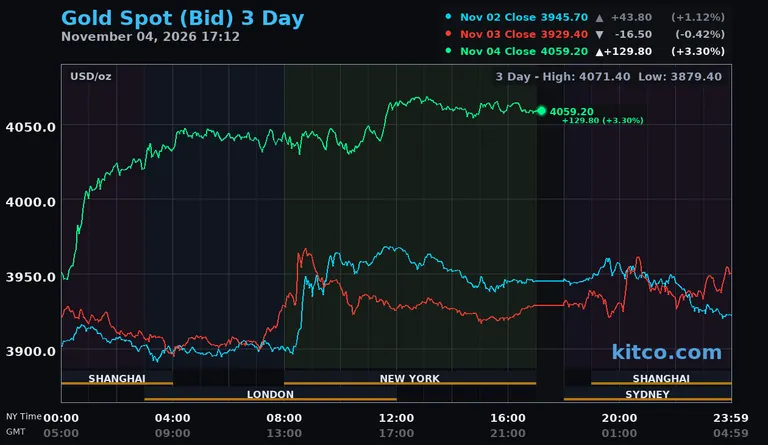
Technically, spot gold bulls' next upside price objective is to push prices through the $4,068.17 resistance level, with a sustained move above that area needed to strengthen the recovery toward $4,200.00. Bears' next near-term downside price objective is a renewed break below $3,975.31, with deeper downside targets at $3,871.24 and then $3,797.07. First resistance is seen at $4,068.17, followed by the broader upside objective near $4,200.00. First support is seen at $3,975.31 and then at $3,871.24.
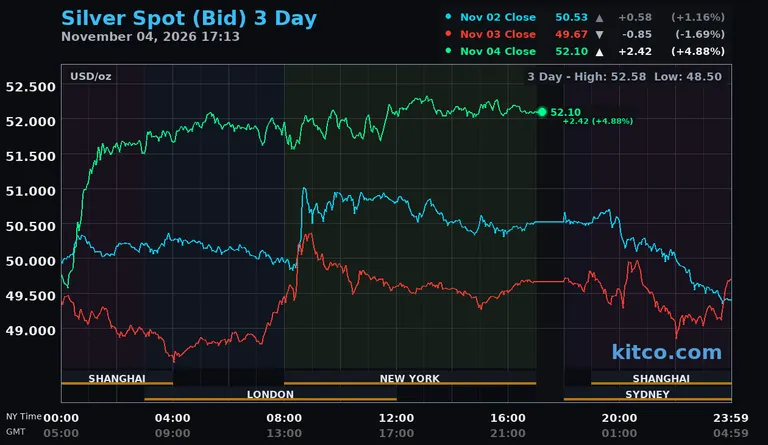
Spot silver bulls' next upside price objective is to drive prices above the $52.849 resistance level, with a sustained recovery targeting the $55.000 area and then $60.000. The next downside price objective for the bears is a break below $51.103, with deeper downside targets at $48.787 and then $47.057. First resistance is seen at $52.849 and then at $55.000. Next support is seen at $51.103 and then at $48.787.
See live precious metals prices for gold, silver, platinum and palladium — in USD, CAD and 12 more currencies.