
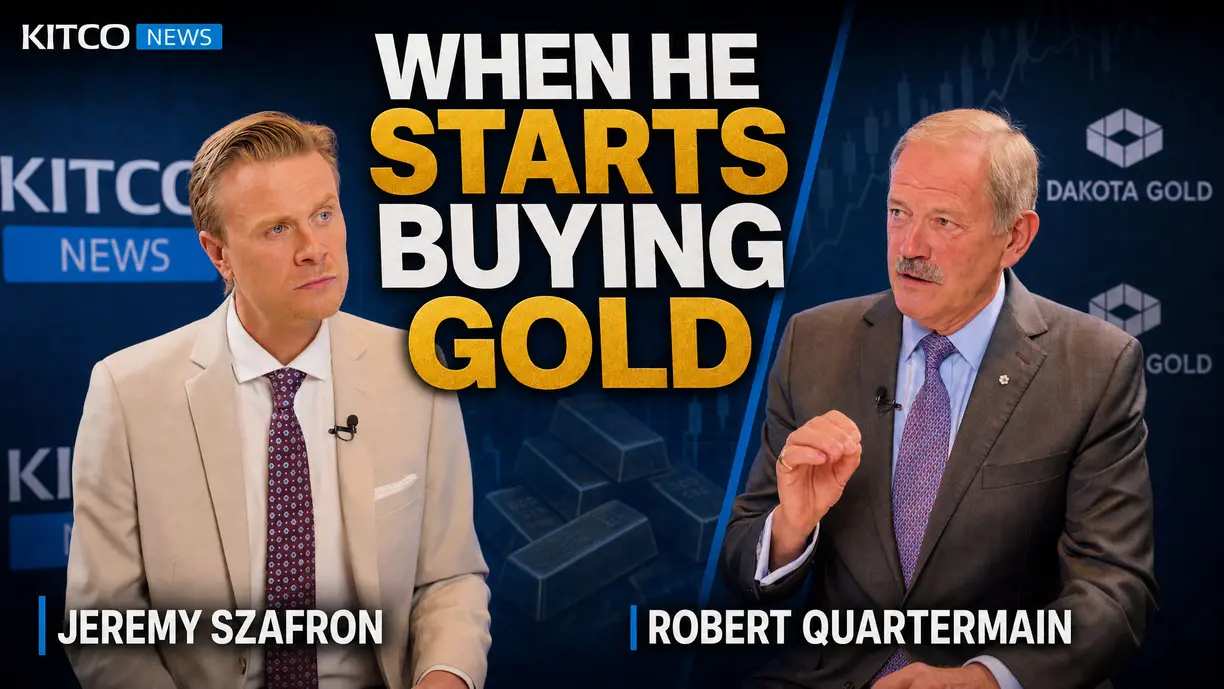
NEW ORLEANS (Kitco News) - The geologist who first went underground at Hemlo in the early 1980s, working for Teck, is now lead director of the company that bought the Ontario gold mine from Barrick. More than 40 years later, he says he knows the rocks better than he did then.
“I have a better understanding of the geology now than I did 40 years ago, and see lots of potential,” said Robert Quartermain, co-chair of Dakota Gold.
That long view runs through his career. After 50 years in mining, he came out of retirement to build one more mine: Dakota’s Richmond Hill project in South Dakota’s Homestake district. It would be his sixth taken from discovery to production. He handed the chief executive job to Jack Henris in August and remains co-chair and, he says, the largest shareholder.
“It’s exciting for me to be building and growing again, which I’ve done throughout my career,” he told Kitco News on Oct. 30 at the New Orleans Investment Conference.
The $140 yardstick
It was a rough day to talk gold. The metal fell more than $100 an ounce and slipped below $4,000, trading between $3,890.90 and $4,027.30, according to Kitco data. It has since rallied after the U.S. midterm elections, trading above $4,100 on Nov. 5.
He was unmoved.
“I started in the business back in 1976. You know, gold was $140 an ounce back then. So 4,000 looks very attractive,” he said.
He is also leaving himself plenty of room. He suspects Dakota will use a gold price of about $3,000 in the Richmond Hill feasibility study, the document it will take to lenders. The 2025 initial assessment used $2,300. You “build lots of buffer in,” he said.
The industry, he said, kept its costs in check while prices ran.
“A lot of the costs when you look in the industry, they’re still in that 1,600 to maybe $2,000 range,” he said. “The industry is still making profits at these prices.”
His own money is on it, too. He holds physical gold, he said, and most of his net worth is tied to it.
“There’s a point where even I start buying physical gold back again,” he said.
One more mine
Richmond Hill sits 2 miles from Coeur Mining’s Wharf mine, which has produced more than 4 million ounces, in a district whose Homestake mine produced more than 40 million. The July 2025 initial assessment outlined about 153,000 ounces of gold a year from a heap-leach operation. Dakota picked up the option in 2022 and is targeting production in 2029.
That is seven years, the same time he said it took to take Brucejack in British Columbia from discovery to production. Brucejack, which began commercial production in 2017, is one of the highest-grade gold mines in the world.
The project is on private land, so its main permits come from Lawrence County and the state. “So we’re not currently impacted by federal regulations in that regard,” he said, calling that clear path one of the reasons he came out of retirement.
The tone has changed, too. It is “the first time in my career,” he said, that politicians have talked about needing these metals and “onshoring them here.”
Almost 50 people from the South Dakota legislature have come to see the project, he said. “They want to understand about how we actually mine, and what the impact will be on the environment.”
Construction could bring 300 to 400 jobs, he said. A law change this year lets Lawrence County share in mining revenue, and Dakota could one day supply “up to a few percent” of the state’s budget, he added. Many of the roughly 40 people at the site are young engineers from the South Dakota School of Mines and Technology.
Dakota is the largest landowner in the district, with about 50,000 acres, and plans to build rather than sell. Building, he said, “is where you capture the value for shareholders.” He saw that at Brucejack, whose owner, Pretium Resources, was bought by Newcrest Mining in 2022 in a deal valued at about C$3.5 billion.
Next door is Maitland, along strike from the old Homestake mine, which closed in the early 2000s with gold near $300. Dakota has 47 drill intersections there averaging about 10.7 grams per tonne over 4 meters, which he called “a third of an ounce across 12 feet.”
“I’ve been in the business long enough; you don’t do random holes like that and get those kinds of results if there’s not a lot more there,” he said.
He wants cash flow from Richmond Hill, not shareholders’ money, to pay for that drilling.

What still has to go right
The hard parts are still ahead, and he is the first to say so.
“We haven’t got our full feasibility out yet. We haven’t arranged financing yet,” he said.
A pre-feasibility study is due in the fourth quarter, with a feasibility study to follow in the first half of 2027. That study will have to account for “current cost increases with inflation,” he said. The 2025 assessment put the mine’s capital cost at roughly $400 million. In September, he told Kitco Mining he expected about an 18-month permitting process.
Dakota had about $99 million in cash at the end of June after raising $75 million this year, enough, he said, to carry it through the feasibility study. He did not rule out issuing shares, but said, “That’s not the plan at this point in time.” He pointed instead to convertible debt, a stream on the project’s silver, royalties and forward gold sales. Those sales could include newer buyers such as stablecoin issuer Tether, which has been adding gold to its reserves.
Diesel prices are another pressure. He expects them to ease by the time Richmond Hill is running, but said, “We have to take it into account.”
Back to Hemlo
Hemlo is the proof he points to. Hemlo Mining Corp. bought the mine, which has produced about 25 million ounces since 1985, from Barrick in a deal valued at up to $1.09 billion that closed in November 2025. Part of the money came from a $300 million gold stream with Wheaton Precious Metals.
“We caught the gold price right,” he said.
The company had net debt of $93 million at the end of 2025 and net cash of $2.3 million by Sept. 30, it reported. “It just shows the opportunity which is there,” he said.
He remembers the mill from his days underground. It was built for 10,000 tons a day and now runs at about 3,800, he said, so the job is to feed it more ore.
The pilot who became a geologist
Before rocks, there were planes. He earned his pilot’s license in 1973 and hoped to fly for a living until his eyesight forced a change.
“I navigated my career on the ground in geology,” he said.
Today he is an honorary colonel in the Royal Canadian Air Force and a member of the Order of Canada, and he helps the Air Force think through its need for critical minerals. Jets such as the F-35 used Chinese components until a few years ago, he said, and North America’s weakness is processing, not mining.
“It’s certainly refining,” he said. China saw “probably 15, 20 years ago that was a choke point they had over North America.”
Canada, he said, has an advantage in what it has not yet dug up. “You could argue that we have a strategic stockpile in the ground.”
His advice for investors rattled by gold’s swings comes from the same long view.
“People have to have that patience and look at this as a business,” he said. “What’s the business doing from a return perspective rather than what’s the gold price doing on a daily basis?”
Kitco News on-site coverage of the New Orleans Investment Conference is presented by Dakota Gold.
See live precious metals prices for gold, silver, platinum and palladium — in USD, CAD and 12 more currencies.
