
(Kitco NewsWire) – Spot gold and silver prices were higher in early U.S. trading Thursday, extending Wednesday's sharp gains as lower Treasury yields and a softer U.S. dollar continued to support precious metals following Democrats' sweeping victories in the U.S. midterm elections. Fresh economic data showing stronger productivity growth and declining unit labor costs provided additional relief from inflation concerns, although resilient employment conditions and expectations for another Federal Reserve interest rate increase in December continued to limit the bullish implications for bullion. At the latest verified morning price reading, spot gold was trading near $4,119.50 an ounce, up $60.30, or 1.49%, while spot silver was trading near $52.390, up $0.294, or 0.56%. Gold had earlier reached $4,146.63, its highest level since Oct. 20, extending its recovery from October's steep correction.
Thursday's U.S. economic reports provided fresh evidence of improving labor productivity and moderating cost pressure, alongside continued resilience in the employment market. Nonfarm business productivity increased at a seasonally adjusted annualized rate of 3.6% in the third quarter, accelerating from an upwardly revised 2.1% in the second quarter. Output increased 3.7%, while hours worked advanced just 0.1%. Unit labor costs declined at a 0.7% annualized rate, reversing the previous quarter's revised 1.9% increase, as productivity growth outpaced the 2.9% increase in hourly compensation. The decline in unit labor costs suggests that improving efficiency is helping businesses absorb wage increases without placing equivalent upward pressure on prices, although the relationship between productivity and consumer inflation is not immediate.
Weekly initial jobless claims fell by 6,000 to a seasonally adjusted 189,000 in the week ended Oct. 31, below expectations near 196,000 and down from an upwardly revised 195,000 in the previous week. The four-week moving average declined by 2,250 to 194,750. Continuing claims increased by 23,000 to 1.718 million in the week ended Oct. 24, while the insured unemployment rate remained unchanged at 1.1%. The figures suggest that employers continue to limit layoffs, although the increase in continuing claims indicates that finding new employment remains more difficult for some workers. The combination of stronger productivity, lower unit labor costs and limited layoffs presents a potentially favorable inflation outlook, but also reinforces expectations that the Fed has room to maintain restrictive policy.
Market positioning remains focused on the implications of Tuesday's Democratic midterm election victories and the Federal Reserve's December monetary policy meeting. Democrats secured control of both the House of Representatives and Senate, raising expectations for legislative gridlock and potentially limiting President Donald Trump's ability to pursue additional fiscal spending and tax reductions. Treasury yields declined Wednesday as investors reassessed federal borrowing requirements and the inflationary implications of a possible shift toward less expansionary fiscal policy. The benchmark 10-year Treasury yield ended the previous session near 4.89%, approximately 6 basis points lower, while the two-year yield declined toward 4.58%. The dollar also weakened, providing direct support for precious metals by reducing the opportunity cost of holding non-yielding bullion and improving affordability for buyers using other currencies.
Despite the easing in yields, interest rate futures continue to reflect a substantial probability of another Federal Reserve increase in December. Recent futures pricing assigned approximately an 80% probability to a 25-basis-point increase at the Dec. 8-9 meeting, compared with expectations above 80% before the election. The Fed left its benchmark target range unchanged at 3.75% to 4.00% in October, with two policymakers favoring an immediate increase. Third-quarter gross domestic product expanded at a 3.4% annualized pace, while September core personal consumption expenditures inflation remained at 3.1% annually. Thursday's decline in unit labor costs could provide some relief from persistent inflation concerns, but the stronger-than-expected jobless claims figures reinforce the view that labor-market conditions remain resilient. For gold, lower Treasury yields and a softer dollar have improved the near-term backdrop, although continued expectations for December tightening could limit the sustainability of the recovery.
Attention now turns to Friday's October U.S. employment report, scheduled for release at 8:30 a.m. EST. Economists expect nonfarm payrolls to increase by approximately 50,000 to 60,000 jobs, while the unemployment rate is forecast to remain near 4.2%. Average hourly earnings will be closely examined for evidence that wage inflation is moderating alongside Thursday's decline in unit labor costs. The preliminary November University of Michigan consumer sentiment survey follows at 10 a.m. EST, providing another reading on household confidence and inflation expectations. Thursday's remaining calendar includes the weekly natural gas storage report at 10:30 a.m. EST and remarks from Federal Reserve officials. Softer payroll growth, easing wage pressure and declining inflation expectations could reduce December tightening probabilities and support gold through lower yields and a weaker dollar, while stronger employment data or persistent inflation would reinforce expectations for additional interest rate increases.
The Strait of Hormuz and U.S.-Iran situation remains a significant source of energy-market uncertainty, despite the sharp decline in crude oil prices following the Democratic victories in the U.S. midterm elections. The election outcome has increased expectations that Washington could face greater political pressure to pursue a negotiated end to the conflict, particularly after President Trump acknowledged the role of the Iran war and elevated energy costs in the Republican election losses. However, no binding agreement has emerged between Washington and Tehran, and the restoration of normal commercial shipping through the Strait of Hormuz remains unresolved. Iranian and Omani officials have discussed practical arrangements for restoring maritime traffic, but disagreements over sanctions, security guarantees, Iran's nuclear activities and the U.S. blockade of Iranian ports continue to complicate negotiations.
The security situation remains fragile. A commercial tanker was struck by projectiles in the Persian Gulf north of Qatar, while Iranian authorities separately claimed that additional vessels were damaged by naval mines in the Strait of Hormuz. The latter incidents have not been independently confirmed, and responsibility for the tanker attack remains undetermined. Continuing threats to maritime traffic, the possibility of renewed military operations and elevated shipping insurance costs leave Gulf petroleum exports exposed to further disruption. The ongoing uncertainty underscores the difference between renewed diplomatic engagement and the restoration of reliable commercial energy flows through the waterway.
Crude oil prices rebounded Thursday after falling more than 8% Wednesday, as traders reassessed the prospect of a negotiated settlement against continuing security risks. Brent crude futures advanced approximately 1.6% to $96.15 a barrel in European morning trading, while Nymex WTI crude futures increased 0.6% to around $88.64. The recovery was relatively modest compared with the previous session's decline, reflecting continued expectations that political pressure following the U.S. elections could encourage negotiations. For gold, lower oil prices compared with last week's levels reduce some energy-driven inflation concerns, while unresolved Gulf security risks continue to support defensive demand. Silver is benefiting from the broader precious metals recovery, although its industrial exposure leaves it sensitive to the outlook for manufacturing activity, energy costs and economic growth.
Global equity markets were mixed before the U.S. open as investors assessed the implications of the Democratic congressional sweep, lower borrowing costs and quarterly corporate earnings. Dow futures indicated a higher opening, while S&P 500 futures were little changed and Nasdaq futures weakened amid renewed pressure on semiconductor and selected artificial intelligence-related shares. Wednesday's U.S. session produced a broad equity rally, with the Dow Jones Industrial Average advancing approximately 3.0%, the S&P 500 gaining 1.58% and the Nasdaq Composite rising 1.44%. European markets remained sensitive to energy-price movements and the outlook for fiscal and monetary policy, while Asian trading reflected continued uncertainty over technology-sector valuations and international trade policy. Investors are assessing whether lower yields and reduced energy costs can sustain the post-election improvement in risk sentiment.
The key outside markets see Nymex WTI crude oil prices higher and trading near $88.64 a barrel, while Brent crude was near $96.15. The yield on the benchmark 10-year U.S. Treasury note is trading near the 4.9% area following Wednesday's decline. The U.S. dollar remains relatively soft as investors reassess fiscal policy and Treasury borrowing requirements after the elections. (Kitco Global Index shows how much of today's gold move is the dollar versus the gold market itself.)
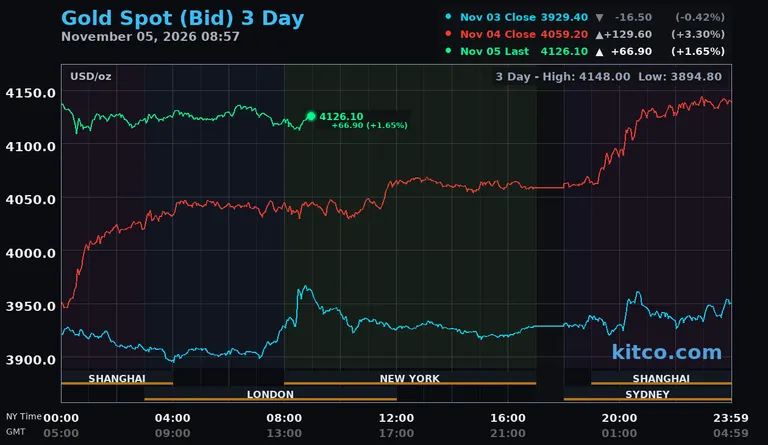
Technically, spot gold bulls' next upside price objective is to push prices back above the $4,146.00 resistance level, with a sustained four-hour close above that area targeting $4,212.00. Bears' next near-term downside price objective is a break below $4,075.00, with a deeper downside target at $3,989.00. First resistance is seen at $4,146.00 and then at $4,212.00. First support is seen at $4,075.00 and then at $3,989.00.
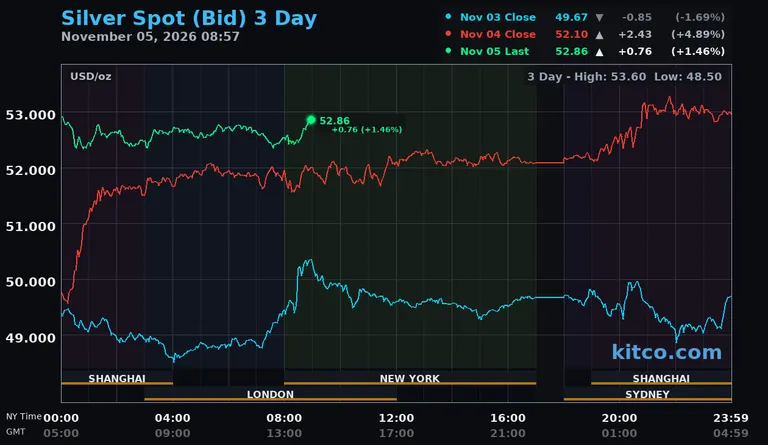
Spot silver bulls' next upside price objective is to drive prices back above the $53.070 to $54.450 resistance area, with a sustained breakout targeting $56.360. The next downside price objective for the bears is a break below $51.240, with a deeper downside target at $50.030. First resistance is seen at $53.070 and then at $54.450. Next support is seen at $51.240 and then at $50.030.
See live precious metals prices for gold, silver, platinum and palladium — in USD, CAD and 12 more currencies.