

(Kitco NewsWire) - Spot gold prices were modestly lower and silver prices were sharply lower in early U.S. trading Tuesday, as a firm U.S. dollar and expectations for additional Federal Reserve interest rate increases continued to pressure precious metals ahead of key inflation figures. Gold struggled to extend Monday's recovery from a 14-month low, while silver gave back part of its recent rebound amid concerns about industrial demand and restrictive monetary policy. Renewed tensions surrounding the Strait of Hormuz provided limited support to bullion as investors remained focused on the outlook for interest rates. At approximately 8:37 a.m. EST, spot gold was trading near $3,621.70 an ounce, down $12.50, or 0.34%, while silver was trading near $42.040 an ounce, down $1.000, or 2.33%, on the session. Gold had traded between $3,606.80 and $3,679.00 during the day, while silver's range extended from $41.710 to $44.080.
Monday's U.S. economic data indicated that business activity continued expanding in November, although growth moderated as elevated prices and tighter financial conditions constrained demand. The preliminary S&P Global U.S. composite purchasing managers' index declined to 54.6 from 55.9 in October, its lowest reading since July. The manufacturing PMI eased to 54.5 from 54.9, while the services PMI declined to 54.7 from 56.1, falling below expectations for a reading near 55.5. New orders continued increasing but at their slowest pace in four months, while employment growth remained relatively firm as companies worked to reduce outstanding orders. Input costs and selling price increases moderated but remained elevated, reinforcing concerns that inflation could persist above the Federal Reserve's target. The figures followed Friday's University of Michigan consumer sentiment report, which indicated that one-year inflation expectations declined to 3.7% from 4.7% in October, while longer-term expectations eased to 3.3% from 3.5%. The combination of slowing business activity and persistent price pressure continued to complicate the outlook for monetary policy.
Market positioning remains heavily tilted toward another Federal Reserve interest rate increase at the Dec. 8-9 meeting, with the latest published futures assessment indicating approximately a 95% probability of a 25-basis-point increase and a 5% probability of a larger 50-basis-point move. New York Fed President John Williams reinforced expectations for additional tightening Monday, emphasizing the persistence of elevated inflation despite some moderation in economic activity. The dollar remained near its strongest levels since April 2025, while the benchmark 10-year Treasury yield traded near the 4.9% area following last week's substantial decline. Investors now turn to Tuesday's September house price figures at 9 a.m. EST, followed by November consumer confidence and the Richmond Fed manufacturing survey at 10 a.m. EST. Wednesday's more consequential releases include October personal consumption expenditures inflation, durable goods orders and the second estimate of third-quarter gross domestic product at 8:30 a.m. EST, followed by the Fed's Beige Book at 2 p.m. EST. The PCE report could significantly influence December rate expectations, Treasury yields and the dollar. Stronger-than-expected inflation would reinforce the case for further tightening and pressure gold, while softer price readings could support a recovery in precious metals.
The Strait of Hormuz and U.S.-Iran situation remains highly uncertain Tuesday as renewed attacks on commercial shipping and stalled diplomatic negotiations maintain significant risks to regional petroleum exports. Iran's Revolutionary Guards claimed Monday that three oil tankers caught fire after striking naval mines in the strategic waterway, although the circumstances of the incidents have not been independently established. The United States is also investigating possible Iranian involvement in cyberattacks targeting energy tankers. Commercial shipping slowed sharply following last week's attacks on vessels operated by the Abu Dhabi National Oil Company, with vessel-tracking figures indicating only five commodity ships transited the strait Saturday and none were recorded Sunday, compared with 31 during the preceding weekend. Some vessels may have operated without active tracking signals, but the decline nevertheless highlighted continuing security concerns. Tehran has ruled out renewed negotiations with Washington until several conditions are met, including an end to the U.S. naval blockade of Iranian ports and relief from sanctions. For gold, the unresolved confrontation supports underlying defensive demand, although expectations for restrictive Federal Reserve policy and dollar strength continue to limit the metal's response to geopolitical risks.
Crude oil prices declined Tuesday as expectations for recovering global petroleum supply and a potential market surplus offset concerns about renewed attacks on tankers in the Strait of Hormuz. Brent crude futures traded near $89.10 a barrel in early European dealings, down approximately 0.3%, while Nymex WTI crude was near $79.97, also down around 0.3%. Both benchmarks approached their lowest levels in approximately three months as increasing inventories and recovering production reinforced expectations that supply growth could outpace demand. Global observed petroleum inventories increased by approximately 52 million barrels during October, suggesting a growing surplus despite continued Middle Eastern shipping disruptions. The reopening of Libya's Sharara oil pipeline also contributed to improving supply expectations. Lower crude prices could help moderate energy-driven inflation, although underlying U.S. price pressures remain the more immediate concern for Federal Reserve policy.
Global equity markets were mixed Tuesday following Monday's sharp technology-led recovery on Wall Street. The Dow Jones Industrial Average advanced 3.01% to close at 49,595.31, while the S&P 500 surged 4.73% to 7,237.17 and the Nasdaq Composite jumped 6.51% to 24,089.56. Canada's S&P/TSX Composite Index also rebounded, gaining 2.69% to finish at 34,082.12, as resource and technology shares recovered from the previous week's losses. European equities recorded their strongest session in approximately six months Monday, led by semiconductor and technology companies, although gains faded in Tuesday morning trading. The pan-European Stoxx 600 was little changed near 637, while technology shares weakened as investors reassessed the sustainability of the rebound. Asian equities advanced sharply Tuesday, with Japan's Nikkei rising nearly 4% and South Korea's Kospi gaining more than 6%, while Taiwan's benchmark surged almost 9%. U.S. stock index futures pointed toward a weaker opening as renewed concerns about artificial intelligence valuations and restrictive monetary policy tempered the previous session's recovery.
The key outside markets see Nymex WTI crude oil futures lower and trading near $80.00 a barrel, while Brent crude was around $89.10 in early European dealings. The U.S. dollar remained firm near recent highs, maintaining pressure on precious metals, while the benchmark 10-year U.S. Treasury yield was trading near the 4.9% area. Expectations for another Federal Reserve interest rate increase in December continued to limit confidence in a sustained recovery in gold and silver, despite renewed geopolitical uncertainty and some moderation in inflation expectations. (Kitco Global Index shows how much of today's gold move is the dollar versus the gold market itself.)
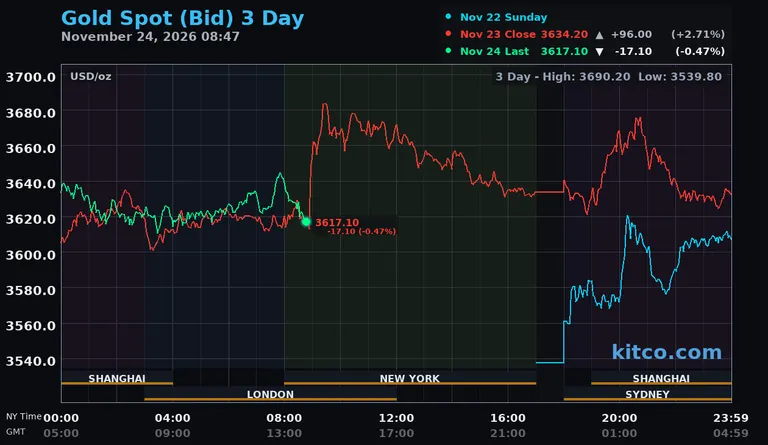
Technically, spot gold bulls' next upside price objective is to push prices back above the $3,651.00 to $3,674.00 resistance zone, with a sustained move through the upper boundary targeting $3,697.00 and improving the near-term technical outlook. Bears' next near-term downside price objective is a break below $3,595.00, with a deeper downside target at $3,503.00. First resistance is seen at $3,651.00 and then at $3,674.00. First support is seen at $3,595.00 and then at $3,503.00.
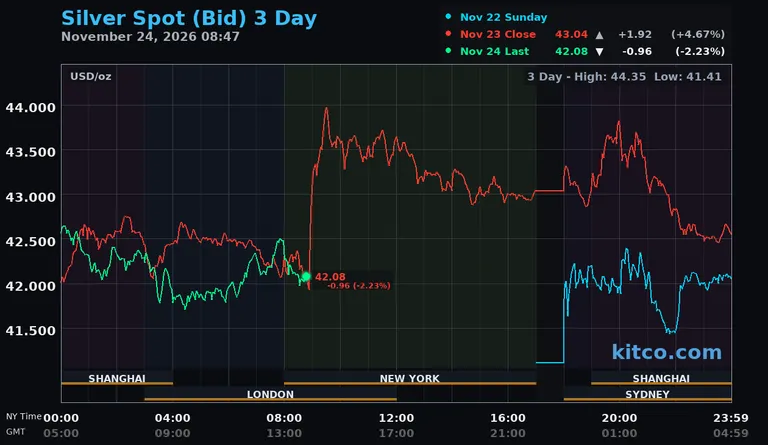
Spot silver bulls' next upside price objective is to drive prices back above the $43.120 to $43.680 resistance zone, with a sustained move through the upper boundary needed to challenge the falling trendline near $44.000 and strengthen the recovery. The next downside price objective for the bears is a break below $41.890, with a deeper downside target at $40.770. First resistance is seen at $43.120 and then at $43.680. Next support is seen at $41.890 and then at $40.770.
See live precious metals prices for gold, silver, platinum and palladium — in USD, CAD and 12 more currencies.

