

(Kitco NewsWire) - Spot gold and silver prices were sharply lower in early U.S. trading Wednesday, as stronger-than-expected underlying U.S. inflation and resilient economic growth reinforced expectations for another Federal Reserve interest rate increase in December. Gold remained near its lowest level in more than a year, while silver fell below $40.000 an ounce as weakness in industrial commodities compounded the selling. Renewed shipping threats in the Strait of Hormuz provided little support to bullion as monetary policy expectations and concerns about financial-market liquidity continued to dominate trading.
Spot gold was trading near $3,482.30 an ounce, down $72.80, or 2.05%, while silver was trading near $39.290 an ounce, down $1.510, or 3.71%, on the session. Gold had traded as low as $3,469.30 during the morning, while silver touched $39.160.
Wednesday morning's U.S. economic data reinforced concerns about persistent inflation despite evidence of moderation in some price categories. The October personal consumption expenditures price index increased 0.3% on the month and 3.8% from a year earlier, compared with September's annual increase of 3.6%. More significantly, the core PCE index, excluding food and energy, increased 0.3% for a third consecutive month, while annual core inflation accelerated to 3.3% from 3.1%, exceeding expectations for 3.2%. The second estimate of third-quarter gross domestic product was revised higher to an annualized 4.3%, indicating continued economic resilience. Personal income increased 0.7% in October, while consumer spending advanced 0.3%. Initial unemployment claims fell to 189,000, suggesting that labor market conditions remain comparatively firm despite recent evidence of slowing manufacturing activity. Durable goods orders were weaker than expected overall, although core capital goods orders increased 1.2%. The combination of stronger economic growth, resilient employment and persistent underlying inflation reinforced expectations for restrictive Federal Reserve policy, adding to pressure on gold and silver.
Market positioning remains heavily tilted toward another Federal Reserve interest rate increase at the Dec. 8-9 meeting, with futures markets assigning approximately a 96% probability to a 25-basis-point increase ahead of Wednesday's inflation release. The stronger-than-expected core PCE reading reinforced expectations that policymakers will maintain a tightening bias, even as recent equity-market weakness and falling energy prices raise questions about economic momentum. U.S. stock index futures extended their declines following the data, while the dollar strengthened and the benchmark 10-year Treasury yield traded near 4.84%. For gold, the combination of persistent inflation, resilient economic activity and expectations for higher short-term interest rates continued to offset potential support from lower oil prices and geopolitical uncertainty. Investors now turn to October new home sales at 10 a.m. EST, the weekly U.S. petroleum inventory report at 10:30 a.m. and the Federal Reserve's Beige Book at 2 p.m. EST. U.S. financial markets will be closed Thursday for Thanksgiving, with Friday's shortened trading session potentially reducing liquidity ahead of the weekend.
The Strait of Hormuz and U.S.-Iran situation remains unsettled Wednesday as renewed attacks on commercial vessels threaten shipping security despite signs of recovering regional petroleum exports. Maritime security authorities identified three vessels struck by unidentified projectiles Monday while transiting eastward through the strait. All three continued their journeys, with their crews accounted for. Iranian authorities subsequently claimed that another container vessel had been targeted for using an unauthorized shipping route, although the circumstances of that incident remain unclear. The continuing U.S. blockade of Iranian ports and stalled negotiations over sanctions and maritime security have maintained significant risks of further escalation. However, expectations for a global petroleum surplus and recovering output from producers outside the immediate conflict zone have limited the oil market's response to recent attacks. For gold, continuing geopolitical uncertainty supports underlying defensive demand, but Wednesday's decline indicated that monetary policy expectations, dollar strength and broader liquidation across financial markets remained more immediate influences.
Crude oil prices fell sharply Wednesday as expectations for a global petroleum surplus outweighed continuing risks to commercial shipping through the Strait of Hormuz. Brent crude futures declined $1.47, or 1.6%, to approximately $89.93 a barrel in earlier trading, while Nymex WTI crude fell $1.52, or 1.9%, to $80.53. The declines reversed part of Tuesday's gains, when renewed tanker attacks had supported a modest recovery in crude prices. Expectations for increasing global petroleum supplies in 2027 continued to pressure the market ahead of the Nov. 29 OPEC+ meetings, where producers are scheduled to discuss output policy and production capacity. Preliminary U.S. inventory figures indicated a modest increase of 126,000 barrels during the week ended Nov. 20, compared with expectations for a substantially larger build. Lower crude prices could eventually ease headline inflation, although persistent underlying U.S. price pressures remain a more immediate consideration for Federal Reserve policy.
Global equity markets were mixed Wednesday following Tuesday's renewed technology-led selloff on Wall Street. The Dow Jones Industrial Average advanced 0.85% to close at 50,018.70, while the S&P 500 declined 0.50% to 7,201.09 and the Nasdaq Composite lost 1.48% to 23,733.54. Canada's S&P/TSX Composite Index also finished lower Tuesday, declining 119.82 points, or 0.35%, to close at 33,962.30 as weakness in base metals and technology shares weighed on the Toronto market. Asian equities fell sharply Wednesday, led by a 6.2% decline in South Korea's Kospi and a 2.8% retreat in Japan's Nikkei 225, as semiconductor companies came under renewed pressure. Mainland Chinese shares also declined, with the Shanghai Composite losing approximately 2.0%. European markets were comparatively resilient in early Wednesday trading, with the Stoxx 600 rising approximately 0.4% and the U.K.'s FTSE 100 gaining around 0.5%. U.S. stock index futures pointed toward a sharply weaker opening following the hotter-than-expected core PCE inflation reading, with technology shares particularly vulnerable to concerns about elevated valuations and restrictive monetary policy.
The key outside markets see Nymex WTI crude oil futures lower and trading near $80.53 a barrel in earlier dealings, while Brent crude was around $89.93. The U.S. dollar strengthened following the latest inflation figures, maintaining pressure on precious metals, while the benchmark 10-year U.S. Treasury yield was trading near the 4.8% area. Expectations for another Federal Reserve interest rate increase in December continued to limit confidence in a sustained recovery in gold and silver, despite falling crude oil prices and renewed geopolitical uncertainty. (Kitco Global Index shows how much of today's gold move is the dollar versus the gold market itself.)
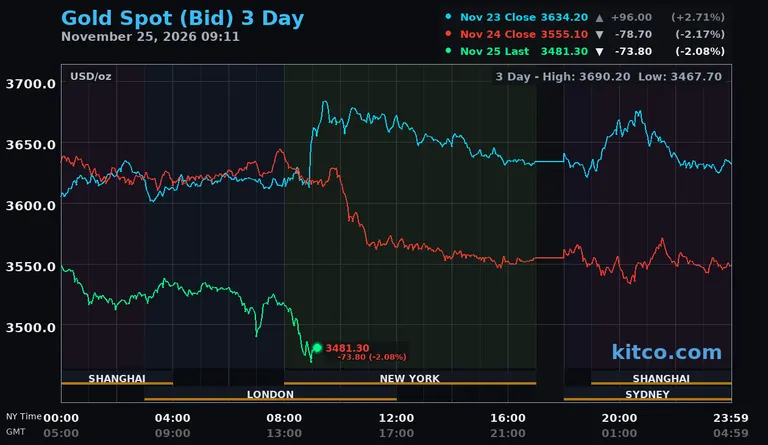
Technically, spot gold bulls' next upside price objective is to push prices back above the $3,503.00 to $3,595.00 resistance zone, with a sustained move through the upper boundary needed to improve the near-term bearish technical outlook and target $3,651.00. Bears' next near-term downside price objective is a sustained break below $3,431.00, with a deeper downside target at $3,400.00. First resistance is seen at $3,503.00 and then at $3,595.00. First support is seen at $3,431.00 and then at $3,400.00.
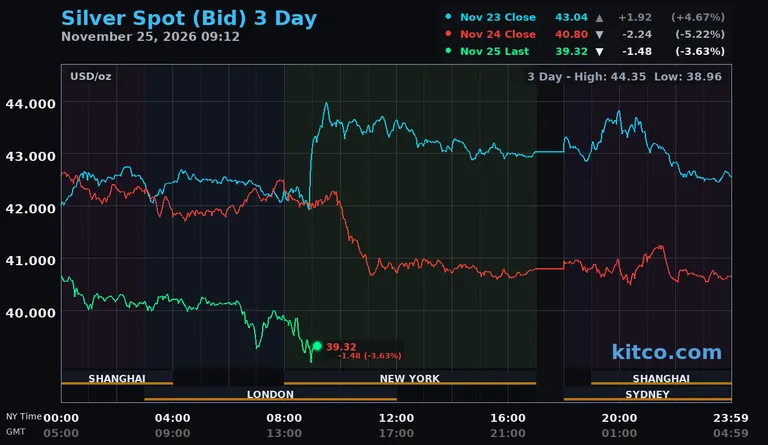
Spot silver bulls' next upside price objective is to drive prices back above the $39.740 to $41.200 resistance zone, with a sustained move through the upper boundary needed to strengthen the recovery and target $42.200. The next downside price objective for the bears is a break below $39.160, with deeper downside targets at $38.740 and then $37.000. First resistance is seen at $39.740 and then at $41.200. Next support is seen at $39.160 and then at $38.740.
See live precious metals prices for gold, silver, platinum and palladium — in USD, CAD and 12 more currencies.

