
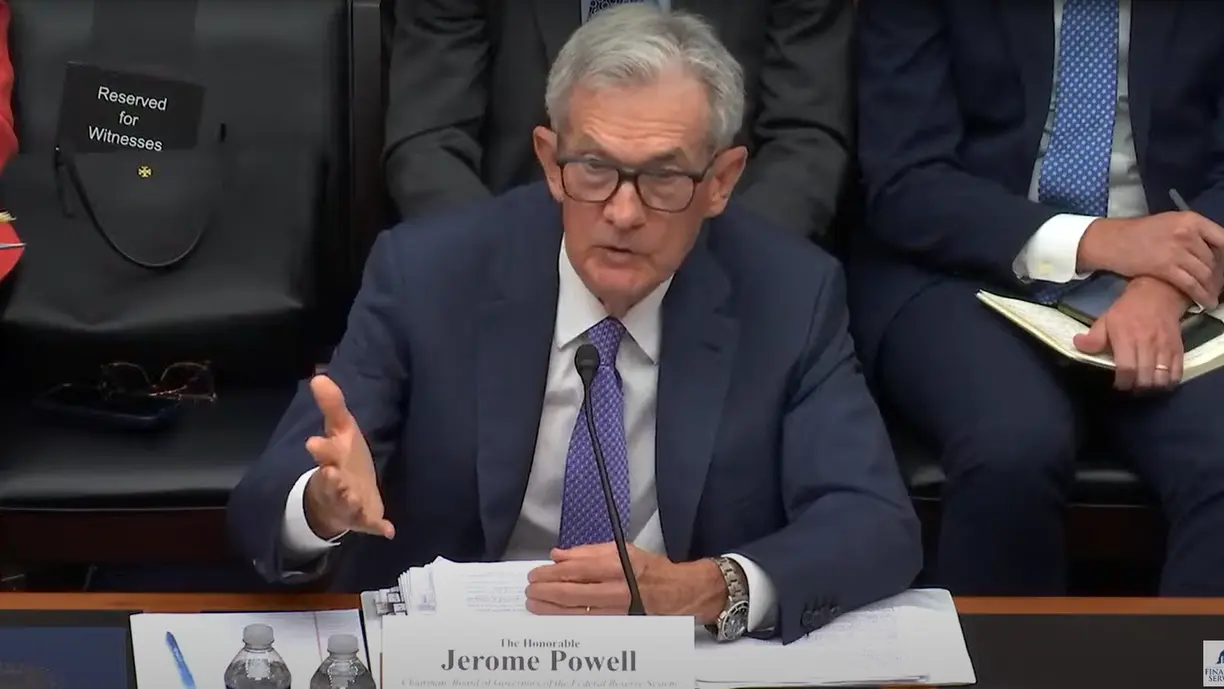
(Kitco News) – Federal Reserve Chair Jerome Powell appeared for his second day of congressional testimony on Wednesday, this time before the U.S. House Committee on Financial Services. While the conversation was more partisan and political than the prior day’s proceedings, it also shed new light on areas including the health of the banking sector, stablecoin legislation, and the Fed’s test for lowering interest rates.
Powell delivered the same opening remarks as he did to the Senate Banking Committee on Tuesday morning, drawing from the Federal Reserve's latest Monetary Policy Report to reiterate that the central bank “remains squarely focused on our dual mandate to promote maximum employment and stable prices” and that it is the view of the FOMC that “the risks to achieving our employment and inflation goals are coming into better balance.”
The Fed Chair also emphasized that the FOMC would continue to make decisions on a meeting-by-meeting basis “after carefully assessing incoming data and their implications for the evolving outlook, the balance of risks, and the appropriate path of monetary policy.”
The question and answer portion of the testimony began with Powell addressing more concerns about the Basel III endgame proposal, saying that he agrees that opening it to further public comment is “the right thing to do.” He added that the Basel III framework doesn't contain any binding enforcement mechanisms for the countries that are formulating it, and the central bank would always defer to laws passed by Congress.
Regarding the Supreme Court’s recent Chevron decision, Powell said the Fed is studying it, along with several other recent decisions.
“I haven't got anything definitive for you on that,” he said. “I think you know us to be an organization that is strongly committed to the rule of law. The Supreme Court says what the law is, and we'll always do what we believe the law is.” He did acknowledge, however, that the ruling seems to imply that “courts will give less deference to agencies” in their interpretations of the law.
Asked whether the Fed would need to see core PCE inflation dip below 2% at least once in the coming months before contemplating a rate cut, Powell disagreed.
“You don't want to wait until inflation gets all the way down to 2% because inflation has a certain momentum,” he replied. “You wouldn't wait that long. If you waited that long, you probably waited too long because inflation will be moving downward and we'll go well below 2% which we don't want.”
Pressed on what factors the FOMC would need to see in order to support a rate cut in September, Powell said “I'm not sending any signals on any particular date of any meeting
whatsoever. What we said is that we want to have greater confidence, and that means more good inflation readings, that inflation is moving sustainably down to 2%.”
“Our test for being willing to consider beginning to loosen policy [...] is that we want to be more confident that inflation is moving on a path sustainably down to 2%, not at 2%, but on a path sustainably to 2%,” he said. “That's the test we've articulated.”
He also reiterated that the high inflation of recent years was caused by “very strong demand colliding with constrained supply.”
Powell refused to address a number of questions about spending priorities and government programs, saying that the Fed keeps monetary policy very separate from fiscal policy, but conceded that, in his view, the U.S. debt path is not sustainable.
On the American banking industry, the Fed Chair said he believes U.S. banks are well capitalized and there's sufficient liquidity in the banking system, and emphasized that their bank stress tests must evolve in order to remain relevant.
When asked whether the pre-pandemic period’s low unemployment and low inflation was a thing of the past, Powell said that was not the Fed’s expectation.
“We've got a period here of low unemployment, [and] we have high inflation,” he replied. “Can we have the best of both worlds? We certainly can, and that's the plan.”
