

(Kitco News) – According to a report from Hong Kong-based Bastille Post, Shanghai's gold market is enjoying a surge in sales of jewelry and other bullion products, with local gold retailers reporting higher foot traffic during the National Day holiday week, which runs from October 1 to 7.
The National Day period – which is often referred to as ‘Golden Week’ – is also wedding season across mainland China.
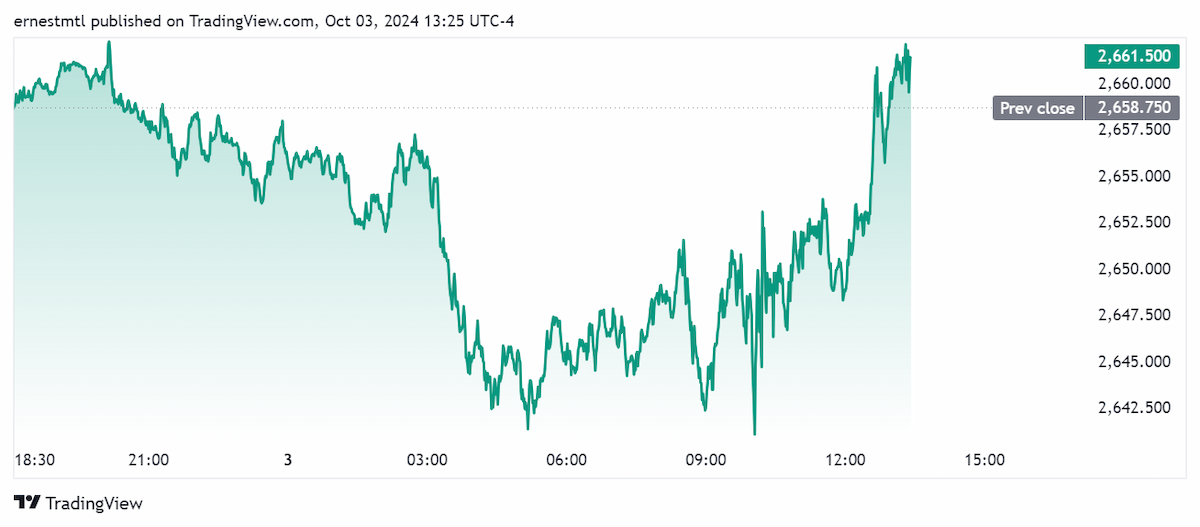
A gold retail store in the city's famous Yu Garden saw customers ready to shop for jewelry as soon as the store opened at 10:00 am, even though the store's sign shows that pure gold will cost them 773 yuan ($110 dollars) per gram. This means that an ounce of gold at local prices is $3,118, significantly higher than the international spot price of $2,661 per ounce at the time of writing.
“I'm preparing for my wedding, so I will take a look at gold earrings, rings and necklaces,” said one customer. “I will not give up buying just because it's expensive.”
Zhou Mingyuan, assistant manager of the gold shop, said they prepare for a massive increase in foot traffic during Golden Week, and they promote seasonal discounts to attract customers.
“During the National Day holiday season, the customer flow basically remains at 800 to 1,000 people per day, an increase of about four times over usual times,” Zhou said. “We are now offering a retail gold price discount of 40 yuan (5.68 U.S. dollars) per gram.”
“I've bought a bracelet hoping it could bring me luck,” another customer said. “The gold price is relatively high, so the store discounts are one factor that prompts us to make purchases.”
At another gold retailer, many customers were purchasing gold jewelry as well as bars of bullion for investment purposes.
The store has introduced several lightweight, design-focused pieces for the holiday, which have attracted considerable attention.
“During the National Day holiday, our store sees quite a large passenger flow, about five or six times more than usual,” said manager Gao Wanying. “Over half of them are young people, and what the customers prefer are products with small gram weight.”
The report added that this year’s National Day ‘gold rush’ is being driven by the traditional Chinese preference for gold as a store of value and gift, but it is also an indication that consumer confidence in the country's economy is recovering.
This bodes well for demand heading into Q4 and the start of 2025, as the most recent demand data from China have been weak.
The latest customs data from Switzerland showed that China imported no gold whatsoever from the world's largest gold refining and transit hub last month, for the first time since January 2021.
Chinese dealers also increased their discounts by as much as $14 over global spot prices compared with last week's $10 discount, while in Hong Kong, gold sold close to the international benchmark.
Hugo Pascal, precious metals trader at Improved, told Reuters that demand in China also remains weak, which is impacting wholesale demand in Hong Kong.
There is also weakness in wholesale demand on the mainland, as highlighted by the World Gold Council, which showed that August withdrawals from the Shanghai Gold Exchange are down 37% from a year earlier, Bloomberg reported. August and September typically see higher withdrawals as jewelers increase their stock ahead of gold fairs and the National Day holiday.
Physical investment demand has remained strong, however, with bars and coins continuing to attract buyers. Data from the China Gold Council suggested a 27% decline in jewelry purchases in the first half of 2024, but only a 6% fall in total demand.
“The decline in consumer demand for gold jewelry stems mainly from the weaker income expectations,” Song Jiangzhen, a researcher at Guangdong Southern Gold Market Academy told Bloomberg. “Elevated gold prices have also discouraged consumers, most of whom are in wait-and-see mode, hoping for prices to come down before buying.”
