
(Kitco News) – High gold prices have yet to adjust to the market’s shallower rate cut expectations and may be due for a significant correction, according to Daniel Ghali, commodity analyst at TD Securities.
“Price action is inconsistent with a Fed that is ‘behind the curve,’ and if anything, last Friday's NFP report marks the first concrete challenge to the market's expected rate cut path,” Ghali wrote in a research note on Monday. “Rates markets have begun to notably reprice the Fed path, but Gold prices have yet to be weighed down by liquidations.”
“After all, there is a limit to repricing the easing cycle's path given the Fed's lean, the Yellow Metal still holds a high margin of safety before the first CTA selling program is kicked off, and macro fund inflows continue to support higher prices, albeit at a drip,” he added. “Interestingly, we still see no sign of substantial inflows hitting the tapes. Contrary to what is implied by price action, the last weeks haven't seen massive inflows into Gold according to our positioning analytics.”
Ghali said that given the weakening support for gold prices at these elevated levels, it’s surprising that the market has seen so few liquidations.
“Our gauge of macro fund positioning is now at its highest levels on record, with our estimates of positioning for this cohort now slightly surpassing levels seen in the weeks that followed the Brexit referendum. Gap risk is elevated, but the repricing in rates markets has thus far failed to catalyze liquidations, suggesting macro funds are still comfortable betting on an 'overly easy' policy nonetheless.”
Last week, Ghali noted that the threat of a direct military confrontation between Iran and Israel was driving safe-haven inflows into gold despite softening demand in Asia.
“Selling activity in Gold has been a bit limited, but the top traders still liquidated nearly 5t of notional Gold over the last week,” Ghali said in a research note. “This contrasts with Western investor sentiment. Our read of macro fund positioning remains at its highest levels since the Brexit referendum in July 2016; re-levering from risk parity and vol-target funds is supporting a reaccumulation from CTAs and prices continue to rally without challenge.”
Ghali said that American and European interest is being driven primarily by worries about inflation and currency debasement.
“For Western investors, concerns surrounding monetary inflation are mounting as participants read the Fed's reaction function as asymmetric, at a time when the US economy remains decent by many measures,” he said. “We expected a more measured normalization of monetary policy to challenge bloated positions, given an aggressive global easing akin to current market expectations has typically occurred in response to deteriorating economic or financial conditions.”
“This prospect of monetary inflation has historically benefited Gold prices, but make no mistake, in real terms, prices are already challenging levels not seen since the 1980s, macro fund positioning is already extreme, central bank buying activity has slowed, and rebooting confidence in Asia could sap a major driver of demand for Gold,” he added. “In the immediate-term, the prospect of a direct confrontation between Iran and Israel is driving even more capital towards Gold.”
Ghali has been a voice of caution among the chorus of bulls in the precious metals markets of late. Earlier in September, he warned that the gold market appeared overbought according to several key metrics, and prices could slide by $200 or more per ounce.
“I absolutely think there's risk,” Ghali said of $2,500 gold. “The setup today in gold markets, any way you slice, it is just not the same as it was a few months ago.”
“In our view, so many of these bullish narratives that are being discounted by investors have already been baked into the cake,” he added. “And at the same time, physical markets are completely different than they were a few months ago. There is a buyer’s strike in Asia. Mind you, most of that buying activity was actually probably related to a currency depreciation hedge, to retail investors in part looking to diversify their wealth at a moment in time when property markets were crashing in China, stock markets were crashing, bond markets weren't necessarily seen as a good investment, so there really wasn't any other alternative than to move your capital into gold.”
Ghali said that the outlook that markets are pricing in today is totally different. “We are talking about a soft landing that's underscored by a pretty aggressive rate-cutting cycle,” he noted. “Capital should move from areas where it's least productive to most productive, so if the market is right about this global macro expectation, then you would actually expect capital to move to more productive uses, and that's just inconsistent with what is currently priced into gold.”
Asked what price he would be looking to buy back into gold, Ghali said he’d be targeting a significant drop from current levels.
“We think a price closer to $2,300 is reasonable relative to the historic analogies that we spoke about,” he said. “Moments in time where positioning is as stretched as it is today have historically resulted in a 7% to 10% drawdown, so that seems reasonable to us.”
Gold prices continue to see considerable volatility on Tuesday morning, with spot gold sliding as low as $2,628.60 per ounce at 4:30 am EDT before spiking to a session-high $2,653.11 just before 8:30 am.
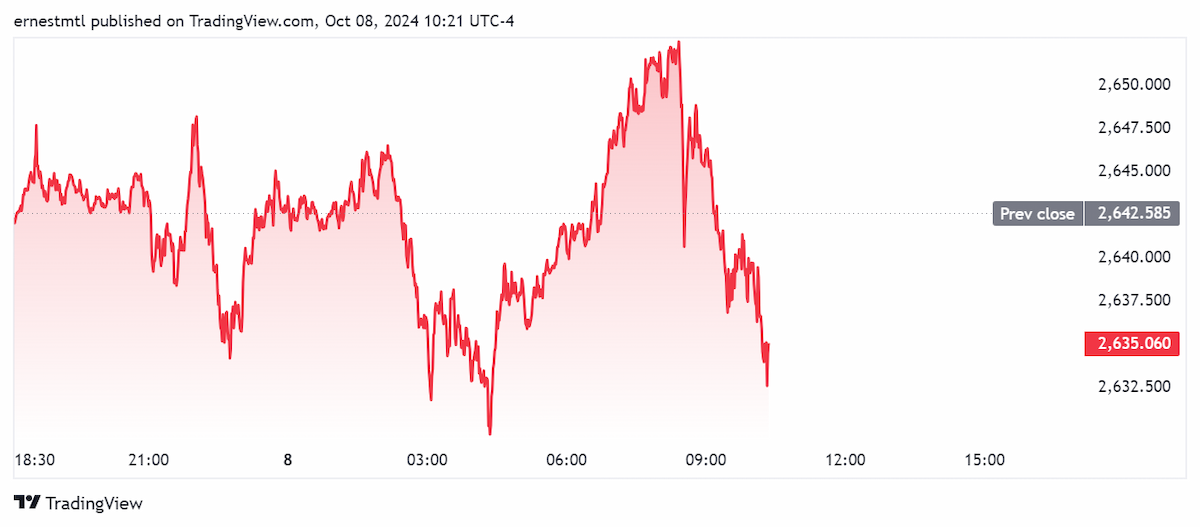
Spot gold last traded at $2,635.06 for a loss of 0.28% on the daily chart.
