

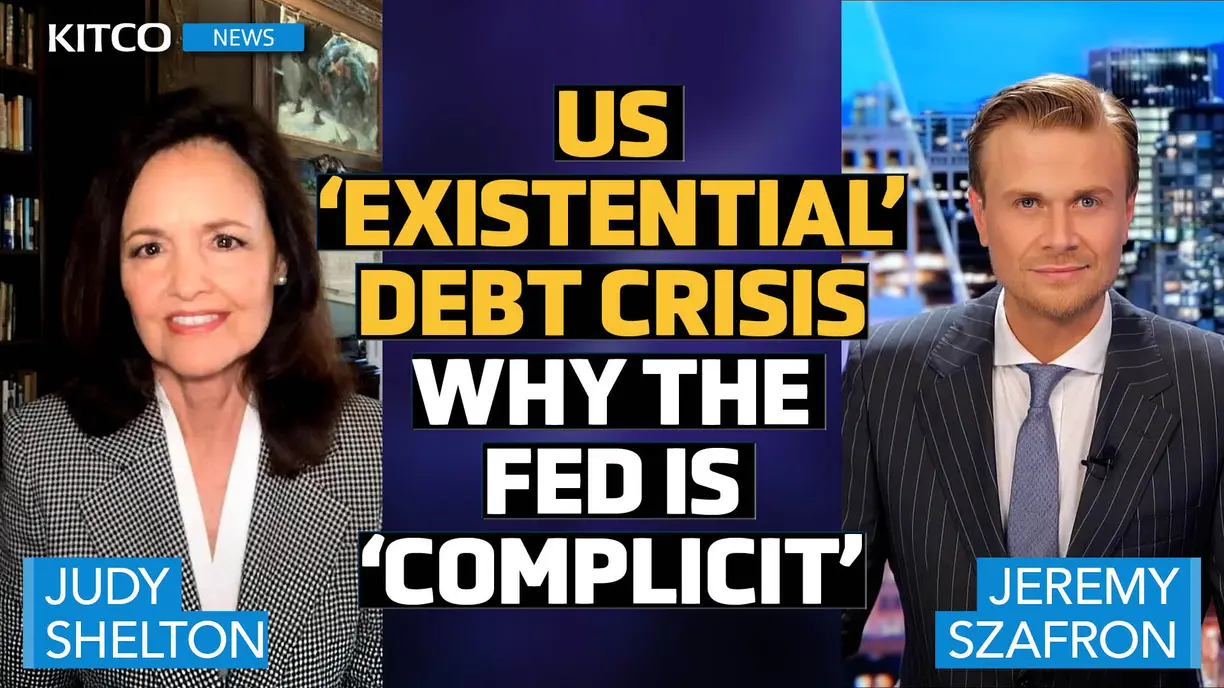
(Kitco News) - With quickly rising debt levels in the U.S., dollar stability and America's economy are facing an "existential threat," warned Dr. Judy Shelton, Senior Fellow at Independent Institute and former economic advisor to President Donald Trump. She added that it is time to get back to sound money, and one historically proven option is linking gold to the U.S. dollar.
The U.S. national debt is fast approaching $36 trillion, and servicing this debt is already costing taxpayers billions of dollars yearly.
"It's come to everyone's attention now that paying the interest on the debt is now costing more taxpayer money … than to pay for our defense needs," Dr. Shelton told Jeremy Szafron, Anchor at Kitco News.
U.S. debt crisis is an 'existential' threat
In her new book, 'Good as Gold: How to Unleash the Power of Sound Money,' Dr. Judy Shelton pointed out that in just over 50 years, U.S. federal debt exploded from $400 billion in August 1971 to around $36 trillion. The exponential curve has also been getting steeper every year.
The latest estimates from the Congressional Budget Office (CBO) make things more dire. The CBO has projected that the ten-year cost of servicing U.S. debt from 2024 to 2033 will be $10.6 trillion, nearly double the original forecast from 2021.
"If you ask someone, do you think the United States will still be here in 50 years? It's troubling that they almost have to think about it. We hear so much about fiscal unsustainability; if we're serious, that's an existential threat," Dr. Shelton said. "I'm not predicting that for the United States, but I'm concerned."
The concern is that the U.S. banking system is becoming a utility that channels credit back to the government to cover an increasing gap in revenues and expenditures.
"The Fed ends up regulating interest rates, controlling them by paying banks, not to make loans to the private sector. This is something that changed after 2008. The Fed was granted an emergency power to pay interest on the reserve balances," Dr. Shelton said.
Why the Fed is complicit in U.S. debt levels, dollar devaluation
The Federal Reserve is at the helm of monetary policy in the U.S., and it has been complicit in all of this by overreaching with its "no-limit" powers, according to Dr. Shelton.
"The Fed has been complicit with deficit spending Congress and White House. We don't want the Fed to make monetary decisions based on what it costs the government to finance its debt. Still, many people are saying our only way out of this is to inflate away the U.S. government debt, which is a disservice to American citizens who don't like to have their purchasing power eroded out from under them," Dr. Shelton noted.
'The Fed has become too prominent, too powerful, and too political'
She added that Congress should look at reforming the Fed, questioning whether the U.S. central bank should have this kind of unlimited power.
"Congress needs to look at whether the Fed should be allowed to have no limits on the amount of government debt it can purchase, no limits on the amount of base money it can create with a keystroke, no limits on the amount of interest payments it can give to commercial banks and money market mutual funds at the expense of taxpayers. The Fed has become too prominent, too powerful, too political," Dr. Shelton told Kitco News.
The U.S. central bank is now in a position to even limit the economic agenda of an incoming president, she pointed out. "The Fed is not the little guy. I'm uncomfortable that the Fed is in such a position to undermine the ability of an elected president to carry out his economic agenda," Dr. Shelton stated.
Why does the dollar need a link back to gold? Classic Gold Standard & Bretton Woods
One of the critical conclusions in her new book, 'As Good as Gold,' is that the world enjoyed far more significant increases in prosperity when there was a link between currencies and gold.
Watch the video above for insights on the classic international gold and Bretton Woods standards.
"We need to initiate serious reforms aimed at recapturing the economic benefits that were earlier achieved – whether that means restoring some of the rules that permitted the Bretton Woods system to function for more than two decades or exploring new proposals for an updated gold standard," Dr. Shelton wrote in her book.
One reason Dr. Shelton looks to gold for answers is that central banks around the world are boosting their gold reserve assets.
"Why gold? Well, it turns out that's what most central banks have: their primary reserve asset. It's interesting that in the 53 years since the United States has had no official link between the dollar and gold, we retain 261 million ounces," she said. "We deserve to have money where value isn't expropriated, the purchasing power isn't deliberately taken away, and the dollar isn't debased as a function of the Fed's framework."
The dollar used to be 'as good as gold'
Dr. Shelton proposes a bold new initiative to restore the U.S. dollar's link to gold after more than half a century of breaking it.
"What we need to do is use the gold holdings as specific collateral for a new treasury instrument – a long-term Treasury Bond," she told Kitco News. "We should have the Treasury issue Treasury Trust Bonds. Those who buy it would have the right at maturity to either take the dollar-denominated face value of that bond or the pre-specified amount of gold. I'm trying to draw attention to the fact that the dollar used to be as good as gold."
The goal is to have a new debt instrument that embodies a commitment to maintain the dollar's value in terms of the purchasing power inherent in a specified weight of gold.
Watch the video above for insights on how the price will be set, the bond's timeframe, and its global impact.
How much gold does the U.S. have, and how is it priced?
Dr. Shelton pointed to using the U.S.'s gold reserves, which are more than 8,100 metric tons, making it the largest gold reserve in the world, to launch these new Treasury Trust Bonds.
However, the way gold is valued needs to be examined more closely, and the place to start is when President Nixon closed the gold window.
"By August of 1971, Paul Volcker, who was the Undersecretary for Monetary Affairs at the Treasury Department at the time under President Nixon, went to Camp David with President Nixon and said, we have to close access to the gold window, or they're going to keep taking away the gold and that the system won't work anymore.” Dr. Shelton described. “So Nixon made his speech, August 15, 1971, on a Sunday that we are temporarily ending this system and building a new international monetary system.”
"We tried to set up a new rate for the next year and a half. It was at $35 per ounce, Volcker thought maybe at $39, then it went to $40. By February of 1973, gold hit $42 an ounce. At that point, through something called the Smithsonian Agreement, the system absolutely ended,” she added. “Today, the Federal Reserve and the Treasury Department carry our gold holdings as an asset, but they value them at a book value of $42.22 per ounce. So with gold at well over $2,700 an ounce, that's quite a windfall profit potentially to be gained between the market value of those gold holdings and how they have been carried for 53 years."
To learn how this gold can be revalued, watch the video above.
This video is brought to you by Goldback --- Inflation-resistant, 24K gold currency.
Learn where to get Goldbacks at https://www.goldback.com/
