

(Kitco News) – After weeks of reports that London’s gold stocks are being withdrawn and moved to the United States, new reports indicate that the unprecedented flows of physical bullion may be a worldwide phenomenon.
“Global bullion banks are flying gold into the United States from trading hubs catering to Asian consumers, including Dubai and Hong Kong, to capitalize on the unusually high premium that U.S. gold futures are enjoying over spot prices,” Reuters reporter Rajendra Jadhav wrote on Monday.
Jadhav said that these bullion banks have traditionally facilitated the flow of gold Eastward to serve China and India, which accounts for nearly half of global gold consumption.
“But alarm about U.S. import tariffs planned by President Donald Trump has driven Comex futures prices substantially above spot prices in recent months, creating a lucrative arbitrage opportunity,” he said.
Reuters spoke with a Singapore-based precious metals dealer at a leading bullion supplying bank. “Gold prices are skyrocketing, and in Asia, demand has pretty much disappeared,” the dealer said. “Meanwhile, a sweet opportunity has popped up in the U.S., and naturally, almost every bank is jumping on it — moving gold over for Comex delivery to cash in on the arbitrage.”
COMEX gold inventories have increased by nearly 80% – or 13.8 million troy ounces – since late November, representing over $38 billion at current prices, with supplies pouring in from London and Switzerland… and now Asian gold hubs.
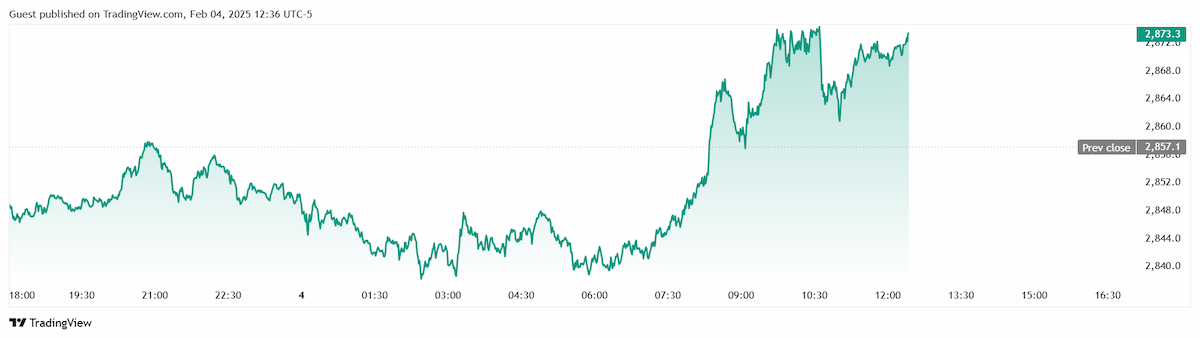
The premium on COMEX futures over spot prices has been widening steadily, hitting around $40 on Monday.
COMEX futures hit a high of $2,874.30 on Tuesday, last trading at $2,873.30 per ounce.
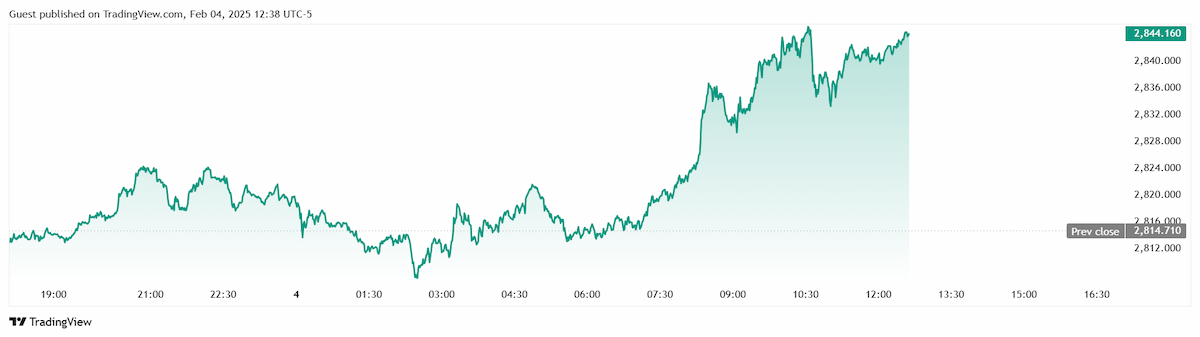
Meanwhile, spot gold hit a high of $2,845.47 on Tuesday, and was also only a dollar off the daily high, last trading at $2,844.14 for a gain of 1.05% on the session.
A Mumbai-based bullion dealer told Reuters that the cost of moving gold from these Asian bullion hubs to the United States is minimal when compared to the sky-high Comex premiums, adding that a “leading bullion bank even moved gold stored in a customs-free zone in India to the U.S. last week.”
While high prices have depressed retail demand in Asia, these bullion banks were going so far as to source gold from refiners in Dubai, which usually serve Indian demand, to now fulfill the burgeoning demand from the U.S., according to a Dubai-based gold dealer.
“The U.S. is like a gold magnet right now, pulling in gold from all over the world,” he said.
Following reports that surging gold shipments to the United States have led to a shortage in London and a massive new stockpile in New York, the London Bullion Market Association (LBMA) announced on Thursday that it was coordinating with CME Group and U.S. authorities to address the significant price premium of COMEX gold compared to the London market price.
“The US gold market has been trading at a premium to the London market since the US presidential election result in late 2024,” the LBMA said. “This happens from time to time in markets around the world.”
The LBMA added that the physical gold stocks and liquidity of the London market remain strong. The CME Group and US Commodity Futures Trading Commission did not immediately respond to a Reuters request for comment.
Last Wednesday, the Financial Times reported that the added demand for gold from the United States has led to a shortage in London. “The wait to withdraw bullion stored in the Bank of England’s vaults has risen from a few days to between four and eight weeks, according to people familiar with the process, as the central bank struggles to keep up with demand,” the report said.
In the weeks since the U.S. election in early November, “gold traders and financial institutions have moved 393 metric tonnes into the vaults of the Comex commodity exchange in New York, driving its inventory levels up nearly 75 per cent to 926 tonnes — the highest level since August 2022.” The FT report cited market participants to pointed out that the real total could be far higher than the Comex numbers, “because there are likely to have been additional shipments to private vaults in New York owned by HSBC and JPMorgan.”
Ross Norman, CEO of Metals Daily, believes the latest bullion panic is overblown. [O]ne might have hoped for better from the Financial Times,” he wrote on Tuesday, and shared a few thoughts as to why.
“Dealers in New York are 'standing for delivery' for physical on futures contracts that are normally either rolled month by month or cash-settled on fears that tariffs will be imposed on gold imports to the US,” Norman conceded. “Yes, about 435 tonnes of gold has moved from London via Switzerland to New York vaults over the last few weeks, which is worth about $82 billion. My first thoughts are – OK, to put that into perspective, that's actually about a couple of average trading days volume or turnover for the London gold market – interesting, but only maybe.”
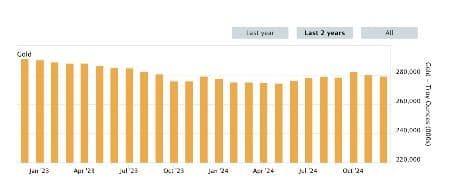
But he said this quantity is hardly the harbinger of a shortage. “London is sitting on about 8710 tonnes of gold according to the latest LBMA vault stats and the drawdown has not exactly moved the dial,” Norman said. “Yes, less than half of this is owned by other central banks, but the majority is ready and available.”
The second reason this may not be the crisis it’s cracked up to be is that this is more a logistical problem than a fundamental change in market demand.
“[F]ine ounces of gold are needed in one location (New York) > which needs to be converted into another form (in Switzerland) > and then shipped across the pond,” he said. “Of course there are limitations on the Swiss refineries melting capacity to convert 400 ounce gold bars into the kilobars, as well as limitations on metal handling. Again… big deal. You've been in a car … temporary log-jams happen.”
“And if 435 tonnes of kilobars are now in New York then surely the problem is as much about surpluses on one side of the Atlantic, as much as so-called 'shortages' on the other,” Norman said. “Taking the 10-year average, the US purchases only about 20 tonnes of physical gold bars each year – so 22 years’ worth of bullion bars have just washed up on their shores.”
“Likely as not, like last time (covid), these bars will simply be flown home to London (via the Swiss refineries where they are converted back into standard 400 oz bars) over the next few months,” he added. “Nice business for some.”
Norman also pointed out that over the last two months alone, “gold miners will have generated about 600 tonnes of fresh new metal… and with premiums on kilobars running high, it follows that much of that production will have been cast into (32 oz) kilobars rather than (400 oz) market bars to satisfy the US demand."
"Yes, the Bank of England may have extended delivery periods just now but there are many other LBMA vaults in London as well as other international locations where metal can flow into the US,” he said.
