
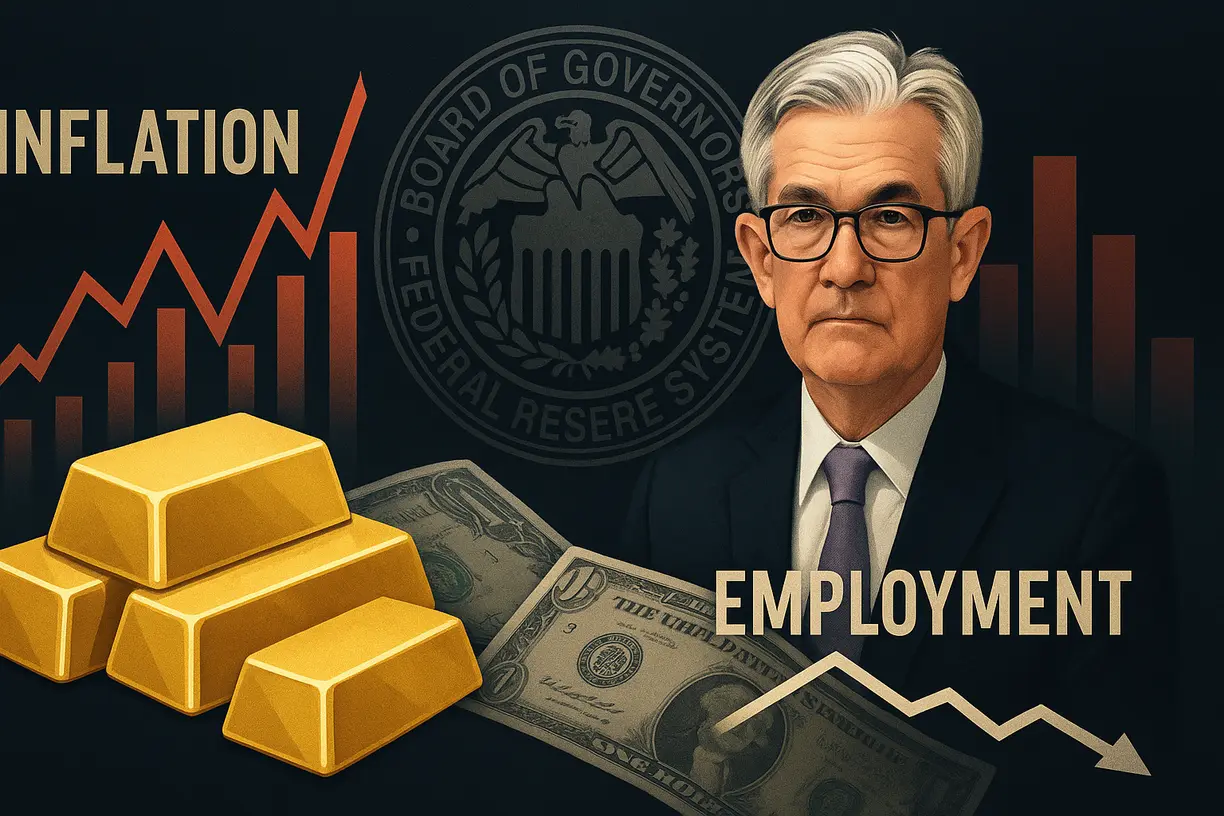
(Kitco News) – This year’s Jackson Hole symposium finds the Fed stuck between a rock and a hard place, with near-intractable problems on both sides of its dual mandate and ongoing challenges to its credibility and its independence, according to Mohamed El-Erian, chief economic adviser of Allianz and president of Queens’ College, Cambridge.
“Jerome Powell will step into the spotlight this Friday at the Jackson Hole gathering of central bankers under unusually challenging circumstances, delivering what is widely expected to be his final address as Federal Reserve chair,” El-Erian wrote in an op-ed for Yahoo News on Thursday. “His best approach would be to focus on broad strategic issues, drawing lessons from his tumultuous tenure and setting the stage for the Fed's periodic review of its Monetary Policy Framework. However, such an approach would go against his usual preference for a tactical, data-dependent stance that, today, risks worsening the challenges facing both himself and the institution he leads.”
El-Erian said the Fed chair faces significant and complex challenges. “For four years, inflation has persistently surpassed the Fed's 2% target, and recent data suggest it might now be rising further,” he said. “At the same time, growing evidence indicates a weakening labor market, directly undermining the second pillar of the Fed’s dual mandate.”
Powell and the Fed also face increasing political pressure from the Trump administration, which risks undermining their independence. “Adding to these issues, his communication style has often been seen as both confused and confusing, which has amplified market volatility rather than contained it,” he added.
“The recent dual Fed governor dissent — the first in over 30 years — shows Powell now leads a clearly divided policy committee,” El-Erian noted. “Additionally, the newly nominated governor, Dr. Stephen Miran, is widely anticipated to be very critical of both the institution's recent actions and Powell's leadership. Above all this, intense speculation about his potential successor casts further doubt on his effectiveness during the remaining time as chair.”
And the divergent market expectations surrounding the central bank’s interest rate path are only exacerbating the instability. “Some investors seek clarification on Powell's interest rate plans for the September FOMC meeting and beyond,” he wrote. “Others are eager to gain insights into the functioning of the labor market, the official theme of this Jackson Hole gathering, hoping for more clarity on structural shifts. Another group eagerly awaits the details of the updated Monetary Policy Framework.”
El-Erian said that all of this adds up to a very difficult path for the Fed to tread.
“To offer real clarity on interest rates, Powell would need to decisively break away from his repeated full reliance on backward-looking data — an approach increasingly questioned by the very data it claims to follow,” he pointed out. “Last week's inflation numbers highlight this ambiguity: Although headline CPI inflation was lower than consensus forecasts, this was offset by significantly higher Producer Price Index (PPI) inflation and the unsettling rise in inflation expectations reported in the University of Michigan’s sentiment survey.”
El-Erian said Powell may also find himself in a challenging position over the other half of the Fed’s mandate: employment.
“His ongoing focus on the headline unemployment rate, which has stayed stable at just over 4%, increasingly seems to rely too much on a single data point that conflicts with several other signs of a weakening labor market,” he wrote. “These signs go beyond the notable surprise of the downward revision to the July jobs report, including companies' decreased hiring appetite, the difficulty recent graduates face in finding jobs, and opportunities that are concentrated in an unusually small number of industries.”
At the same time, “both the supply and demand sides of the labor market could be experiencing major structural changes,” El-Erian said – ones that elude traditional economic models.
“The Trump administration’s crackdown on illegal immigration impacts the number of actual and potential workers,” he noted. “This occurs at a time when there are still significant questions about the long-term effects of artificial intelligence, especially the delicate balance between labor enhancement and displacement.”
“This forms an uncomfortable backdrop for the unveiling of the new monetary policy framework, which is meant to provide the strategic overlay for the central bank’s pursuit of its dual mandate of low inflation and maximum employment,” El-Erian wrote. “Its eagerly awaited unveiling follows the widely perceived failure of the previous iteration, which was essentially "dead on arrival. Having been formulated in a backward-looking way heavily influenced by concerns about the effective lower bound on interest rates and persistent inflation undershooting, it proved to be poorly prepared for the unprecedented structural changes sweeping the global economy since 2020.”
Also, “given the amount and duration of the inflation overshoot, Chair Powell has consistently refused to discuss an issue that some economists believe needs examination: the appropriateness of the current 2% inflation target in today’s structurally changing economy,” he warned.
“All these factors combine to put Powell in a tough spot as he also faces potential legal issues due to budget overruns on the Fed’s building project,” El-Erian noted. “Based on recent behavioral patterns, Powell would likely want to maintain maximum policy flexibility. However, this strategy risks increasing political pressure on the Fed’s independence and intensifying divisions within the FOMC. Conversely, signaling a major rate cut now could lead to the bond market steepening the yield curve in response, much like what happened last year.”
“[A]n already narrowly defined Framework Review is unlikely to gain the strategic attention it desperately needs,” he concluded, “leaving more important long-term policy issues unresolved.”
El-Erian has been among the most prominent and credible voices warning about the impact of dedollarization and the concurrent rise in gold. In the run-up to the March FOMC rate decision, he said that the ongoing gold price rally represents a dire warning for the future position of the U.S. dollar in international markets.
“This should be flashing yellow in Washington here, that if gold continues to go up, regardless of all this, it's broken down all its historical correlations,” he added. “There's something going on about the dollar internationally, and that's something that they have to take really seriously.”
And on June 13, El-Erian warned investors not to rely on U.S. government bonds as safe havens in the midst of geopolitical flare-ups.
“As I've been highlighting recently, don't look to US Treasuries for ‘safe haven’ or ‘flight to quality’ flows,” he wrote in an X post. “Their yields barely budged after the Israeli attack on Iran. Instead, watch gold […] and silver.”
“The flows are happening; they're just not headed to Treasuries as historical experience would suggest,” he added.
