
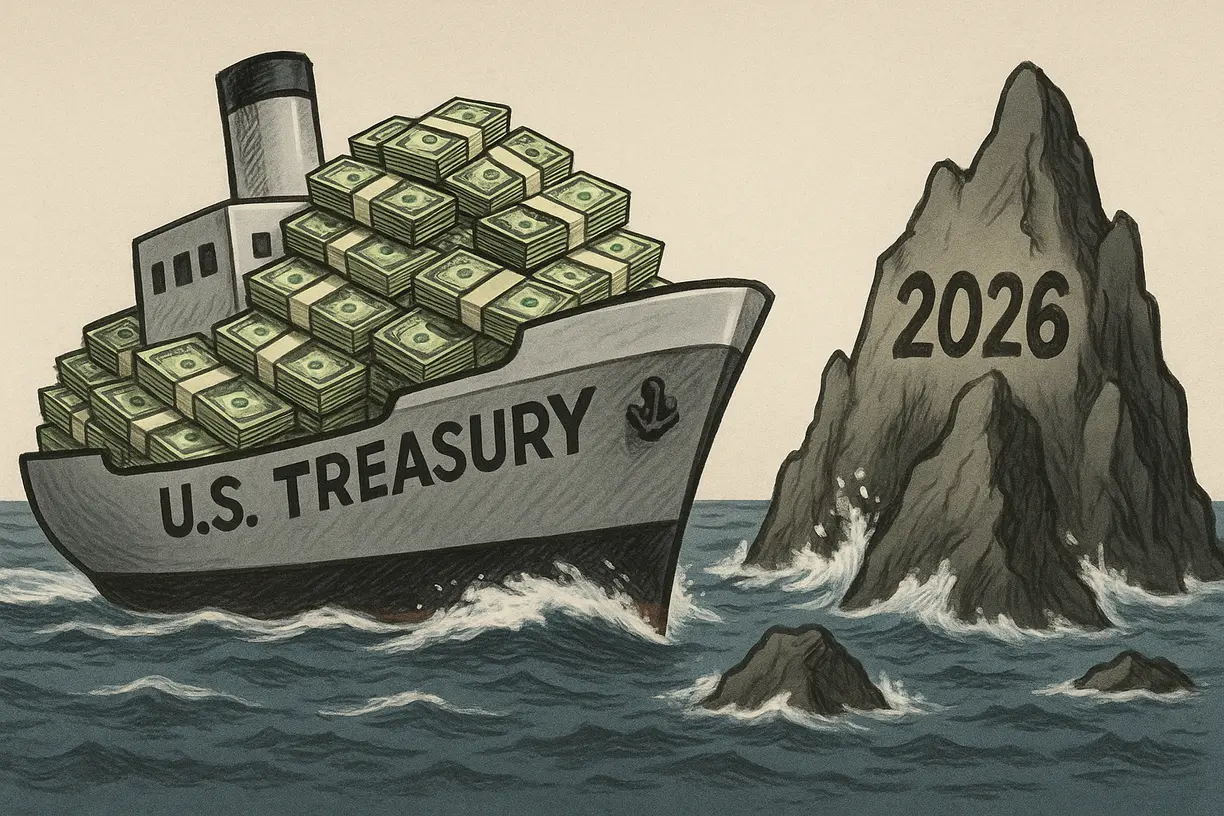
(Kitco News) – Even as the prospect of another government shutdown looms large in the United States, the Treasury department is under less fiscal strain than many experts were predicting just three months ago – though today’s good news could mean big challenges next year, according to Adrian Day, president of Adrian Day Asset Management.
On Tuesday, the country drew closer to a possible Federal government shutdown on Oct. 1 after President Donald Trump refused Democrats’ preconditions ahead of a meeting to head off the budgetary crisis.
“After reviewing the details of the unserious and ridiculous demands being made by the Minority Radical Left Democrats in return for their Votes to keep our thriving Country open, I have decided that no meeting with their Congressional Leaders could possibly be productive,” Trump wrote in a post to his Truth Social platform.
Day has been closely following the Treasury’s budgetary challenges this year. In an interview with Kitco News the day after last week’s Federal Reserve rate decision, he shared his assessment of the U.S. government’s fiscal position – which has received an unexpected boost from tax revenues.
“September 15th is a big date for taxes, and I saw the taxes came in much higher than expected, meaning that the TGA, the treasury general account, is already replenished,” he said. “Higher than expected tax receipts mean the Treasury is not under quite so much urgency.”
Day explained that while the deadline to pay taxes without penalties is in April, many Americans – and particularly those with significant investments – don’t have clarity on their annual income until the dust settles on corporate earnings, which can take several more months.
“What you pay in April is still an estimate of what you think your tax is going to be, and then the taxes are actually due in October,” he said. “You get a lot of corporate taxes paid on September 15th. And with the corporate taxes being filed, for a lot of people, that now means you have clarity on your individual taxes.”
He warned, however, that the reason why this year's tax receipts are so high could prove problematic for next year – with the midterm elections coming soon after the October corporate tax deadline.
“In general, a stronger economy means stronger taxes,” he said. “But increasingly, a lot depends on the stock market. Are people selling because they're worried about the stock market next year?”
Day said if investors are worried that the stock market may be topping now, and their portfolios may be worth significantly less next year, they would choose to sell their equity holdings and pay the capital gains on them, rather than watch the values decline over the coming months.
“I’m not sure that's the case right now, but certainly if the stock market started to sell off, and the narrative shifted towards the market having a big downturn, you would get more people inclined to lock in their games this year, which means paying taxes rather than not selling.”
Things are less clear on the political front, where Day said he’s not sure about the GOP’s claims that they have enough congressional support to pass a placeholder budget bill.
“I don't know that Republicans have got the votes for a continuing resolution,” he said. “I'm not sure if [Speaker Johnson] does or not, but he may.”
Day said Republicans are also attempting something they normally don't do: Making the Democrats appear responsible for the shutdown if the budget resolution doesn’t pass.
“I think in the past, it's fair to say that in these government shutdowns, the Republicans have always seemed like the ones that fall,” he said. “That goes back for years. But they're trying to shift the narrative, and I think doing a reasonably good job.”
Another key area to watch is, of course, the market itself: The bond yields, the Treasury auctions, and the overall temperature of U.S. sovereign debt.
“There are now more players who are not participating, or who are not participating to the extent that they have in the past,” Day said. “It's not just foreign central banks now, and it's not just regional banks – the big money-center banks and investment dealers, even though they had a bit of a carrot and stick with the lowering of the reserve requirement, which was expected to get more of the big money-center banks to buy more – most of the buying is really coming from people with long-dated liabilities like pension funds and insurance companies.”
“They'll always be there, because they have to,” he said. “And it's also coming from hedge funds – they're not long-term holders, of course, but hedge funds looking for lower interest rates.”
But Day said this still raises an important question: “If the Fed cuts rates, do we get a more inverted yield curve? Do we get higher rates at the long end, which will bring in more buyers? Or do we get cuts across the board?”
“I suspect it’s more of the former, because a cut in the Fed funds rate doesn't necessarily follow through for long-dated interest rates – that's always been the case – it only influences long-dated interest rates,” he said. “But also, frankly, because I think to attract buyers other than the insurance companies and pension funds that just have to buy 30-year dated assets because they have 30-year liabilities, even hedge funds want to start from a higher position to give them a better chance of a profit if they think rates are coming down. So I still suspect we're going to see a yield curve sharpening.”
Day said that the emergency that market participants were fearing at the beginning of the summer – a full year of Treasury issuance crammed into less than six months, with U.S. debt already looking less attractive than in previous full years – has become less dire. Also, if the jobs market deteriorates further, this could actually stimulate demand at the long end.
“I think one of the biggest factors will be if we see a sharp continuing deterioration in the labor market, which I don't think is out of the question – if not this month, next month, or the month after,” he said. “A deterioration in the labor market would obviously affect the Treasury because that would lead to sharper interest rate cuts. But that would be positive, because it would bring in buyers, if only hedge funds, but it would bring in buyers looking to lock in rates for a longer period.”
But even if these near-term positive (and negative) developments serve to ease some of the near-term pressure on the Treasury market, Day said the long-term trend doesn’t look good – and he doesn’t expect many of the traditional buyers of U.S. sovereign debt to return anytime soon.
“Let's just say I'm not expecting foreign central banks, including Japan, China, and Russia, to pivot and become big buyers of Treasuries,” he said. “I'm not expecting a surge in foreign buying. I'm not expecting a surge in bank buying, unless there are changes in the rules that – carrot or stick, either one – encourage banks to buy more. I'm not expecting that.”
