
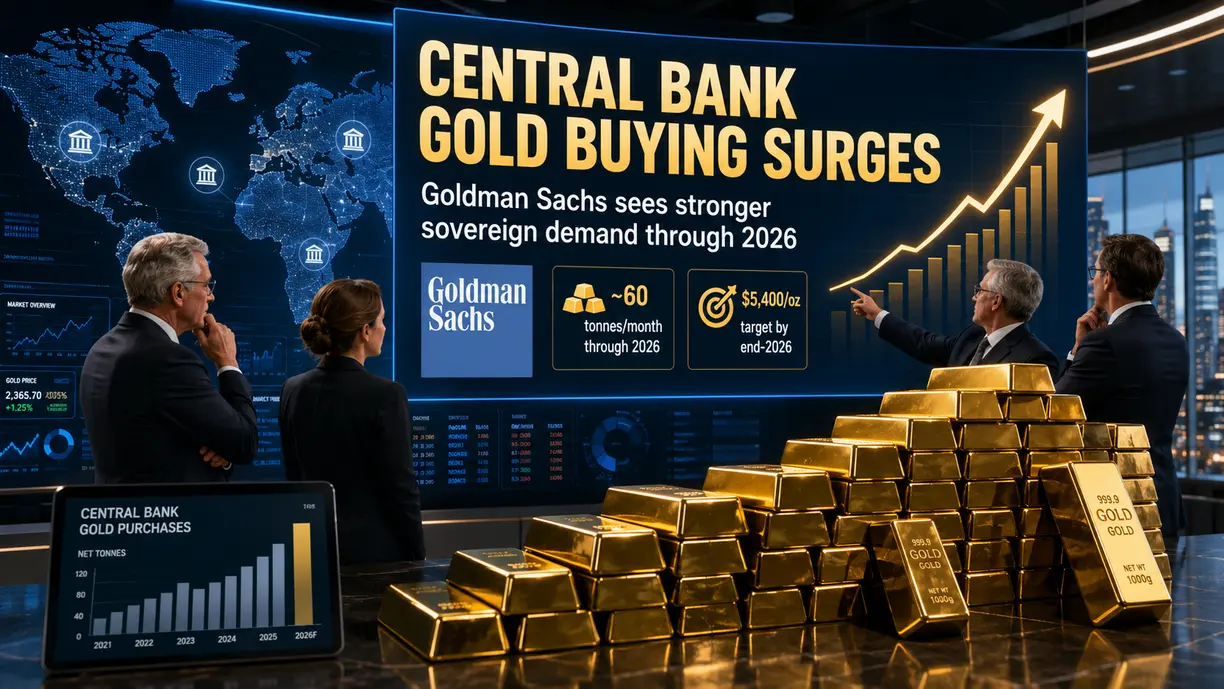
(Kitco News) – Central bank gold purchases have come in stronger than previous estimates so far in 2026, and updated projections have sovereign demand rising further in the second half of the year, according to commodity strategists at Goldman Sachs.
Goldman Sachs analysts announced on Friday that they have revised their central bank gold demand model to account for gaps in official trade data.
Back in March, the investment bank raised its nowcast of central bank purchases to about 50 tonnes per month on a 12-month moving average basis, up from 29 tonnes under its earlier methodology.
The bank now expects central banks to average around 60 tonnes per month through 2026, supported by continued diversification demand amid geopolitical uncertainty.
Goldman analysts said their previous estimates had underestimated sovereign demand since August 2025, when UK trade data began failing to fully capture gold outflows from London vaults, resulting in unrecorded sovereign buying.
"Strong underlying interest in gold remains evident," Goldman said, citing its own central bank survey along with recent geopolitical developments as factors likely to support increased demand from both governments and private investors over time.
Goldman Sachs reiterated its $5,400 per ounce gold price target for year-end 2026, but warned that bullion prices could still face near-term pressure if investors are compelled to sell liquid assets to raise cash during market stress.
Back in late January, as gold prices were setting fresh all-time highs above $5,000 per ounce, Goldman Sachs raised its December 2026 price target to $5,400 an ounce.
At the time, Goldman analysts led by Daan Struyven and Lina Thomas wrote in a note that the upgraded forecast is based on their belief that private investors who bought gold as a hedge against macro policy risks will hold these positions through the end of the year.
The analysts said that, unlike previous hedges which were tied to specific events – such as the November 2024 US election – gold positions taken to protect against risks such as fiscal sustainability are unlikely to be fully resolved this year and are therefore “stickier.”
Emerging market central banks are “likely to continue the structural diversification of their reserves into gold,” the analysts said.
The debasement trade is also prompting physical bullion purchases by high-net-worth families and investor call-option buying amid mounting concerns over the long-term monetary and fiscal policy trajectories in major economies, they noted.
Risks to the updated forecast are “significantly skewed to the upside because private-sector investors may diversify further on lingering global policy uncertainty,” the analysts wrote. “That said, a sharp reduction in perceived risks around the long-run path for global fiscal/monetary policy would pose downside risk if it were to cause liquidation of macro policy hedges.”
The diversification trend was already very much on Goldman’s radar heading into this year. In their 2026 Commodities Outlook published in late December, the investment bank wrote that gold is the best bet in the entire commodities complex, adding that if private investors join central banks in their diversification, the price could well exceed their base case – though they also advocated diversification across the commodities complex as well.
“Even as gold remains our single favorite long commodity, we see a strong role for broader commodity length in strategic portfolio allocations,” they wrote. “The very high geographic concentration of commodity supply and the increasing geopolitical, trade, and AI competition has led to a more frequent use of commodity dominance as leverage. This raises the risk of supply disruptions, which underscores the insurance value of commodities.”
“Equity-bond portfolios are not well-diversified when commodity supply losses drive both weaker growth and higher inflation as well as strong commodity returns,” the analysts warned.
