
(Kitco News) – The minutes from the June 16-17 Federal Open Market Committee (FOMC) meeting showed members united on monetary policy and changes to the Fed’s post-meeting communications but concerned about the economic impacts of the Iran war, tariffs, and the AI buildout, with the majority still seeing upside risks to inflation.
In the staff review of the financial situation, they noted that the information available at the time of the meeting “indicated that inflation remained elevated and had moved higher, partly reflecting the effects of energy and other supply shocks,” while “labor market conditions remained stable, and real gross domestic product (GDP) continued to expand at a solid pace.”
The staff noted that economic growth abroad slowed in Q1 of 2026, with weakness seen in Canada, the euro area, and Mexico. “By contrast, output growth in several high-income Asian economies remained robust, as their exports of high-tech goods continued to surge, driven by the AI buildout,” they wrote. “Recent indicators suggested that the conflict in the Middle East was weighing on foreign economic activity because of higher energy costs and weaker consumer and business confidence, particularly in lower-income Asian economies and in Europe.”
The staff also noted that foreign headline inflation “had increased significantly since the start of the conflict in the Middle East, with a sharp rise in retail energy and producer prices across Europe and much of Asia.”
On inflation expectations, the staff noted that “optimism around the Iran conflict pushed market-based measures of expected inflation significantly lower over the period, leaving near-term inflation expectations only moderately higher than they were before the onset of the conflict.”
“Longer-term inflation expectations remained well anchored near the Committee's 2 percent longer-run inflation objective,” they added.
On monetary policy expectations, the minutes said that while market participants “generally expected no change in the target range of the federal funds rate at the June FOMC meeting,” they noted that “market- and survey-based measures of expected policy rates moved higher” over the intermeeting period. “Market pricing suggested that one rate hike was priced for mid-2027, but the manager noted that these measures were likely boosted, in part, by term premiums,” they said.
Turning to the economic outlook, Fed staff noted that their inflation forecast for 2026 and 2027 “was higher than the one prepared for the April meeting, reflecting incoming data, higher energy prices and other input costs due to the conflict in the Middle East, and the effects of the AI buildout on consumer prices.”
“Total inflation was projected to slow over the second half of this year from its recent pace, as retail gasoline prices were expected to decline, although core inflation was forecast to change little over the rest of the year,” they wrote. “Inflation was projected to step down next year, as some of the factors lifting inflation this year—such as tariffs—were expected to wane, and then move down further to about 2 percent in 2028.”
The staff's outlook for real GDP growth was slightly lower than the one prepared for the previous meeting. “Real GDP was forecast to expand at about the same pace as potential this year and to slightly outpace potential over the next two years, buttressed by persistently strong productivity growth, continued gains in AI-related capital spending, and supportive financial conditions,” they said. “The unemployment rate was expected to remain close to the staff's estimate of its longer-run rate this year and next before edging slightly below it in 2028.”
Fed staff continued to view the uncertainty around their forecast as elevated, mainly due to the conflict in the Middle East and the potential economic effects of AI investment and adoption. “On balance, risks to the forecasts for employment and real GDP growth were seen as tilted somewhat to the downside,” they wrote. “Risks to the inflation projection were seen as more skewed to the upside. With inflation having run significantly above 2 percent over the past five years and in light of some emergent price pressures that appeared unrelated to tariffs or energy prices, the staff continued to view the possibility that inflation would be more persistent than projected as a salient risk.”
Turning to FOMC members’ deliberations, the minutes noted that participants observed that “inflation had increased further and remained well above the Committee's 2 percent longer-run objective, with both core and total inflation moving higher, which they attributed to “the lingering effects of tariffs, supply chain disruptions related to the closure of the Strait of Hormuz, and strength in demand for some goods and services stemming from robust AI-related investment.”
“Several participants commented that price pressures had become more broad based, with a large share of goods and services—including transportation, airfares, petrochemical products, and agricultural inputs—experiencing substantial increases,” the minutes noted. “Several participants remarked that services price inflation excluding housing had declined little and remained high.”
The majority of participants were recorded as saying that “most measures of medium- and longer-term inflation expectations remained at levels consistent with the Committee's 2 percent objective,” and they anticipated that inflation “would remain elevated in the near term and then begin to decline as the effects of tariffs and energy price increases wane and other supply disruptions related to the closure of the Strait of Hormuz diminish. Participants judged that the risks to the inflation outlook were still tilted to the upside.”
Regarding the labor market, participants observed that payroll employment gains “had strengthened this year and appeared roughly consistent with underlying labor force growth,” with several participants saying that “labor market indicators, such as job openings, initial unemployment insurance claims, and layoffs had remained stable in recent months and that such data pointed to a balanced labor market.”
“Several participants noted, however, that declines in the job-finding rate and certain survey measures of job availability reflected a labor market with relatively low dynamism.”
In their consideration of monetary policy, the minutes noted that “all participants supported maintaining the current target range for the federal funds rate.”
“Participants generally assessed that information received over the intermeeting period suggested that upside risks to price stability remained elevated while downside risks to achieving maximum employment had moderated a bit,” the minutes stated. “A few participants commented that, in light of these developments, there was a case for raising the target range for the federal funds rate, but those participants indicated that they supported maintaining the current target range at this meeting. Several participants remarked that they did not see the current policy stance as restrictive, while a few other participants commented that they saw the current policy stance as slightly restrictive.”
Regarding the outlook for monetary policy, while acknowledging “high assessed uncertainty,” FOMC members “discussed a range of scenarios for the evolution of the economy and for future monetary policy actions.”
“Most participants remarked on scenarios in which inflationary pressures would dissipate and inflation would soon begin to return to 2 percent,” the minutes said. “In such scenarios, almost all of these participants noted that it would likely be appropriate to maintain or eventually lower the target range for the federal funds rate. Most participants, however, also pointed to scenarios in which, in the context of stable labor market conditions, inflation would remain elevated due to strong AI-related demand, the conflict in the Middle East, or the effects of tariffs. In such scenarios, almost all of these participants indicated that some policy firming would likely be warranted to return inflation to 2 percent.”
“Regarding participants' individual assessments of appropriate monetary policy under what each participant judged to be the most likely scenario for the economy, many participants indicated that the appropriate level of the federal funds rate would be within or slightly below the current target range at the end of this year,” they stated. “Many other participants, however, assessed that the appropriate level of the federal funds rate would be above the current target range at the end of this year.”
Members also discussed the significant overhaul of the post-meeting statement. “A majority of participants remarked that they saw advantages in shortening the statement,” the minutes said. “Most participants emphasized that they preferred not to repeat the language in the previous postmeeting statement that had suggested an easing bias regarding the likely direction of the Committee's future interest rate decisions.”
Gold prices saw little reaction to the 2 pm Eastern release as they continued to trade in a narrow $10 range.
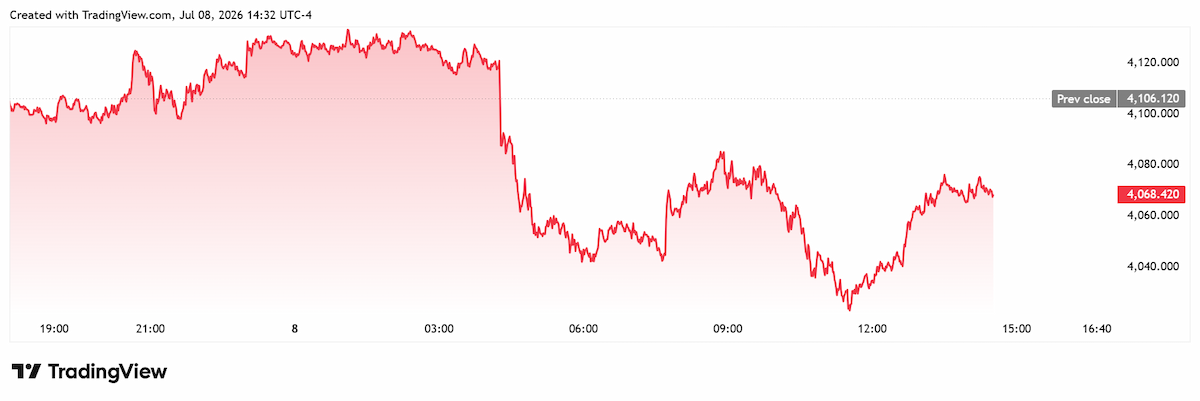
Spot gold last traded at $4,068.44 for a loss of 0.92% on the session.
Jeffrey Roach, Chief Economist for LPL Financial, told Kitco News that the minutes suggest the FOMC had a 'good family fight' over the various scenarios under review.
"There’s some ambiguity in the minutes, suggesting several competing views on policy," he said. "One thing is certain: future policy is heavily contingent on the political situation in the Middle East."
"If we can tease out any forward guidance from the minutes, it would be the committee is working through a wide range of scenarios and will not commit to a specific scenario until the incoming data provides necessary clarity," Roach added. "I don’t expect the committee to alter policy at the next meeting."
