
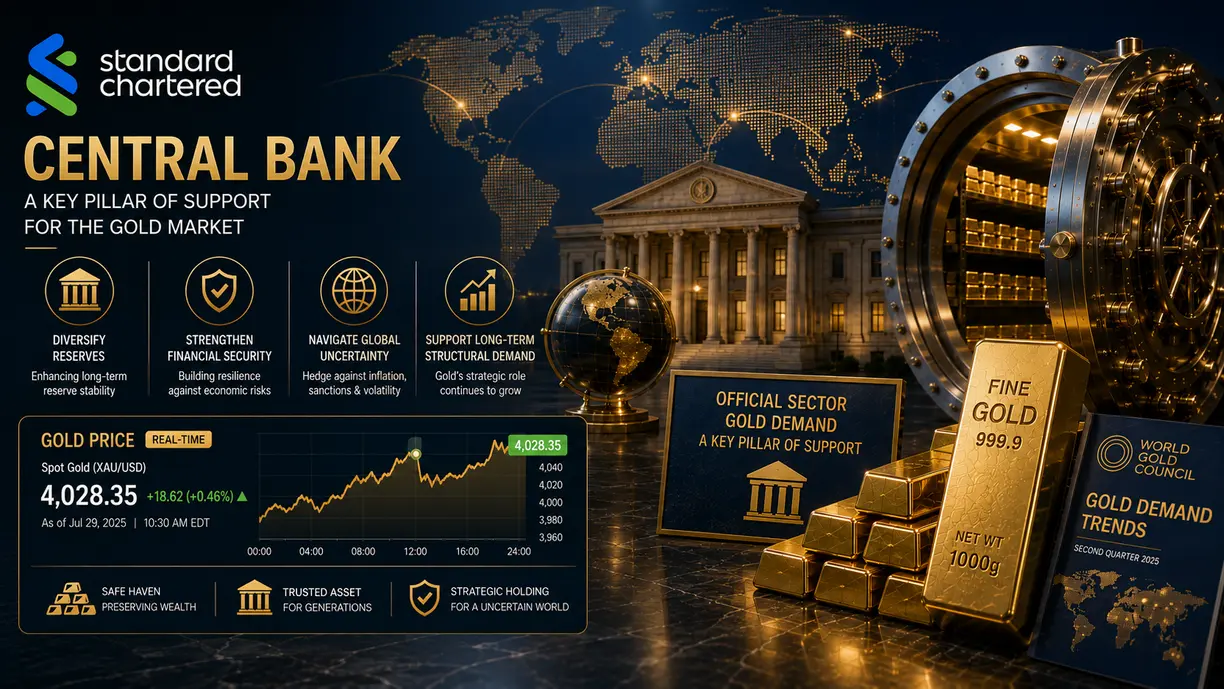
(Kitco News) - Central bank gold demand remains a key pillar of support for the market as prices continue to hold critical support at $4,000 an ounce, and although official-sector demand has become more of a two-way trade as nations deal with inflation and a global energy crisis, one analyst said this scenario supports healthy long-term demand.
Focus on official-sector gold demand has been renewed in recent days following the World Gold Council’s second-quarter Gold Demand Trends report.
The report showed that central banks purchased a net 289 tonnes of gold during the second quarter, a sharp rebound from the revised first-quarter total of just 56.5 tonnes.
The World Gold Council also revealed that its estimate for first-quarter official-sector buying had been significantly reduced from its previously reported figure of 244 tonnes after reassessing unreported over-the-counter purchases.
Despite the sizeable revision, analysts at Standard Chartered said the updated data should not be viewed as a negative for the longer-term outlook.
"The key takeaway is that central bank buying rebounded quarter-on-quarter in Q2 2026 to the highest level since the first quarter of 2024," wrote Suki Cooper, Global Head of Commodities Research at Standard Chartered.
"We have noted that the growing two-way flow — central bank selling and higher mine output — is much healthier for the longer-term gold price trend than the surge in retail demand," she added.
Cooper noted that while the lower first-quarter estimate trims the bank's full-year official-sector demand forecast by just over 100 tonnes, the revision better aligns with what market participants had already been expecting.
"Official-sector demand has cushioned the gold price since the third quarter of 2022, but the lower estimate also partly explains the reassertion of some macro correlations," she said. "The rebound in official-sector demand bodes well, particularly as it partly offsets ETF outflows and weaker jewellery consumption."
The World Gold Council's latest report showed that central banks once again emerged as one of the largest sources of gold demand during the quarter, outpacing global jewellery consumption. Jewellery demand fell 17% year-over-year to 278 tonnes, its weakest quarterly level since the pandemic, while official-sector purchases climbed 62% from the same period last year.
Cooper reiterated her view that central banks continue to treat price weakness as an opportunity rather than a reason to reduce exposure.
"The recent uptick in reported buying, coupled with recent central bank surveys, suggests price dips are still likely to be viewed as buying opportunities," Cooper said. "Reserve managers continue to see gold as a long-term diversifier rather than a short-term trade."
While central bank demand remains a bullish factor for gold, Cooper noted that investment demand is expected to continue struggling as real yields remain elevated.
“Gold’s focus has shifted to near-term macro hurdles, with the three-month rolling correlation with five-year real yields deepening to -39%, and to -47% with nominal five-year yields. Similarly, gold’s correlation with the USD remains significant at -55%, while its correlation with oil is at -29%,” she said.
She added that speculative positioning also continues to favor lower prices.
“One-month risk reversals remain firmly in favour of puts but have edged higher as prices have stabilised around the USD 4,000/oz milestone,” she said. “Short interest in the largest gold ETP rose 16% in the first two weeks of July but was below mid-June levels. The uptick suggests cautious gold positioning without a clear direction.”
