
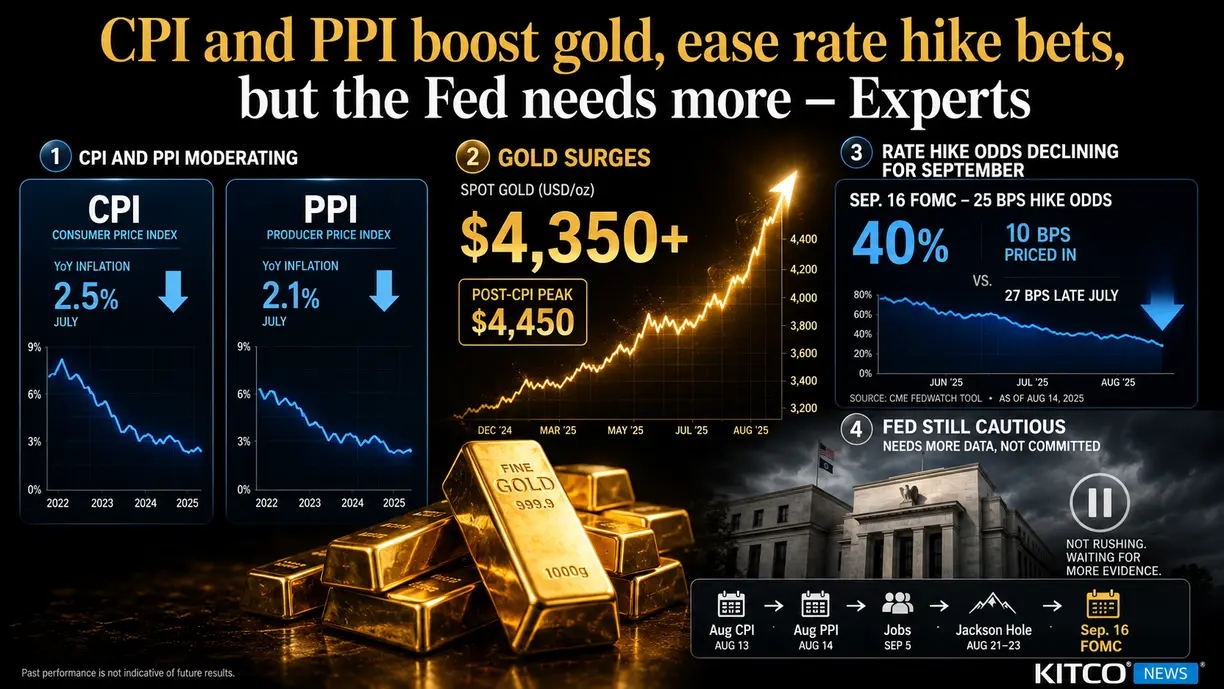
(Kitco News) – Gold prices got a boost from a reassuringly in-line CPI report on Wednesday, and while Thursday morning’s equally benign PPI print didn’t push prices higher, the yellow metal has successfully broken out of its recent range and is holding above $4,350 on Thursday afternoon, exactly $100 below its post-CPI peak.
But while many commentators are quick to declare victory over inflation after two months of positive data, industry experts believe the Federal Reserve’s view will be more nuanced and more cautious – and rate cuts may still be on the horizon.
Scott Anderson, Chief U.S. Economist at BMO, said the CPI report painted a tamer picture of consumer price pressures for a second month in a row, but believes the Fed will want to remain in wait-and-see mode.
“While not definitive, the report should further ease the Fed’s fears about an energy-driven inflation spiral,” he said. “Most major price components revealed visible cooling compared to the first three months of the war.”
“The cool down in consumer inflation over the last two months, along with the weaker than expected payroll report for July, should give the FOMC some more breathing space to maintain the current policy rate at the September policy meeting, though we will get one more CPI report for August before the Fed has to make its decision,” he said. “The Fed will need to see more evidence in future inflation reports that core services inflation is truly moderating before they take their rate hike threat completely off the table.”
Diane Swonk, Chief Economist at KPMG, said July’s CPI report delivered a sideways headline reading, but not a decisive turn lower in inflation.
“Gasoline will likely add more noise in August, while food prices are being restrained by discounting rather than broad-based relief,” she said. “That distinction matters. Inflation is cooling at the headline level, but the consumer is still absorbing the aftershocks of the price surge while the shocks keep coming.”
Swonk said that while supply side inflation was supposed to be a one-time event, it has become a constant. “That is eroding the Fed’s inflation-fighting credibility,” she warned. “Service sector inflation remains elevated, which will only harden the resolve of hawks within the Fed.”
“We are essentially back where we were at the start of the year, before the war, when their concern about the persistence of inflation intensified, while inflation is likely to get hotter in August,” she said. “The September meeting is still live. We still expect rate hikes by year-end, but the timing is tricky due to deep divisions within the Fed.”
Daniel Hynes, Senior Commodity Strategist at ANZ, said after the CPI report that the inflation data cooled rate hike bets and boosted the attractiveness of gold.
“The data mean the Fed is likely to remain on hold at its next meeting, leaving the market pricing only a 40% chance of an interest rate hike,” he noted. “This continues the steady stream of data that have tempered expectations of monetary tightening and should provide further support for gold in the coming months.”
“Investors have been steadily increasing their exposure in recent weeks,” Hynes added. “Gold backed exchange traded funds saw USD3bn of inflows in July, snapping two straight months of outflows.”
Derek Holt, Head of Capital Markets Economics at Scotiabank, said CPI came and went with little market fanfare, but it served to further weaken the overly pessimistic market expectations of Fed rate hikes.
“Pricing for the September FOMC meeting slipped and now sits at just 10bps, down sharply from a peak of 27bps toward the end of July,” he wrote. “It’s pretty clear to date that markets have been overly aggressive in pricing nearer term hikes as July’s 8bps of tightening was countered by a hold and September keeps getting reduced.”
Holt noted that 2-year Treasury yield has fallen by around 15bps to 4.18% since late July as bonds have become increasingly attractive. “Perhaps this illustrates the point that Chair Warsh shouldn’t outsource monetary policy to markets which has merely upped volatility,” he said. “Just like 2023 with SVB, or the post-GFC period when markets wrongly thought inflation would rip higher.”
James Knightley, ING’s Chief International Economist in New York, said the details of the CPI report were supportive of a continued Fed pause, but warned that there’s plenty of data still to come ahead of the September meeting.
“In terms of 3M annualised core inflation, we are now down to just 1.6%, which, after the poor jobs report last Friday, should leave the Fed hawks less confident on the need for a rate hike, but we do have another job and inflation print plus the annual Jackson Hole symposium before the next FOMC meeting on 16 September,” he said.
Knightley offered four reasons why ING expects inflation to continue cooling into 2027.
First, gas prices are still above where they would be expected to be relative to oil. “Gasoline can continue to contribute to lower headline inflation,” he said. “[I]f we get a deal to reopen the Strait of Hormuz and flow resumes, we should see margins compress, which will deliver lower gasoline costs.”
Secondly, housing – the heaviest weighted component in CPI at 35% - is seeing price growth show and rents are actually dropping.
“[H]ome prices are barely rising 1% and rents are now falling outright in a growing number of states, according to data from Zillow and Realtor.com,” Knightley wrote. “We expect this dominant component to exert steady downward pressure on overall inflation over the next 12 months.”
Thirdly, the labor market has worked through its post-COVID distortions. “We’ve gone from a situation where, in 2022, there were two job vacancies for every unemployed American to being in balance today,” he said. “Private wage growth, according to the Employment Cost index, is rising just 3.1% YoY, the same as average hourly earnings. That is fully consistent with 2% consumer price inflation.”
The fourth reason is the moderation of the Trump administration’s trade tariff policies. “Now that we've arguably entered a less onerous tariff regime that includes lots of exemptions, we’re increasingly confident that their upward influence on inflation will rapidly fade,” he said. “Federal budget data show the International Emergency Economic Powers Act (IEEPA) 'Liberation Day' tariffs, that were struck down by the Supreme Court, are now being repaid to corporate America… This boost to corporate cash flow should mitigate cost pressures elsewhere and therefore maintain the disinflationary trend.”
Knightley acknowledged that Fed has failed to reach its inflation target for the past five years. “Nonetheless, progress does appear to be being made and consumer inflation expectations are within tolerable ranges, suggesting little risk of second-round price effects from the energy spike,” he said. “Meanwhile, market inflation expectations are benign, with 10Y break-even inflation rates in line with their 25-year average.”
“The market is still pricing a rate hike from the Fed, but we see the more likely course of action is for the Fed to hold rates steady for a prolonged period, well into 2027.”
And Bill Adams, Chief U.S. Economist at Fifth Third Commercial Bank, said that while headline PPI was cooler than expected, the details of Core PPI have upward implications for July core PCE.
“Portfolio management services jumped 6.5% on the month in the PPI report and are up 22.5% on the year,” he said. “Portfolio management prices’ big July increase will add to core PCE inflation in the next release. But that upward contribution will be revised down on September 30, when the BEA makes annual revisions that make the calculation less sensitive to the level of the stock market.”
“For the Fed, the PPI report doesn’t change the big picture on inflation: It’s too high, but core inflation is lower than the headline, and the picture for both improved in July,” Adams wrote. “The July CPI and PPI reports keep a narrow path open for the Fed to hold rates steady at the September decision. The August CPI and PPI reports will come out before that decision, so today’s data aren’t the final word.”
