
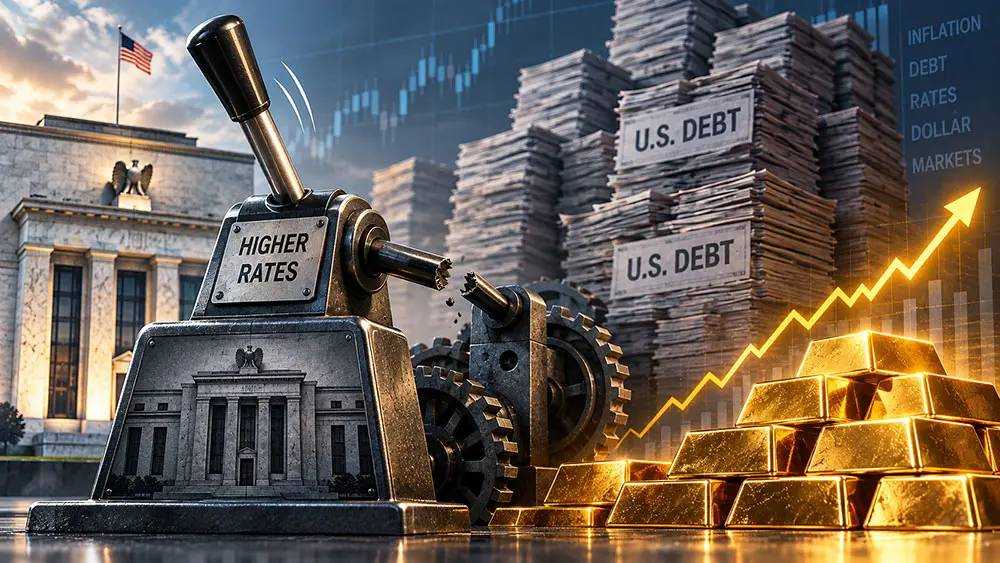
(Kitco News) - Gold investors may have to endure more volatility as markets continue to wrestle with stubborn inflation and the prospect of higher interest rates, but one fund manager says the market is focused on the wrong question.
In an interview with Kitco News, Eric Strand, Founder of AuAg Funds, said it is only a matter of time before gold resumes its long-term uptrend as investors recognize that higher interest rates will do little to address the forces actually driving inflation.
Strand said markets have positioned themselves for higher interest rates, which has supported the U.S. dollar and created headwinds for gold. However, he argued that investors are simply reacting to elevated inflation without looking closely enough at what is causing prices to rise.
Strand explained that higher commodity and input costs are driving inflation rather than excessive consumer demand.
“Raising rates in a cost-push inflation doesn't have any effect. It doesn't take inflation down,” he said. “It's not like consumers are buying too much [and] you want to cool it down. You're just putting another cost on top of everything else.”
Although gold has struggled as investors price in the possibility of tighter monetary policy, Strand said bearish positioning could ultimately provide the fuel for the precious metal’s next move higher.
Strand said his strategy amid the volatility remains relatively simple: wait for the market to recognize its mistake.
“We just wait,” he said. “Wait it out and prices will come back.”
At the same time, Strand said he remains skeptical that the Federal Reserve will be able to follow through on its hawkish rhetoric. He described the central bank's stance as essentially “all talk, no action,” arguing that policymakers have little choice but to project inflation-fighting credibility even if economic and fiscal conditions ultimately prevent them from meaningfully tightening monetary policy.
The bigger problem, according to Strand, is the U.S. government's mounting debt burden.
With federal debt surpassing $40 trillion, Strand said the government increasingly needs lower long-term borrowing costs simply to keep debt-servicing expenses manageable. That dynamic, he argued, will eventually overwhelm the Federal Reserve's inflation-fighting rhetoric.
“They need lower rates on this long rate,” he said. “For me, it's very obvious that they will need to do QE, or whatever they will call it.”
Strand said the government's broader objective of growing its way out of its debt problem is also fundamentally inconsistent with substantially tighter monetary policy.
“If you want to grow the economy, you cannot raise rates and make people not consume. You have to really have the pedal to the metal,” he said.
Strand added that inflation itself could ultimately become part of the solution to the debt problem because rising nominal economic activity reduces the real value of existing liabilities.
“They will have to give up,” he said. “Inflation helps them to get rid of the debt.”
Strand expects the Federal Reserve to resist that reality for as long as possible, but he said policymakers will ultimately be forced to follow the Treasury's lead as the government seeks to contain long-term borrowing costs.
“The Fed will wait. They will wait until they must,” he said.
Strand's comments come as investors increasingly focus on the long end of the Treasury market, where elevated yields have complicated the government's efforts to finance persistent deficits.
He argued that deteriorating demand for U.S. government debt will ultimately force policymakers toward renewed quantitative easing or another mechanism designed to suppress longer-term yields — effectively a form of yield-curve control.
For gold, Strand said this shift would be the catalyst for a much larger move.
While markets may continue to react to every inflation report and every change in interest-rate expectations, Strand said investors should instead focus on the structural forces that monetary policy cannot easily fix: higher commodity costs, rising demand for metals, massive government debt and the growing need to keep borrowing costs contained.
He said August's rally offered a small preview of what could happen when investors are eventually forced to unwind positions built around expectations for higher rates and a stronger U.S. dollar (Kitco Global Index shows how much of today's gold move is the dollar versus the gold market itself.).
Gold gained roughly 10% in August, but Strand said moves of that magnitude could pale in comparison with what comes next.
“It can easily go up 20, 30% the rest of the year,” he said. “When we start to see that the Fed has been all talk and no action ... you will have to start to change your positions.”
For investors who missed the earlier stages of gold's rally, Strand said the recent correction should be viewed as another opportunity.
“This is a second chance,” he said. “If you don't go in, you will miss it again, and you will be left at the station again.”
Strand remains particularly bullish on precious-metals miners. Despite their strong performance, he said valuations remain attractive relative to underlying commodity prices, while years of higher gold and silver prices have strengthened company balance sheets and reduced financial risk.
He noted that even after their recent gains, miners are cheaper relative to commodity prices, while limited exploration and a lack of new mine development continue to constrain future supply.
“It's a fantastic situation,” he said. “We don't find more gold, we don't find more silver.”
Ultimately, Strand said the investment case extends well beyond short-term Federal Reserve policy. A weaker dollar, mounting U.S. debt, constrained mine supply and rising demand for metals across defense, artificial intelligence and infrastructure are creating a powerful structural backdrop.
“The dollar is not going to get stronger, and they will have to print more just to service the debt and the price of debt,” he said. “We don't get so much metal out of the ground, and we need so much more metal in the system.”
For Strand, the question is therefore less about whether gold moves higher and more about when markets recognize that interest-rate hikes cannot solve the problems driving inflation — and that the Federal Reserve may ultimately have little choice but to accommodate the government's growing debt burden.
See live precious metals prices for gold, silver, platinum and palladium — in USD, CAD and 12 more currencies.
