

(Kitco News) - Gold prices are facing growing near-term headwinds as surging U.S. bond yields and increasingly hawkish monetary policy expectations raise the opportunity cost of holding a non-yielding asset; however, one market strategist says the precious metal can still find solid support as the traditional relationship between gold, yields and the U.S. dollar continues to break down.
In a commentary Friday, Adam Turnquist, Chief Technical Strategist at LPL Financial, said the benchmark 10-year Treasury yield is rapidly approaching the psychologically significant 5% level as inflation, geopolitical and fiscal concerns converge.
Turnquist noted that yields have generally followed a “two-steps-forward, one-step-back” trajectory through much of the year, but the move has accelerated sharply during the past month.
A breakout in oil prices to multi-month highs due to escalating Middle East tensions and persistent supply constraints have reignited inflation concerns. At the same time, growing fiscal concerns have pushed worries about future U.S. debt issuance to the forefront.
Turnquist pointed out that yields are rising as markets have also adopted an increasingly hawkish outlook for U.S. monetary policy, creating another significant obstacle for gold.
“Higher rates and the hawkish repricing of monetary policy have certainly weighed on gold,” he said.
However, Turnquist noted that the Federal Reserve has yet to validate the market's increasingly hawkish expectations. Meanwhile, efforts by the U.S. Treasury to contain upward pressure on yields have so far had little immediate impact.
From a technical perspective, Turnquist said there is growing evidence that Treasury yields have room to move higher. 10-year yields are starting the week at 4.97%.
The 10-year yield has been trending higher since early March, with momentum accelerating after yields broke above resistance between 4.70% and 4.75%. According to Turnquis, that breakout completed a multi-year consolidation pattern and has put 5% “squarely in focus.”
A sustained move above that threshold could open the door to the 2006-2007 highs between 5.25% and 5.35%, which Turnquist identified as the next major resistance zone. Momentum indicators also continue to favor higher yields, with the positive directional movement indicator remaining above its negative counterpart and the Average Directional Index turning higher.
Although a push above 5% would represent another significant hurdle for gold, said the precious metal continues to display surprising resilience.
Normally, higher Treasury yields and hawkish monetary policy expectations would be expected to support the U.S. dollar, creating a two-pronged headwind for gold. But that relationship has weakened.(Kitco Global Index shows how much of today's gold move is the dollar versus the gold market itself.)
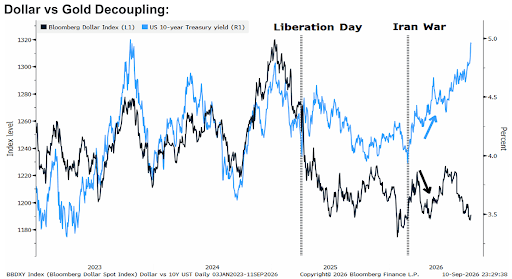
Turnquis said the growing “debasement trade” has helped drive that divergence. Safe-haven and hedging demand, continued central-bank purchases and renewed inflows into physically backed gold exchange-traded funds have provided an important counterweight to rising yields.
A growing chorus of analysts have said that the growing he divergence between gold and bond yields could become increasingly important for gold investors. While 5% Treasury yields would raise the opportunity cost of holding bullion and could continue to generate short-term volatility, gold's ability to withstand higher rates without facing corresponding strength in the U.S. dollar suggests investors remain focused on broader fiscal and currency risks.
See live precious metals prices for gold, silver, platinum and palladium — in USD, CAD and 12 more currencies.
