

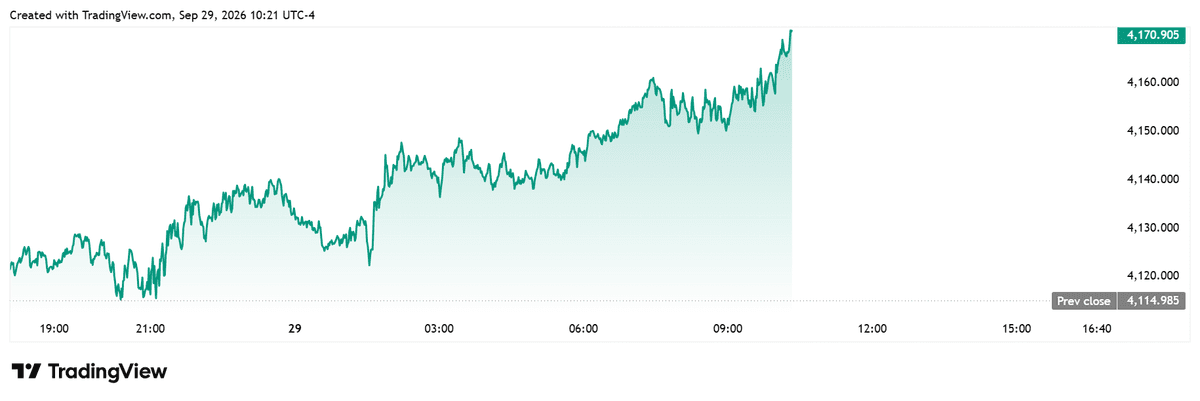
(Kitco News) - Gold prices are trading at session highs after the latest data painted a worsening picture of U.S. consumer sentiment this month.
The Consumer Confidence Index fell to 81.9 in September, below economists’ consensus forecast for a 89.2 reading and also below the downwardly revised 88.6 print from August, the Conference Board announced on Tuesday.
The Present Situation Index—based on consumers' assessment of current business and labor market conditions—retreated by 7.9 points to 109.3, the report said. The Expectations Index—based on consumers' short-term outlook for income, business, and labor market conditions—fell by 5.9 points to 63.6, its third consecutive monthly decline. The survey period was September 1-23, which included the Fed rate hike and ongoing geopolitical tensions.
Gold prices were setting fresh session highs in the wake of the 10 am ET data release, with spot gold last trading at $4,170.90 per ounce at the time of writing for a gain of 1.36% on the daily chart.
"The Consumer Confidence Index deteriorated notably in September, following two prior months of softening," said Dana Peterson, Chief Economist at The Conference Board. "The Present Situation Index fell sharply, while the Expectations Index slipped further into negative territory. Consumer appraisals of current business conditions became negative for the first time since September 2024. Perceptions of the current labor market also worsened, though remained within positive territory. Over the next six months, consumers expected both business conditions and the labor market to weaken. Consumers still anticipated their household incomes to rise, but less so compared to previous months."
"Consumers' write-in responses regarding factors affecting the economy were mostly pessimistic in September,” Peterson added. “References to prices, the high cost of goods and services, and oil and gas prices in particular, rose to new heights, reflecting September's surge in fuel costs. Comments about war/conflict eased this month but remained elevated. Consumers also frequently cited politics, trade, and employment in their write-in responses, though to a lesser extent."
The Present Situation Index worsened in September, with net views of current business conditions declining by 3.4 percentage points to –1.9%, according to the report. Perceptions of current employment conditions also softened, with the labor market differential—the share of consumers saying jobs are "plentiful" minus the share saying jobs are "hard to get"—retreating by 2.5 ppts to just +1.7%.
The Expectations Index also declined in September with all three of its components deteriorating, with net expectations for business conditions dipping by 3.2 ppts to –9.5%, net expectations for the labor market declining by 3.1 ppts to –14.4%, and net expectations for household income falling by 3.0 ppts but remaining in positive territory at +2.5%.
On a six-month moving average basis, confidence across all age groups and nearly all income groups trended downward. “While higher-income groups remained generally more optimistic, those with a household income of $125,000-$149,000 reported the greatest decline in confidence over the last six months,” the report noted. “By generation, confidence for Gen Z, followed by Millennials, remained the highest on a six-month moving average basis. Confidence among the three oldest generations—Generation X, Baby Boomers, and the Silent Generation—continued to weaken. Confidence fell in September across all political affiliations—Democrats, Republicans, and Independents.”
Turning to price pressures, consumers' average and median 12-month inflation expectations rose 0.3 percentage points in September to 6.1% and 5.1% respectively,” the Conference Board said. The share of consumers anticipating higher interest rates over the next 12 months jumped by 5.2 ppts to 68.4%, and while consumers still largely expected stock prices to rise in the next 12 months, optimism moderated in September.
Jeffrey Roach, Chief Economist at LPL Financial, told Kitco News that the details of this month's report show the Iran conflict and stubborn inflation are weighing on households.
"Americans feel jobs are more scarce and are pulling back on plans for homes, cars, and big-ticket purchases, emitting a warning sign for holiday spending even though layoffs data show employers aren't yet cutting workers to match the gloom," he said. "This is just a survey, not hard data so I don’t expect material changes in Fed expectations. If the hard data hold up, the Fed will feel forced to hike one more time this year."
