
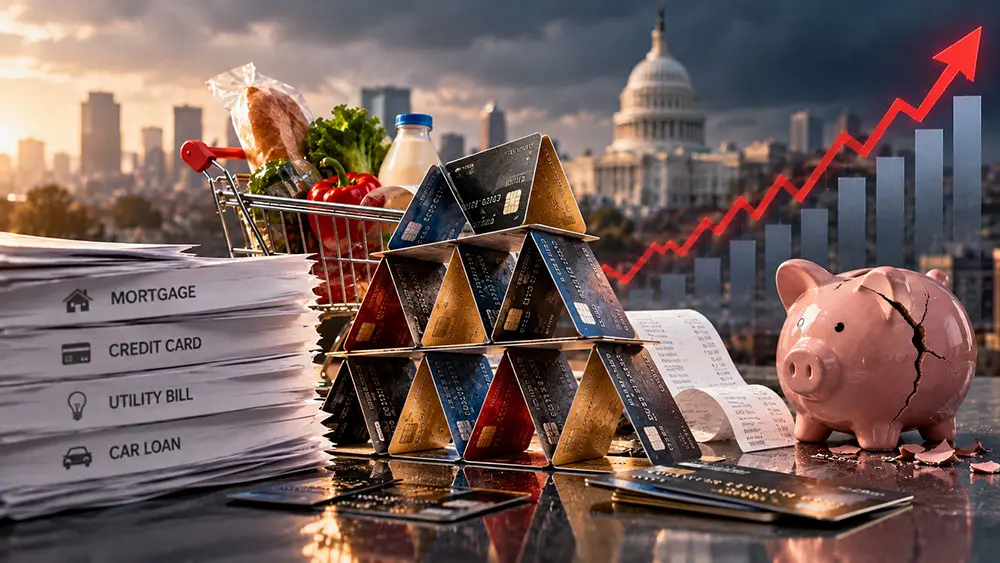
(Kitco News) - American consumers are facing mounting financial pressure as persistent inflation, higher borrowing costs and record household debt take their toll, but one market analyst warns that traditional economic indicators may be masking the true extent of the deterioration in household finances.
In an interview with Kitco News, Matt Layton, senior vice president of consumer analytics at LegalShield, warned that continued consumer spending is giving economists and policymakers a potentially misleading picture of the U.S. economy as more Americans rely on credit to maintain their standard of living.
His comments come as LegalShield's latest Consumer Stress Legal Index (CSLI) rose to 75.7 in September, its highest level since March 2020. The index increased 6.3% from a year earlier and 1.5% from the end of the second quarter.
More importantly, the index has now recorded 27 consecutive months of year-over-year increases, the second-longest streak in its 24-year history. The only longer period was the 34-month stretch between November 2006 and August 2009, which encompassed the Great Recession.
Layton said the sustained increase in financial stress is particularly concerning because it has developed gradually, without the kind of dramatic economic shock that typically attracts attention from policymakers and financial markets.
"This is long-term pain for the everyday consumer," he said.
Unlike the financial crisis of 2008 or the COVID-19 pandemic, when financial stress increased sharply over a relatively short period, Layton explained that the current deterioration reflects a prolonged erosion of household purchasing power.
He said consumers are increasingly finding themselves running out of money earlier each month as they struggle to manage everyday expenses and recurring bills.
"Nothing in our data suggests that any improvement is on the near-term horizon for these specific issues where consumers are, you know, looking at their budget around the kitchen table, which bills can I pay, which bills can I put off?" he said.
Although the current trend bears some resemblance to the buildup of financial stress before the Great Recession, LegalShield's report shows that the deterioration has been considerably slower.
Over the current 27-month period, the composite index has increased 22%, compared with a 40% increase during the first 27 months of the 2006–2009 period.
The index also remains at roughly 60% of its December 2008 peak of 125.2.
Layton emphasized that LegalShield is not forecasting a recession. However, he said the similarities between the two periods demonstrate how financial pressures can accumulate over an extended period without producing an immediate economic crisis.
The latest report also highlights a growing disconnect between traditional consumer confidence surveys and actual household financial behavior.
The Conference Board's Consumer Confidence Index fell to 81.9 in September, its lowest level since 2014. At the same time, more consumers described their family finances as bad than good, according to the survey.
Unlike traditional sentiment indicators, LegalShield's index measures actual requests for legal assistance. The company analyzes approximately 150,000 monthly calls from U.S. consumers seeking help with financial issues, including bankruptcy, foreclosure and consumer finance disputes.
"Confidence surveys tell you how people feel. Our data show what people are doing about it," Layton said in the report. "When a growing share of our members' calls are about losing a home, filing for bankruptcy or dealing with consumer debt, the strain has moved past worry and into action."
For Layton, one of the biggest concerns is that economists and financial markets continue to rely heavily on consumer spending to assess the health of the U.S. economy.
Consumer spending accounts for more than two-thirds of U.S. economic activity, making it a critical indicator of economic growth. However, Layton argued that growing access to credit, including buy now, pay later services, could be allowing households to maintain spending even as their underlying financial position deteriorates.
"I fully believe that consumer spending numbers are no longer an adequate measurement of the financial health of the everyday consumer," he said.
He explained that consumers increasingly have access to alternative forms of credit, allowing them to continue purchasing necessities even when their incomes are insufficient to cover their expenses.
He questioned whether this borrowing is artificially supporting consumer spending figures and delaying a more visible economic adjustment.
"Are we just kicking the can down the road and, you know, the budget of the consumer is just going to explode at some point?" he asked.
The latest household debt figures reinforce some of these concerns.
According to Federal Reserve Bank of New York data cited in LegalShield's report, total U.S. household debt reached $18.77 trillion in the second quarter of 2026, an increase of $383 billion from a year earlier.
Meanwhile, the annualized share of credit card balances transitioning into serious delinquency stood at 6.97%, roughly unchanged from the previous year.
LegalShield's Consumer Finance Index, which tracks legal requests involving billing disputes, collections, repossessions and creditor negotiations, rose 4.5% during the third quarter to 112.5.
The index is now approximately 6% above its July 2007 level, recorded ahead of the Great Recession, although it remains below the peak reached during the pandemic.
The report noted that consumer finance issues accounted for most of the composite index's quarterly increase.
"When the pandemic hit, consumer finance calls jumped almost overnight," Layton said in the report. "This time there is no single shock. Consumer finance is above anything we recorded during the Great Recession, and it moved higher again this quarter."
Financial pressure is also becoming increasingly evident in the housing market.
LegalShield's Foreclosure Index rose 14.8% from a year earlier to 52.6 in September, representing the largest annual increase among the three components of the consumer stress index.
Ben Farrow, a LegalShield provider attorney and partner at Anderson, Williams, & Farrow, said many homeowners seeking legal assistance are struggling with rising essential expenses rather than excessive discretionary spending.
"The homeowners calling us budgeted and did the right things, but inflation is eating into their income and then their insurance doubled," he said. "They're not buying Porsches and ribeyes. Things just cost too much, and there's not much left in the piggy bank."
The deterioration in household finances is also raising concerns about a further increase in personal bankruptcies.
LegalShield's Bankruptcy Index averaged 41.0 during the third quarter, an increase of 14.3% from the same period last year and its highest quarterly average since late 2019.
The quarterly index has now risen on an annual basis for 17 consecutive quarters, the longest such stretch on record.
The report noted that the Bankruptcy Index has more than doubled since the Federal Reserve began raising interest rates in March 2022.
Layton said LegalShield's historical data suggest that bankruptcy filings could continue rising into next year.
"Historically, our Bankruptcy Index has led federal court filings by about two quarters," he said. "The data point to filings continuing to rise into early 2027."
Despite the growing financial strain, Layton said the gradual pace of deterioration could help explain why the problem has not generated a stronger response from policymakers.
Although he acknowledged that there is no obvious policy solution, Layton said the absence of a sudden spike in financial stress could mean the economy has more time to adjust than it did during previous crises.

