
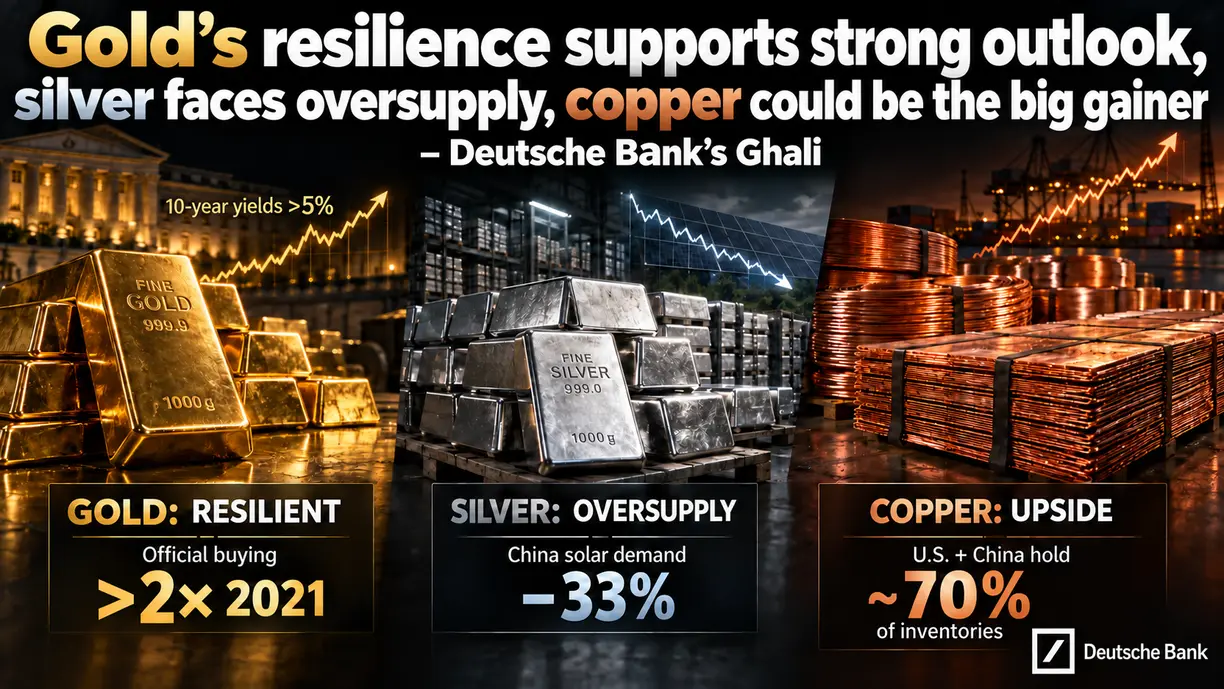
(Kitco News) – Gold is performing remarkably well despite the high-yield environment, and while the silver market has likely tipped into oversupply, the biggest potential gains in the metals complex are likely to be found in copper, according to Daniel Ghali, head of metals research at Deutsche Bank.
In a recent interview with BNN Bloomberg, Ghali acknowledged that the multi-decade highs in bond yields have put pressure on gold prices, but the metal has actually held up surprisingly well.
“The pullback in gold, I would actually argue, has been incredibly limited,” he said. “Gold markets have faced a strikingly different outlook for the Fed. US 10-year yields have rocketed north of 5%. Crude oil is trading north of $100 a barrel. And yet, gold prices still haven't managed to print a new low since July. That's a really strong, resilient price action in my book.”
Ghali was asked what might trigger gold’s next leg up in the rally.
“In our view, the setup right now really screams echoes of 2022,” Ghali said. “We're looking at a positioning setup in gold which is probably the most bearish since October 2021. And yet this is a completely different regime for the market. Firstly, official sector purchases are running at more than double the clip that they were back then. Separately, the network of institutional investors that participate in gold has probably grown by roughly 70% since 2021, and the pool of reserves that reserve managers have to allocate from has grown as well. And separately, I would argue the case for higher allocations in and of itself has also grown over the last several months. So, it's really a surprise to us that discretionary participants still remain on the sidelines.”
“I think the weak performance in the context of the war in Iran has really shocked some participants, and has kept them on the sidelines,” he added. “But as we look forward to next year, we think this is a really strong setup. Positioning is low, gold is oversold as-is and it's underowned. So this is a really great time for gold.”
Ghali was asked how he would approach the balance between gold and bonds in the current market.
“I don't think you need to choose between bonds or gold,” he said. “I think what's happening now, and this is really what the market is missing, is that the bear market in treasuries is actually fueling part of the need for institutional investors to diversify. If you think back at what happened at some of the large institutional investors across the globe, namely pension funds, endowments, trusts, insurance companies, their allocations to alternative assets have grown dramatically over the last 20 years. But the types of alternative assets that they piled into have retained a yield sensitivity, and in this case, the bear market in treasuries is actually fueling more diversification in gold within that alternatives mix.”
Ghali was then asked to share his analysis on silver following its run-up to all-time highs in the early months of the year, followed by its 50% pullback following the start of the Iran war.
“The context for silver has dramatically changed,” he said. “We're looking at a market that probably was at its scarcest levels, in terms of physical inventory availability in the last year, since the Hunt brothers tried to corner the market almost half a century ago. Today, the outlook for physical availability is completely different. Our measure of free-floating London inventories, which is the pool of inventories sitting in London's commercial vaults that are available for purchase, has risen back to its highest level since November 2024. Meanwhile, the Comex, which initially attracted a tidal wave of metal imports into the United States, still retains a substantial oversupply or stockpile that is too large for its inventory, for its open interest. So, there's still a backstop in the CME if ever London gets scarce again. Meanwhile, Shanghai inventories have risen.”
Ghali said silver isn't just an inventory story, as higher prices have also changed the demand picture.
“The high price environment has actually catalyzed really fast-paced demand destruction,” he said. “Our read on Chinese industrial demand, specifically for silver, for solar, is probably down by a third in 2026 relative to last year. So, the market now has more inventories to cover a shrinking deficit, and perhaps even a physical primary market surplus in the coming year.”
Asked if this means silver prices could see a further pullback, Ghali said this is a distinct possibility.
“The context for silver prices themselves is one where this argues for underperformance – silver relative to gold, deterioration in the silver to gold ratio if you like – and it also calls for a more constrained volatility environment,” he said. “The market is constantly expecting the same kinds of moves as we've seen last year, but the fundamental setup in silver has drastically changed, so we don't expect that, and we expect more availability to result in less volatility and underperformance going forward.
Ghali said that for investors looking for the largest potential gains in the short and medium term, copper is the most interesting of the metals complex.
“To us, it certainly is, in terms of the size of the moves that we could be looking at,” he said. “We're looking for an increasingly convex reaction function in copper prices relating to what we think is the most acutely scarce copper environment on record, dating back to the 1980s. What we think is happening right now is that dual stockpiling that has been occurring for many years now, both in the United States and China, has locked up a large pool of what you'd call the world's aboveground inventories.”
“Another way to put that is that the US and China combined now probably have locked up about 70% of the world's global inventory pool,” Ghali said. “This is a really critically scarce copper environment, and we expect prices to rise as a result.”
See live precious metals prices for gold, silver, platinum and palladium — in USD, CAD and 12 more currencies.
