
(Kitco NewsWire) - Spot gold and silver prices were higher in late U.S. trading Tuesday, recovering from early-session losses as declining crude oil prices eased inflation concerns and supported renewed buying interest in precious metals ahead of Wednesday's Federal Reserve monetary policy decision. Diplomatic efforts involving Iran and several regional powers helped reduce some of the immediate geopolitical risk premium in energy markets, while stronger U.S. economic data and a firmer dollar limited bullion's advance. At the latest verified afternoon price reading, spot gold was trading near $4,058.20 an ounce, up $42.00, or 1.05%, while spot silver was trading near $54.200, up $0.353, or 0.66%, on the session.
Tuesday's U.S. economic reports pointed to resilient consumer demand and business investment despite elevated borrowing costs. September durable goods orders rose 1.8%, following a modest increase in August, supported by stronger transportation equipment demand. Orders excluding transportation increased 0.5%, while nondefense capital goods orders excluding aircraft, a closely watched measure of business investment, also advanced 0.5%. October consumer confidence increased sharply to 91.7 from an upwardly revised 84.2 in September, exceeding market expectations. The present situation index climbed to 120.4, while the expectations index improved to 72.6, partially reversing three consecutive monthly declines. September new-home sales slipped to a seasonally adjusted annual rate of 676,000 units from a revised 680,000 in August, although the result exceeded expectations of approximately 650,000. The Richmond Fed manufacturing index remained at minus 2 in October, indicating continued modest contraction in regional factory activity.
Market positioning remains focused on an October Federal Reserve pause, followed by the possibility of additional tightening before year-end. September consumer inflation increased 0.6% on the month and 3.7% annually, while producer prices rose 1.3% and 6.3%, respectively. Friday's preliminary October business activity surveys showed continued expansion and accelerating selling-price inflation, while consumer inflation expectations remained elevated. Fed funds futures indicated approximately a 90.6% probability that the central bank would leave its benchmark rate unchanged at 3.75% to 4.00% when its Oct. 27-28 meeting concludes Wednesday. However, expectations for another increase in December remain substantial, with recent market positioning indicating approximately a 73% probability of additional tightening by year-end. Treasury yields were little changed to slightly higher Tuesday, with the benchmark 10-year yield trading near 4.99%. The stronger dollar limited some of the benefit to gold from falling energy prices, although reduced oil-driven inflation concerns helped the metal recover from earlier losses.
The Federal Reserve's two-day monetary policy meeting began Tuesday, with the interest rate decision scheduled for Wednesday at 2 p.m. EDT, followed by Fed Chair Kevin Warsh's news conference at 2:30 p.m. EDT. Market attention will focus on whether policymakers signal that the expected October pause represents a temporary interruption or a more durable end to the tightening cycle. Thursday brings the advance third-quarter gross domestic product estimate, September personal consumption expenditures inflation figures and weekly initial jobless claims, all scheduled for 8:30 a.m. EDT. The European Central Bank is also scheduled to announce its policy decision Thursday, while the Bank of Japan meets later in the week. Softer inflation readings or less restrictive Fed guidance could reduce December rate hike expectations and support gold through lower Treasury yields and a weaker dollar. Conversely, stronger economic activity, persistent inflation and hawkish policy guidance would reinforce expectations for additional tightening and maintain pressure on non-yielding bullion.
The Strait of Hormuz and U.S.-Iran situation remained a significant source of uncertainty Tuesday, although renewed diplomatic activity helped ease immediate concerns about another major escalation. Iranian security officials met senior government leaders following talks in Tehran with representatives from Saudi Arabia, Turkey and Pakistan aimed at restoring regional stability and reducing the threat of renewed hostilities. The participating countries agreed to continue discussions on regional peace and security, although no agreement between Washington and Tehran has been confirmed. Iran continues to insist on its conditions for ending the conflict, while renewed Houthi attacks against Saudi Arabia and the possibility of additional U.S.-Israeli military operations remain obstacles to a lasting settlement. Maritime security risks and uncertainty about the restoration of normal commercial shipping through the Strait of Hormuz continue to support an elevated geopolitical premium in energy prices.
Crude oil prices declined as traders assessed the prospect of renewed diplomatic negotiations against continuing threats to Gulf energy infrastructure and commercial shipping. Brent crude retreated toward $114.00 a barrel, while WTI moved closer to $100.00, reversing part of the previous week's sharp advance. For gold, the decline in energy prices reduced immediate concerns about oil-driven inflation and additional Fed tightening, allowing bullion to recover despite a stronger dollar. The absence of a confirmed settlement, however, leaves the risk of renewed disruptions to Middle Eastern petroleum supplies. Silver also benefited from improving precious metals sentiment, although its industrial exposure leaves it vulnerable to any renewed deterioration in economic activity or further increases in borrowing costs.
North American equity markets finished higher Tuesday as technology and semiconductor shares led a recovery ahead of major corporate earnings and the Federal Reserve's policy announcement. The Dow Jones Industrial Average edged up 15.99 points, or 0.03%, to close at 52,377.57, while the S&P 500 gained 45.83 points, or 0.60%, to finish at 7,722.60. The Nasdaq Composite advanced 308.43 points, or 1.18%, to close at 26,477.81, outperforming as renewed enthusiasm for artificial intelligence-related stocks supported the broader technology sector. Semiconductor shares benefited from improving sentiment surrounding the prospective Anthropic public offering, while investors continued to assess the financing requirements and profitability of major artificial intelligence investments. Meta Platforms declined approximately 1.6% amid concerns about its expanded equity fundraising, while Boeing fell 10.7% following a larger-than-expected quarterly loss. United Parcel Service gained 5.8% after raising its annual revenue and profit forecasts. Canada's S&P/TSX Composite Index also advanced, supported by stronger base metals, financial and selected technology shares, although declining crude oil prices weighed on energy producers.
European equity markets closed mostly higher Tuesday as stronger corporate earnings and declining crude oil prices helped major benchmarks recover from early losses. The pan-European Stoxx 600 advanced 0.47% to 643.68, reversing an intraday decline of approximately 0.4%. Germany's DAX gained approximately 0.8%, while France's CAC 40 rose around 0.6%. The U.K.'s FTSE 100 underperformed, falling approximately 0.7% as disappointing quarterly results from HSBC pressured banking shares. Austrian circuit board manufacturer AT&S and Dutch semiconductor equipment supplier Besi were among the strongest performers, advancing 11.5% and 11.4%, respectively. Investors also remained focused on France's fiscal uncertainty and Thursday's European Central Bank decision, with policymakers widely expected to leave interest rates unchanged while assessing persistent energy-related inflation risks.
The key outside markets see Nymex WTI crude oil prices lower and trading near $100.00 a barrel, while Brent crude was near $114.00. The yield on the benchmark 10-year U.S. Treasury note is trading near the 4.99% area. The U.S. dollar index was firmer near 102.23 during the session, reflecting stronger economic data and expectations that Federal Reserve monetary policy will remain restrictive despite Wednesday's anticipated pause. (Kitco Global Index shows how much of today's gold move is the dollar versus the gold market itself.)
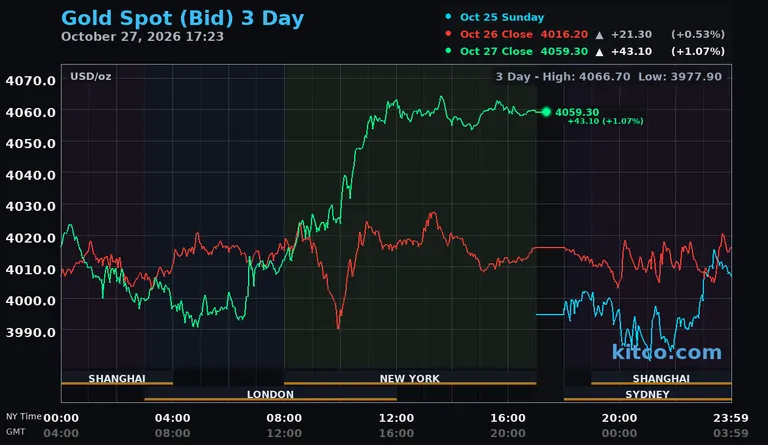
Technically, spot gold bulls' next upside price objective is to push prices back above the $4,079.00 to $4,100.00 resistance zone, with a sustained move targeting $4,160.00 and then $4,180.00. Bears' next near-term downside price objective is a break below $4,015.00, with deeper downside targets at $3,975.00 and then $3,959.00. First resistance is seen at $4,079.00 and then at $4,100.00. First support is seen at $4,039.00 and then at $4,015.00.
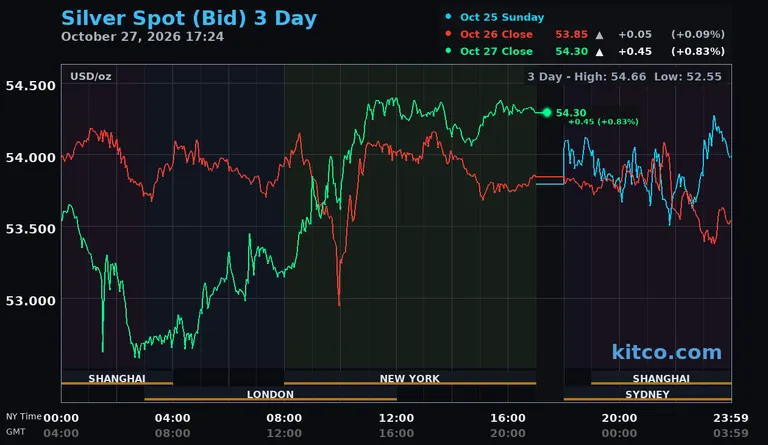
Spot silver bulls' next upside price objective is to drive prices back above the $54.460 to $55.770 resistance zone, with a sustained move targeting $56.000 and then $57.000. The next downside price objective for the bears is a break below $53.000, with deeper downside targets at $52.410 and then $51.390. First resistance is seen at $54.460 and then at $55.770. Next support is seen at $53.000 and then at $52.410.
See live precious metals prices for gold, silver, platinum and palladium — in USD, CAD and 12 more currencies.

