
(Kitco NewsWire) – Spot gold prices were lower and spot silver prices were modestly higher in early U.S. trading Friday, as investors assessed the latest U.S. employment figures following Thursday's sharp equity-market selloff and renewed tensions involving Iran and the Strait of Hormuz. The U.S. economy added substantially more jobs than expected in October, reinforcing the case for another Federal Reserve interest rate increase in December and driving Treasury yields and the dollar higher immediately after the release. At the time of writing, spot gold was trading near $4,050.95 an ounce, down $34.10, or 0.89%, while spot silver was trading near $51.864, up $0.089, or 0.17%.
The U.S. Labor Department reported Friday that nonfarm payroll employment increased by 165,000 in October, substantially exceeding economists' expectations for approximately 65,000 new jobs and accelerating from an upwardly revised September gain of 60,000. The unemployment rate declined to 4.1% from 4.2%, while average hourly earnings increased 0.4% on the month, above expectations for a 0.3% gain. Average hourly earnings were 3.1% higher than a year earlier. The stronger employment and wage figures indicated that labor-market conditions remain resilient despite elevated borrowing costs, geopolitical uncertainty and recent weakness in technology shares.
Revisions provided additional evidence of improving employment conditions. August payroll growth was revised higher by 53,000 to 186,000, while September's increase was revised upward by 31,000 to 60,000. The two-month revisions added a combined 84,000 jobs to previously reported employment. Professional and business services led October hiring with 70,000 additional positions, followed by health care with 42,000 and transportation and warehousing with 25,000. Manufacturing employment increased by 19,000. The labor-force participation rate held at 61.9%, while the average workweek remained unchanged at 34.4 hours. The report suggests that demand for labor remains stronger than anticipated, although hiring continues to vary considerably across industries.
The employment figures changed the immediate balance of risks for Federal Reserve policy expectations. Before the report, interest rate futures indicated approximately a 70% probability of a 25-basis-point increase at the Fed's Dec. 8-9 meeting, as concerns about slowing artificial intelligence investment and Thursday's heavy equity losses had reduced expectations for further tightening. Friday's upside surprise in payrolls, lower unemployment and stronger wage growth strengthened the case for an additional increase. The two-year Treasury yield rose approximately 6 basis points to 4.53% following the release, while the dollar also advanced. That response presented an additional headwind for gold, reversing some of the support provided by falling yields earlier in the week.
The latest data also underscore the competing influences shaping monetary policy. Thursday's preliminary third-quarter productivity report showed nonfarm business productivity increasing at a 3.6% annualized rate, while unit labor costs declined 0.7%, suggesting that efficiency gains are helping moderate some production-cost pressures. Weekly initial jobless claims fell to 189,000, indicating that employers remain reluctant to reduce staffing. Earlier in the week, September job openings increased to 7.523 million and the October Institute for Supply Management manufacturing index rose to 55.5. Together with Friday's stronger payrolls, the reports point to continued economic resilience, even as the equity-market selloff raises questions about the outlook for corporate investment.
Market positioning remains sensitive to the sharp decline in technology and artificial intelligence-related equities Thursday, which drove investors into U.S. government bonds and pushed longer-term Treasury yields toward two-month lows. The S&P 500 lost 4.36% Thursday, while the Nasdaq Composite declined approximately 5.52%, reflecting concerns about technology valuations, data-center investment and financing conditions. Some investors also sold gold to raise liquidity and cover portfolio losses, temporarily offsetting its defensive appeal. Friday's stronger employment report now raises the possibility that bond yields could recover if traders increase expectations for additional monetary tightening. Gold therefore faces competing influences from defensive investment demand and higher interest rates, while silver remains particularly exposed to industrial-demand concerns and broader risk appetite.
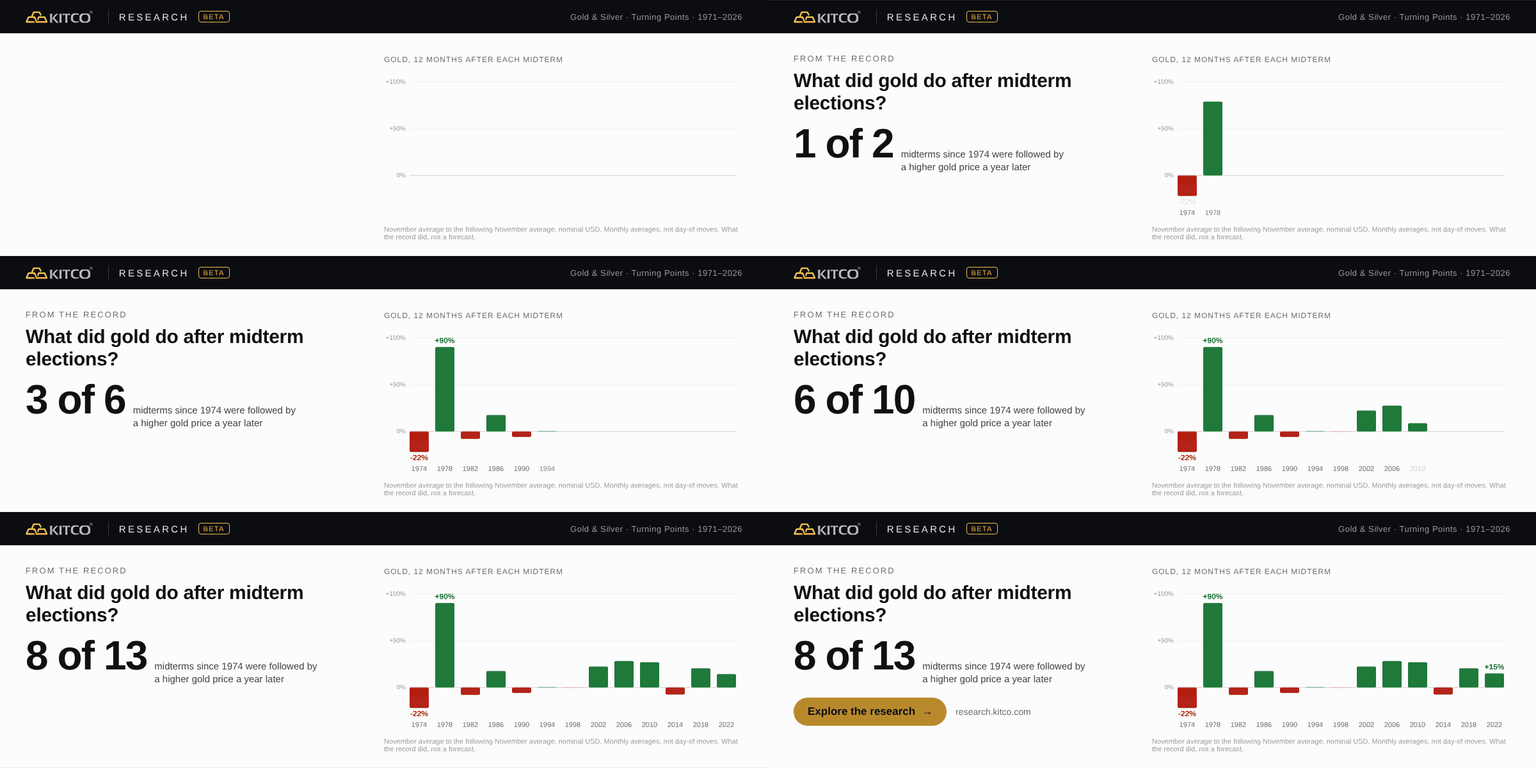
The Democratic victories in Tuesday's U.S. midterm elections remain an important secondary influence on financial markets. Democrats secured control of both chambers of Congress, raising expectations for legislative gridlock and potentially limiting the administration's ability to enact additional fiscal measures without congressional agreement. Investors initially interpreted the outcome as potentially moderating future government borrowing requirements, supporting Treasury prices and weakening the dollar. However, Friday's stronger employment report highlights the distinction between longer-term fiscal expectations and the Federal Reserve's immediate inflation and labor-market considerations. Congressional control does not directly determine interest rate policy, and the extent of any reduction in Treasury issuance will depend on subsequent budget negotiations.
The next major U.S. inflation test comes Tuesday, Nov. 10, when the Labor Department releases the October consumer price index at 8:30 a.m. EST. September headline consumer prices increased 0.6% on the month and 3.7% annually, leaving inflation well above the Fed's 2% objective. The October producer price index follows Friday, Nov. 13, also at 8:30 a.m. EST. Friday's preliminary November University of Michigan consumer sentiment survey, due at 10 a.m. EST, will provide an earlier assessment of household confidence and inflation expectations. Stronger consumer inflation or an increase in longer-term inflation expectations would reinforce the implications of the employment surprise for December rate policy, while softer inflation figures could help offset some of the pressure from resilient hiring.
The Strait of Hormuz and U.S.-Iran situation continues to present a significant risk to global energy supplies, despite renewed diplomatic efforts following the American midterm elections. Iranian authorities reported additional attacks on commercial tankers Thursday, while maritime security reporting confirmed multiple incidents involving vessels operating in the Persian Gulf and the strategic shipping corridor. Iran's Revolutionary Guards claimed that two tankers struck naval mines and that another vessel caught fire, although those specific claims have not been independently confirmed. British maritime security authorities separately reported that a vessel was struck by two unidentified projectiles Wednesday night. At least five vessel incidents have been reported in the Gulf since Sunday, reinforcing concerns that commercial shipping remains exposed to further disruption.
Diplomatic efforts continue through Qatar, with Washington and Tehran reviewing proposals intended to narrow differences over the U.S. blockade of Iranian ports, sanctions relief, maritime security and Iran's nuclear program. However, Iranian officials have indicated that the two sides remain far apart, and no binding settlement has been announced. The Democratic congressional victories have increased political pressure on the Trump administration over the economic costs of the conflict, but the possibility of renewed U.S. military action remains unresolved. The persistence of tanker attacks and uncertain security guarantees means that hopes for a negotiated reopening of normal commercial traffic through the Strait of Hormuz have yet to translate into a durable reduction in physical supply risks.
Crude oil prices remained volatile Friday following Thursday's rebound from two-month lows. Nymex WTI futures were trading around $90.40 a barrel in an 8:40 a.m. EST market indication, while Brent futures were near $98.20. Crude remains substantially below last week's elevated levels as traders consider whether the U.S. election results could accelerate negotiations with Iran, but continuing threats to shipping have prevented a more decisive removal of the geopolitical risk premium. Higher oil prices can reinforce inflation expectations and strengthen the case for restrictive monetary policy, creating a headwind for gold even as the conflict supports defensive demand. Silver faces the additional complication that elevated energy costs and slowing technology-sector investment could affect industrial consumption.
Global equity markets remained unsettled ahead of the U.S. open following Thursday's steep Wall Street losses. U.S. stock index futures were mixed as investors weighed the stronger-than-expected employment figures against concerns about artificial intelligence investment and corporate financing. Asian technology-heavy markets weakened following the U.S. semiconductor selloff, while European investors assessed the potential effects of a prolonged decline in technology valuations and continued restrictive monetary policy. The stronger employment report reduced the likelihood of an imminent easing in U.S. financial conditions, although the extent of further equity selling will depend on corporate earnings, Treasury yields and the outlook for economic activity.
The key outside markets see Nymex WTI crude oil near $90.40 a barrel and Brent crude near $98.20 in the latest available morning futures observations. The benchmark 10-year U.S. Treasury yield was near 4.85% before the employment release, following Thursday's decline toward two-month lows, while shorter-dated yields increased following the stronger payroll figures. The U.S. dollar was firmer, with the dollar index having traded near 101.89 earlier in the morning. (Kitco Global Index shows how much of today's gold move is the dollar versus the gold market itself.)
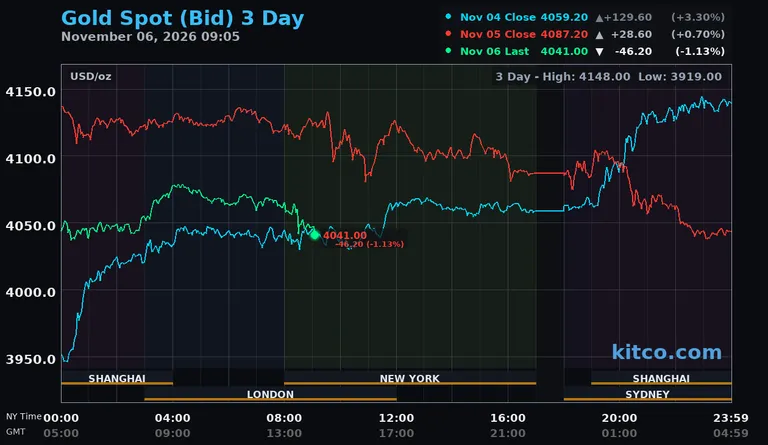
Technically, spot gold bulls' next upside price objective is to push prices back above the $4,051.45 to $4,088.51 resistance zone, with a sustained move through the upper boundary needed to invalidate the immediate bearish technical outlook and reopen the path toward higher resistance. Bears' next near-term downside price objective is a break below $4,021.95, with a deeper downside target at $3,991.58. First resistance is seen at $4,088.51 after the recovery above $4,051.45. First support is seen at $4,051.45 and then at $4,021.95.
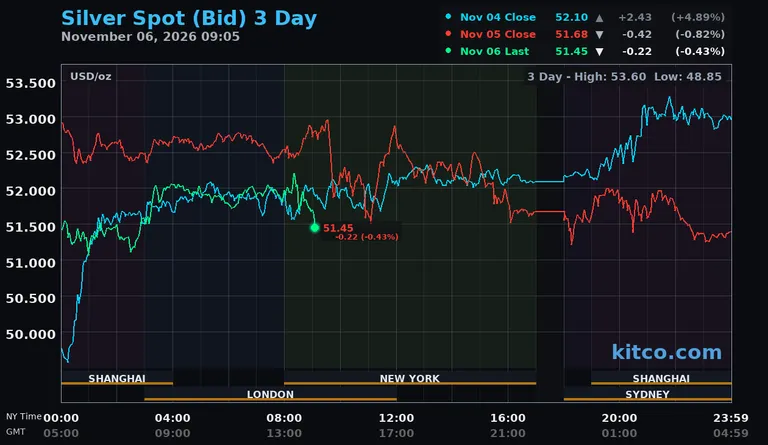
Spot silver bulls' next upside price objective is to drive prices back above the $53.107 to $54.617 resistance zone, with a sustained move through the upper boundary needed to improve the near-term technical outlook. The next downside price objective for the bears is a break below $50.515, with a deeper downside target at $49.013. First resistance is seen at $53.107 and then at $54.617. Next support is seen at $50.515 and then at $49.013.
See live precious metals prices for gold, silver, platinum and palladium — in USD, CAD and 12 more currencies.