
(Kitco NewsWire) - Spot gold and silver prices were sharply lower in late U.S. trading Tuesday, reversing Monday's recovery as stronger-than-expected U.S. consumer confidence, renewed concerns about trade tariffs and another technology-led equity selloff pressured precious metals. Gold fell below $3,600.00 an ounce, approaching last week's 14-month low, while silver suffered heavier losses as weakness in industrial commodities and broader portfolio liquidation compounded the selling. Bullion failed to benefit from a softer U.S. dollar and slightly lower Treasury yields as investors reduced exposure to metals ahead of Wednesday's important U.S. inflation data. At approximately 4:50 p.m. EST, spot gold was trading near $3,552.50 an ounce, down $81.70, or 2.25%, while silver was trading near $40.790, down $2.250, or 5.22%, on the session. Gold traded as low as $3,546.00 during the day, while silver touched $40.570.
Tuesday's U.S. economic data indicated a substantial improvement in consumer confidence and modestly stronger regional manufacturing activity, reinforcing expectations that underlying economic demand remains resilient despite elevated borrowing costs. The Conference Board's November consumer confidence index surged 11.4 points to 103.3 from an upwardly revised 91.9 in October, substantially exceeding expectations near 92.5 and reaching its highest level since January 2025. The present situation index increased to 132.8, while the expectations index rose to 83.6, reflecting improved assessments of business conditions and the labor market. The Richmond Fed's manufacturing index also strengthened to 3 from minus 2 in October, with new orders improving to 2 from minus 8 and employment rising to 6 from 3. Meanwhile, September house prices were unchanged on the month, while the national Case-Shiller index increased 2.1% from a year earlier, below the prevailing inflation rate. The combination of improving consumer sentiment, modest manufacturing expansion and subdued housing-price growth highlighted the uneven economic outlook, although the stronger confidence figures reduced immediate concerns about a sharp slowdown in consumer demand.
Market positioning remained heavily tilted toward another Federal Reserve interest rate increase at the Dec. 8-9 policy meeting, with the latest published futures assessment indicating approximately a 95% probability of a 25-basis-point increase. Tuesday's stronger consumer confidence figures reinforced expectations that policymakers will remain focused on persistent inflation rather than near-term economic weakness. However, renewed equity-market selling encouraged some demand for Treasury securities, with the benchmark 10-year yield easing toward 4.90% and the two-year yield holding near 4.67%. The dollar index also retreated from recent highs, although the weaker currency provided little support to precious metals. Investors now turn to Wednesday's October personal consumption expenditures price index, scheduled for release at 8:30 a.m. EST, alongside personal income and spending figures, durable goods orders and updated third-quarter gross domestic product estimates. The PCE report will be particularly important for expectations surrounding the Fed's December meeting, with annual headline inflation expected near 3.8%. A stronger inflation reading could reinforce tightening expectations and pressure gold, while softer price data could encourage a decline in Treasury yields and support bullion ahead of Thursday's U.S. Thanksgiving holiday.
The Strait of Hormuz and U.S.-Iran situation remained highly unstable Tuesday as additional attacks on commercial shipping intensified concerns about the security of petroleum exports through the strategic waterway. Iranian military authorities claimed that two more oil tankers struck naval mines and caught fire Tuesday morning, although the circumstances of the incidents have not been independently established. The attacks followed last week's incidents involving vessels operated by the Abu Dhabi National Oil Company and a sharp reduction in commercial shipping activity. Vessel-tracking figures indicated that only five commodity ships transited the strait Saturday, compared with 31 during the preceding weekend, while none were registered Sunday in one shipping-data assessment. Other tracking estimates also indicated a substantial decline in November traffic, although vessels operating without active transponders complicate the measurements. Iran continued threatening further action against ships using unauthorized routes, while the U.S. naval blockade of Iranian ports and stalled negotiations over sanctions and maritime security remained unresolved. The continuing confrontation supported an underlying geopolitical premium in crude oil, although recovering petroleum supply outside the immediate conflict zone limited the broader market response. For gold, the elevated security risks maintained potential defensive demand, but Tuesday's sharp decline indicated that liquidation across precious and industrial metals remained the more immediate influence.
Crude oil prices recovered Tuesday as renewed attacks on tankers and continuing disruption to Persian Gulf shipping encouraged some rebuilding of the geopolitical risk premium following several weeks of declines. Nymex WTI crude futures advanced approximately 2.3% to settle at $82.05 a barrel, while Brent crude gained 2.3% to finish at $91.40. The rebound followed Monday's weakness, which had taken both benchmarks toward their lowest levels in several months as expectations for recovering Middle Eastern exports and a global petroleum surplus pressured prices. The latest shipping incidents highlighted continuing vulnerabilities in regional energy logistics, particularly as commercial transit volumes remain substantially below normal levels. However, expectations for growing global petroleum inventories and additional supply from producers outside the Gulf continued to constrain gains. Investors now await Wednesday's official U.S. petroleum inventory report at 10:30 a.m. EST for further evidence about supply and demand balances. Higher oil prices could reinforce inflation concerns and expectations for restrictive Fed policy, potentially offsetting some of the defensive support that geopolitical uncertainty ordinarily provides to gold.
North American equity markets finished mixed Tuesday as renewed selling in technology and artificial intelligence-related companies reversed part of Monday's sharp rebound, while industrial and other blue-chip shares demonstrated greater resilience. The Dow Jones Industrial Average advanced 423.39 points, or approximately 0.85%, to close at 50,018.70, while the S&P 500 declined 0.50% to finish at 7,201.09. The Nasdaq Composite fell 1.48% to 23,733.54, and the Russell 2000 advanced approximately 0.6% to 2,684.94. Technology shares came under renewed pressure following Monday's broad recovery, with Anthropic falling below its initial public offering price and semiconductor-related companies facing additional selling. Concerns about artificial intelligence investment returns, technology valuations and prospective U.S. trade restrictions continued to influence investor sentiment. The divergence between the advancing Dow and declining Nasdaq reflected rotation away from growth-oriented companies toward selected cyclical and defensive shares. Gold and silver fell alongside technology stocks despite lower Treasury yields, suggesting that broader deleveraging and concerns about global commodity demand remained dominant influences on precious metals.
Canada's S&P/TSX Composite Index finished lower Tuesday, giving back part of Monday's 2.69% rebound as weakness in mining, technology and financial shares weighed on the resource-heavy Toronto market. Late completed-session market summaries placed the benchmark's decline between 0.33% and 0.38%, following Monday's close at 34,082.12. The materials sector faced renewed selling as gold, silver and industrial metals declined, while technology companies also came under pressure amid the broader retreat in artificial intelligence-related shares. First Quantum Minerals fell 10.35%, Celestica declined 8.40% and Capstone Copper lost 7.95%, illustrating the weakness in base metals and technology-related companies. Selected consumer and real estate shares outperformed, but the broader market struggled to maintain the previous session's gains.
European equity markets finished lower Tuesday, reversing part of Monday's recovery as technology and mining companies declined amid renewed concerns about artificial intelligence investment and U.S. trade policy. The pan-European Stoxx 600 fell 0.66% to close at 632.74, while Germany's DAX declined 1.26% to 25,017.81. France's CAC 40 edged down 0.05% to 8,040.49, and the U.K.'s FTSE 100 lost 0.13% to finish at 10,467.07. Mining companies were among the weakest performers as falling gold, silver and copper prices weighed on producers. Antofagasta declined approximately 8%, Anglo American lost 5.7% and Fresnillo fell 4.9%, reflecting the pressure on precious and industrial metals companies. Semiconductor equipment manufacturers also weakened amid renewed concerns about artificial intelligence investment and technology valuations. Defensive consumer-oriented shares demonstrated relative resilience, although the broad decline indicated that Monday's recovery had failed to establish a sustained improvement in European risk sentiment.
The key outside markets see Nymex WTI crude oil futures higher after settling at $82.05 a barrel, while Brent crude finished at $91.40. The benchmark 10-year U.S. Treasury yield eased toward 4.90%, while the two-year yield remained near 4.67%. The dollar index softened toward 103.76, providing little relief to gold and silver as renewed equity-market selling and concerns about industrial demand pressured precious metals. Persistent expectations for additional Federal Reserve tightening, together with uncertainty surrounding Wednesday's PCE inflation report, continued to limit investor confidence in a sustained bullion recovery. (Kitco Global Index shows how much of today's gold move is the dollar versus the gold market itself.)
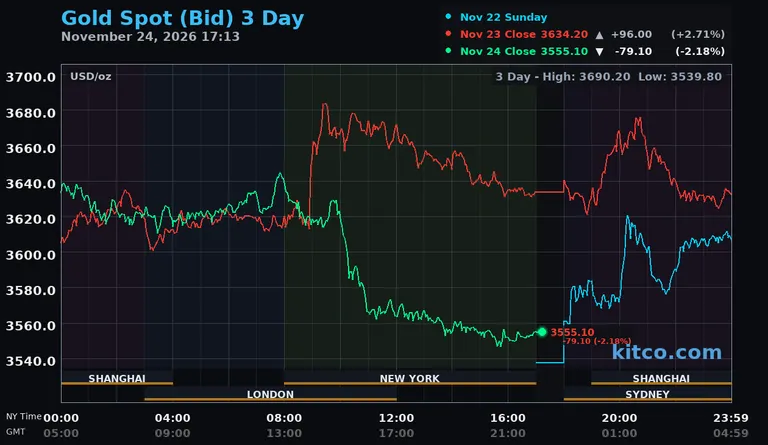
Technically, spot gold bulls' next upside price objective is to push prices back above the $3,630.00 to $3,650.00 resistance zone, with a sustained recovery targeting $3,674.00 and then $3,697.00. Bears' next near-term downside price objective is a sustained break below $3,550.00, with deeper downside targets at $3,520.00 and then $3,500.00, followed by the $3,380.00 to $3,400.00 support zone. First resistance is seen at $3,630.00 and then at $3,650.00. First support is seen at $3,520.00 and then at $3,500.00.
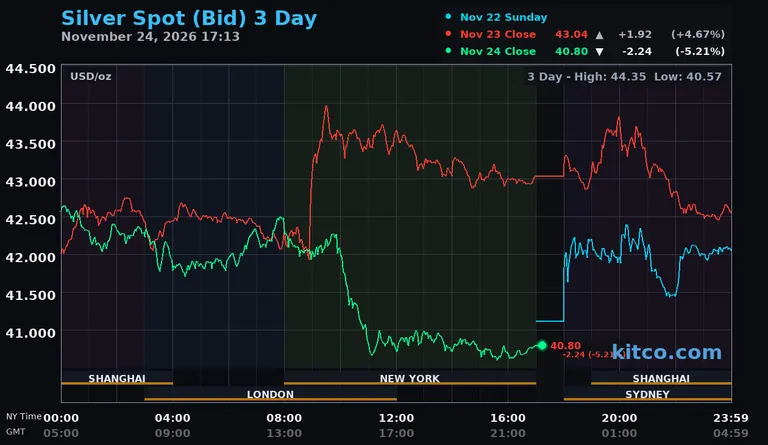
Spot silver bulls' next upside price objective is to drive prices back above the $44.000 to $44.500 resistance zone, with a sustained recovery targeting $47.000. The next downside price objective for the bears is a sustained break below $40.500, with deeper downside targets at $38.000 and then $37.500. First resistance is seen at $44.000 and then at $44.500. Next support is seen at $40.500 and then at $38.000.
See live precious metals prices for gold, silver, platinum and palladium — in USD, CAD and 12 more currencies.