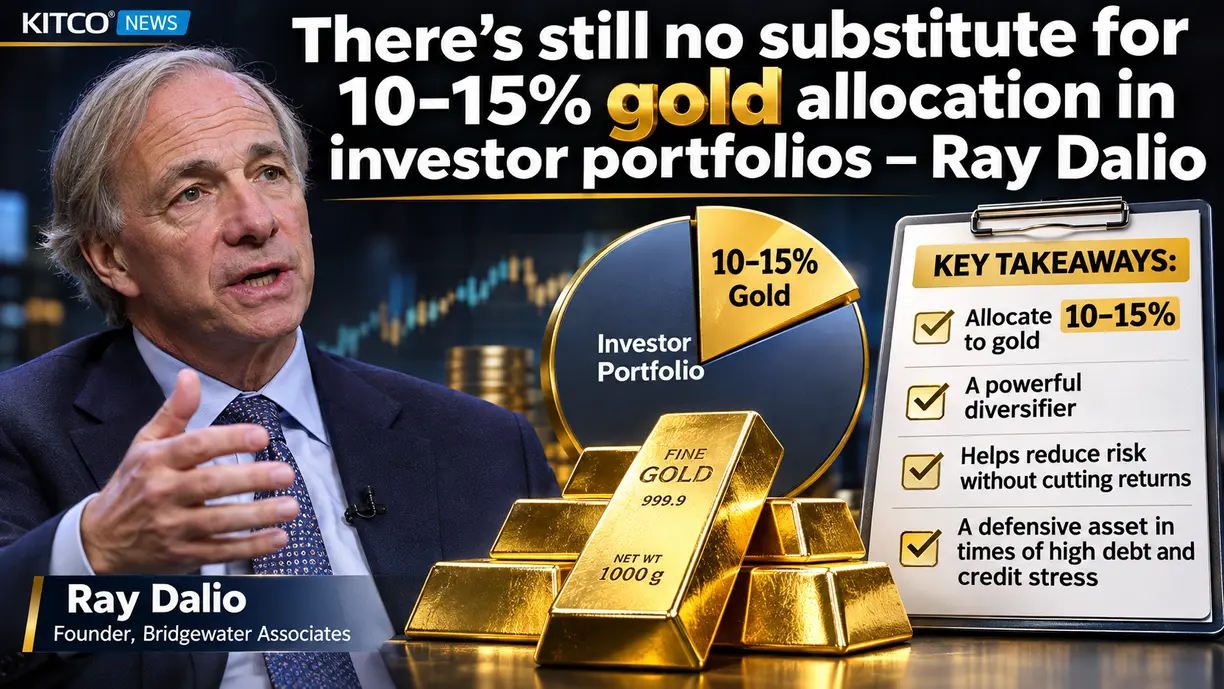
(Kitco News) – Gold is irreplaceable as an effective diversifier in investor portfolios, and a 10% to 15% allocation is the right move regardless of where we are in the investment cycle, according to Bridgewater Associates founder Ray Dalio.
In a recent interview, Dalio said the most important starting point for every investor is knowing how much they need for their life to be stable, and securing that amount through safe, diversified investing.
“When looking at the amount of money that you have, you have to think of how much it returns after inflation, because you're storing buying power.”
Dalio said the next step is to estimate that inflation will eat away an average of about 3% of the value of your investments, and to also be prepared for a worst-case scenario of a 50% drawdown.
“Do you have, first and foremost, enough money that you're good, that you know you're good [after inflation and potential drawdowns]? Once you have that, you can move on from that to do other things, to take more chances. You will have freedom and security. There is nothing more important than that, because if you know what your worst-case scenario is, and you know you're good, and you know your family's good, then you have peace of mind, and you have power, and then you can take risks.”
Dalio then spoke about the importance of building a resilient investment portfolio through what he refers to as ‘the holy grail of investing.’
“The holy grail of investing means that you can reduce risk without reducing returns by knowing how to diversify well,” he said. “In other words, if you take two equally good investments and they move differently, you will have the same return because they're equally good, but you will have less risk because they diversify each other. My mantra is 10 to 15 good uncorrelated investments produce a risk reduction by almost five times. In other words, you can have the same return with one-fifth of the risk.”
“Know your number, achieve that, have that well-diversified, and be humble.”
Dalio then underlined the importance of having gold within the portfolio as a defensive asset.
“Most financial markets do well when the credit system is normal,” he said. “When the credit system is not normal, when there's too much debt and there are big problems, gold is an effective diversifier. So, gold should be part of a portfolio as a diversifier.”
“Now, what's that amount? Between 10% and 15%,” he said. “If you have a traditional portfolio and you have about 10 or 15% in gold and that kind of bad time happens, you'll be well diversified. Whether you expect a good time or a bad time, it's a good thing to have between 10% and 15% in the portfolio.”
Dalio also warned that for all their advantages, cryptocurrencies cannot fulfill the role that gold does in investors’ portfolios.
“There are pros and cons to crypto,” he said. “During very difficult times, there is a desire to have privacy for ownership. [But] gold is an investment that has been held by central banks, that they can securely hold because it's in their hands. There's a saying that gold is the only investment asset that is not dependent on somebody giving you something. Central banks I don't believe, are going to hold crypto in the same way, because it can be monitored: who's owning it, what is being done with it, and it can be taken in various ways legally. So crypto is less appealing to me than gold.”
At the World Economic Forum in Davos earlier this year, the Bridgewater Associates founder discussed the ongoing convergence of debt, capital flows, domestic politics and international conflict.
Dalio said it’s no surprise that central banks and sovereign wealth funds are pivoting away from Treasuries and towards gold.
“When you have very little debt relative to your income, you can increase it and it's not a problem,” he said. “But the more debt and debt service you have, then it squeezes out your spending. That's when you start to get into financial problems.”
There’s also a supply-and-demand dynamic. “In other words, one man's debts are another man's assets. So when you sell the bonds and somebody's holding those bonds, they expect to have a decent, real return; otherwise they wouldn't hold the bonds.”
“The world has a lot of that debt, and then you're selling a lot more,” he added. “Do you want to buy a lot more?”
Dalio said that the increase in geopolitical conflict adds another layer of complexity – and additional risk.
“We're now talking a lot about trade wars,” he said. “You could see more capital wars, or you can understand why buyers or holders of U.S. dollar-denominated debt might feel it's risky, either because of [supply-demand] or because you have a war-like environment. If you were China, wouldn't you be worried that you could be sanctioned? And if you're the United States, then there's a risk that's not bought.”
This new risk calculus is showing up very clearly among sovereign buyers, who are passing up fiat in favor of hard money.
“What you're seeing happen now is a change in central banks’ holdings: They're moving to gold,” he said. “Gold is now the second-largest currency.”
“Why did the gold market go up? Why is it going up? You're seeing central banks and sovereign wealth funds and so on beginning to build that kind of money,” he said. “Why? Because that is the safer kind of money.”
In the current environment, Dalio said the most surprising thing is that people are still surprised.
“It's shocking to me that everybody wakes up every day, reads the news, and is shocked because of something that never happened in their lifetime,” he said. “Connect the dots. How is the money? Why did gold go up 67%? We've been through this before. Who are the buyers? What is happening domestically? Pay attention to what is happening! Is this not the real story?”
See live precious metals prices for gold, silver, platinum and palladium — in USD, CAD and 12 more currencies.
