

(Kitco NewsWire) - Spot gold prices were modestly lower and silver prices were higher in late trading Thursday, as persistent expectations for additional Federal Reserve interest rate increases and a comparatively firm U.S. dollar weighed on bullion during a holiday-thinned session. Gold struggled to extend Wednesday's recovery despite continued geopolitical uncertainty in the Middle East, while silver demonstrated relative resilience as European equity markets rebounded sharply from their recent losses. U.S. financial markets were largely closed for Thanksgiving, reducing trading activity and limiting fresh economic and monetary policy developments. S was trading near $3,565.50 an ounce, down $22.50, or 0.63%, while silver was trading near $41.420, up $0.136, or 0.33%, on the session.
Wednesday's U.S. economic data reinforced expectations for restrictive Federal Reserve monetary policy as stronger-than-expected economic growth coincided with persistent underlying inflation. The October personal consumption expenditures price index increased 0.3% on the month and 3.8% from a year earlier, while core PCE inflation, excluding food and energy, accelerated to 3.3% annually. The second estimate of third-quarter gross domestic product indicated that the economy expanded at an annualized 4.3%, exceeding earlier estimates and highlighting continued economic resilience despite elevated borrowing costs. Personal income increased 0.7% in October, while nominal consumer spending advanced 0.3%, although inflation-adjusted spending was essentially unchanged. Initial unemployment claims declined to 189,000, indicating continued resilience in the labor market, while durable goods orders increased just 0.2%. The combination of strong growth, persistent inflation and uneven consumer spending highlighted the challenges facing policymakers as they attempt to contain inflation without triggering a more substantial economic slowdown.
Market positioning remained heavily tilted toward another Federal Reserve interest rate increase at the Dec. 8-9 meeting, with the latest published futures assessment indicating approximately a 99.4% probability of a 25-basis-point increase. Wednesday's stronger GDP and core PCE figures reinforced expectations that policymakers will maintain a tightening bias, even as falling Treasury yields and recent equity market volatility reflect concerns about the outlook for economic growth. The benchmark 10-year Treasury yield declined Wednesday to 4.845%, while the two-year yield eased to 4.633%, providing some relief to precious metals following their recent sharp losses. However, the dollar remained comparatively firm, maintaining pressure on gold. U.S. Treasury cash markets were closed Thursday for Thanksgiving, leaving Wednesday's yields as the latest regular-session reference. Investors now turn to Friday's shortened U.S. trading session and upcoming economic releases for additional signals about the Fed's tightening trajectory. Reduced holiday liquidity could amplify price movements, particularly if new geopolitical developments or monetary policy commentary emerge before regular trading resumes.
The Strait of Hormuz and U.S.-Iran situation remained unsettled Thursday as continuing threats to commercial shipping and regional energy infrastructure maintained uncertainty surrounding petroleum exports through the strategic waterway. Recent reports of attacks involving tankers and Saudi Arabian energy facilities highlighted the continuing security risks, although the circumstances of some incidents remained disputed or unconfirmed. The U.S. naval blockade of Iranian ports and stalled negotiations over sanctions and maritime security remained obstacles to a comprehensive diplomatic settlement. At the same time, recovering petroleum exports and expectations for increasing global supply have reduced the immediate risk of a sustained worldwide oil shortage. The continuing confrontation maintains the possibility of renewed disruptions to tanker traffic, particularly if military activity expands or commercial shipping operators further restrict transit through the region. For gold, unresolved geopolitical tensions provide underlying support for defensive demand, although expectations for additional Federal Reserve tightening, persistent inflation and a relatively firm dollar continue to constrain the metal's upside.
Crude oil prices eased Thursday following Wednesday's recovery, as expectations for a global petroleum surplus offset renewed concerns about the security of Middle Eastern energy infrastructure and commercial shipping. Brent crude futures traded near $93.65 a barrel in earlier European dealings, down approximately $0.96, or 1.01%, while Nymex WTI crude was near $83.25, down $0.43, or 0.51%. The previous session's gains reflected renewed supply concerns following reports of attacks involving regional energy facilities and shipping routes, although recovering production and expectations for rising global inventories continued to limit the geopolitical risk premium. Both benchmarks remained sensitive to developments involving Iran and its regional allies, particularly as disruptions to commercial shipping could quickly affect petroleum transportation costs. U.S. energy markets operated on a Thanksgiving holiday schedule Thursday, with no regular WTI futures settlement. Lower crude prices could help moderate energy-driven inflation, although persistent underlying U.S. price pressures remain a more immediate influence on Federal Reserve policy and precious metals.
North American equity markets were divided by the Thanksgiving holiday Thursday, with U.S. cash stock markets closed while Canadian shares traded normally. Wednesday's U.S. session saw the Dow Jones Industrial Average advance approximately 164 points, or 0.33%, to close at 50,182.95, while the S&P 500 declined 0.25% to finish at 7,182.78. The Nasdaq Composite fell 0.62% to 23,585.80, while the Russell 2000 advanced approximately 0.7% to 2,704.06. The mixed performance followed a sharp recovery from substantial intraday losses as selling in technology and artificial intelligence-related companies moderated during the afternoon. The rebound encouraged some improvement in risk sentiment, although concerns about elevated technology valuations, restrictive monetary policy and the sustainability of artificial intelligence investment remained significant influences. U.S. stock markets will reopen Friday for a shortened post-Thanksgiving session, when reduced trading volumes could contribute to additional volatility.
Canada's S&P/TSX Composite Index advanced Thursday, extending Wednesday's recovery as improving international equity sentiment supported selected financial, technology and resource-related companies. The benchmark was indicated near 34,427, up approximately 0.72%, in the available completed-session historical market record, following Wednesday's close of 34,179.99. The gain reflected an improvement in investor sentiment after the previous week's sharp losses, although precious metals producers continued to face uncertainty from gold's inability to extend its recent rebound. Selected financial and industrial companies benefited from stronger international equity markets, while energy shares remained sensitive to movements in crude oil. Trading activity was influenced by the U.S. Thanksgiving holiday, which reduced participation from American investors.
European equity markets finished sharply higher Thursday, extending their recovery as technology, financial and cyclical companies benefited from improving risk sentiment following the recent international selloff. The pan-European Stoxx 600 advanced 1.75% to close at 636.98, while Germany's DAX gained 2.08% to 25,215.52. France's CAC 40 rose 1.61% to 8,108.74, and the U.K.'s FTSE 100 climbed 1.75% to finish at 10,609.30. Technology shares recovered following recent losses linked to concerns about artificial intelligence investment and elevated valuations, while banking and industrial companies benefited from renewed demand for cyclical equities. The rebound also reflected easing concerns surrounding potential additional U.S. trade tariffs, although uncertainty about international trade policy and restrictive monetary conditions continued to influence sentiment. The gains contrasted with gold's modest decline, suggesting that improving equity-market confidence was reducing immediate demand for defensive assets despite continuing geopolitical tensions.
The key outside markets see Nymex WTI crude oil futures lower in holiday trading, with the latest available European-session quotation near $83.25 a barrel, while Brent crude was around $93.65. The benchmark 10-year U.S. Treasury yield finished Wednesday near 4.85%, while the two-year yield closed near 4.63%, with U.S. cash Treasury markets closed Thursday for Thanksgiving. The dollar remained comparatively firm, maintaining pressure on gold even as silver demonstrated relative strength. Expectations for another Federal Reserve rate increase in December continued to limit confidence in a sustained precious metals recovery, although lower Treasury yields and renewed geopolitical uncertainty provided some offsetting support. (Kitco Global Index shows how much of today's gold move is the dollar versus the gold market itself.)
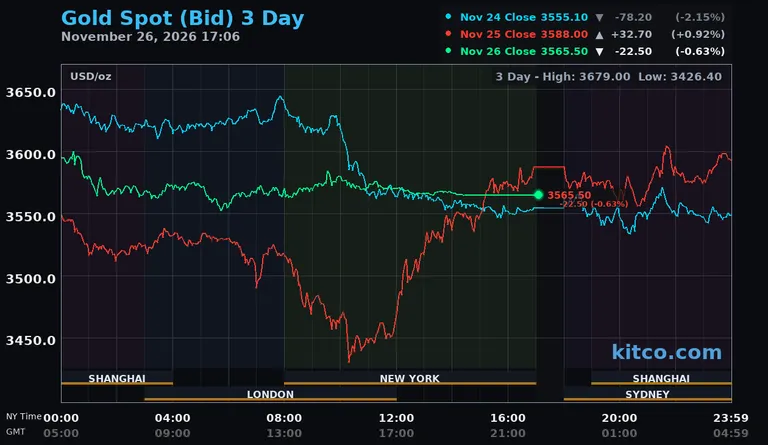
Technically, spot gold bulls' next upside price objective is to push prices back above the $3,630.00 to $3,650.00 resistance zone, with a sustained recovery targeting $3,800.00. Bears' next near-term downside price objective is a sustained break below the $3,500.00 to $3,520.00 support zone, with deeper downside targets at $3,400.00 and then $3,380.00. First resistance is seen at $3,630.00 and then at $3,650.00. First support is seen at $3,520.00 and then at $3,500.00.
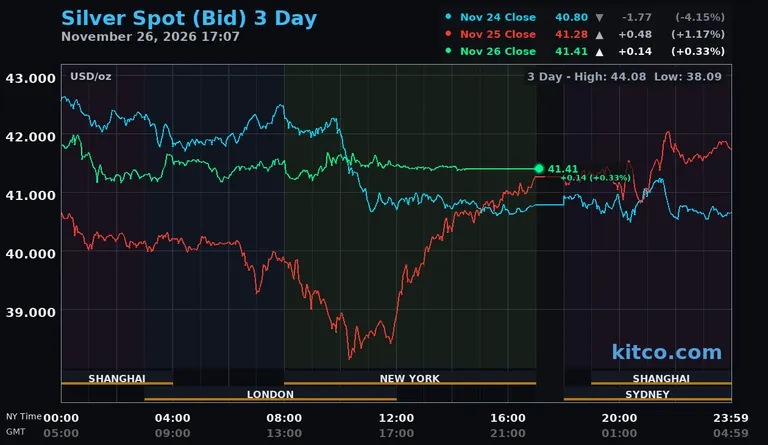
Spot silver bulls' next upside price objective is to drive prices back above the $44.500 to $45.000 resistance zone, with a sustained recovery needed to improve the near-term technical outlook. The next downside price objective for the bears is a break below $40.500, with deeper downside targets at $38.000 and then $37.500. First resistance is seen at $44.500 and then at $45.000. Next support is seen at $40.500 and then at $38.000.
See live precious metals prices for gold, silver, platinum and palladium — in USD, CAD and 12 more currencies.

