
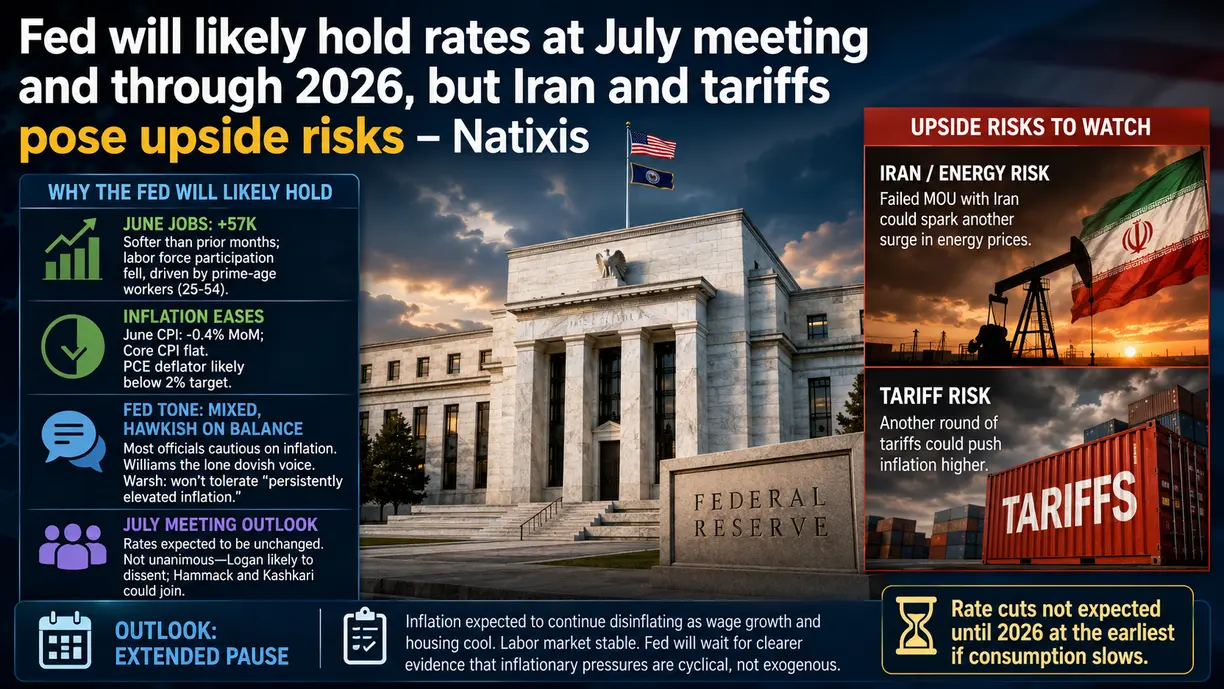
(Kitco News) – The Federal Reserve will likely keep rates unchanged, at next week’s meeting and through 2026, as recent data has bought the FOMC some breathing room, according to economists at Natixis.
Economists Christopher Hodge and Selin Aker wrote in Natixis’ FOMC preview that while data from the intermeeting period was sparse, it leaned dovish.
“[T]he one Employment Situation Report since the June meeting was mixed but a bit softer than in the previous prints,” they wrote. “Payrolls registered a gain of 57k in June, following gains that averaged 164k in the preceding three months.”
Natixis believes the changing composition of the labor force decline is also significant.
“The labor force participation rate has fallen a bit in recent years and that’s primarily a function of older Americans – boosted by huge gains in asset prices – stepping out of the job force,” the authors wrote. “In June’s employment report, the fall was driven by prime-age workers (between 25-54), which is a more troubling development if that continues because it would convey a sense of frustration in the job-finding efforts of the biggest labor group in the country.”
Inflation data since the June meeting was also encouraging. “The June reading of headline CPI was notably softer, coming in at -0.4% on the month, an unsurprising development since energy fell precipitously following the ceasefire agreement between the US and Iran,” they noted. “More notable was the disinflation indicated by core CPI which was flat on the month.”
“The components from CPI and PPI that flow to the Fed’s preferred measure of inflation (the PCE deflator) suggest a reading for June that would be below the Fed’s 2% target.”
Fed communication since the June meeting, however, has been mixed but hawkish on balance, the authors wrote, with Waller, Logan, Hammack and Kashkari expressing concern about inflation, and Williams the only notable dove, saying he “believes that the current stance of policy is “well-positioned” and that there are “encouraging reasons to expect inflation has peaked and should come down in the coming quarters.”
Meanwhile Fed Chair Warsh said during his Congressional testimony last week that they would not tolerate “persistently elevated inflation” while characterizing the AI buildout as likely a one-time price pressure. “This suggests that there is at least some willingness to look through near-term inflation effects on the expectation that they will prove temporary,” Hodge and Aker said. “Overall, while hawkish members continue to lean toward a potential rate increase, the more influential voices on the Committee (in our opinion) appear inclined to wait, with the softer June inflation data lowering the need for near-term changes to the policy rate.”
Natixis expects the Fed to keep its policy rate unchanged at its July meeting, but the authors do not expect the vote to be unanimous.
“So far the only FOMC voter to advocate for a hike is Dallas Fed President Lorie Logan and we suspect she will dissent from a Committee vote for a hold and perhaps be accompanied by Cleveland Fed President Beth Hammack and/or Minneapolis Fed President Neel Kashkari,” they wrote. “Others are skeptical that disinflation will resume but seem willing to hold their fire and wait on incoming data. In this group, we would include Governors Waller and Cook and we suspect given the better than expected inflation data from June, these voters will be on board with a hold.”
They also expect the statement “will be little changed from the pared down version introduced at the June meeting.”
Looking ahead, Hodge and Aker see the Fed staying on hold for an extended period.
“We are cautiously optimistic about the trajectory of inflation as the primary drivers of recent years (namely hot wage growth and housing inflation) look set to cool off in the coming quarters,” they said. “We also think that the labor market, while stable, will not provide an inflationary impulse.”
The key questions, they said, are how quick and steady the disinflation will be and what the Fed will do if it isn’t fast enough.
“We think in the near term the onus will be on further subdued inflation readings for the Fed to avoid a hike, and that is indeed our call,” the authors wrote. “We view the June inflation readings as being anomalous in their magnitude (being well below consensus) but not in their signal (that progress towards 2% is underway). The possibility of another round of tariffs or yet another leg up in energy prices from the failed MOU with Iran are both significant risks to our outlook.”
If inflation data surprises to the upside or remains too high, Natixis said Warsh may need to raise rates to preserve his own credibility. “On the flip side, if we are correct about reduced domestically generated price pressures, the Fed could avoid hikes in the near term,” they wrote. “And should consumption slow as we are forecasting, the odds of a reduction in the Fed’s policy rate increase, but this scenario would likely not be apparent until next year.”
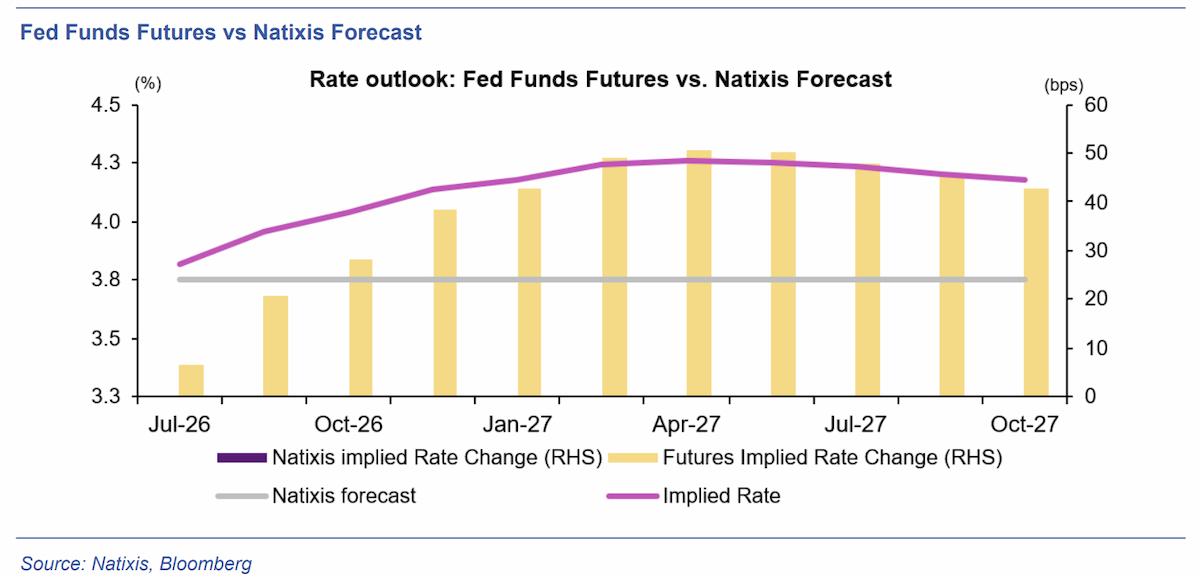
“[W]e expect the Fed to wait for clearer evidence that inflationary pressures are being driven by cyclical, not exogenous, forces,” they said. “As we don’t expect inflation to reaccelerate, we anticipate an extended pause.”
