
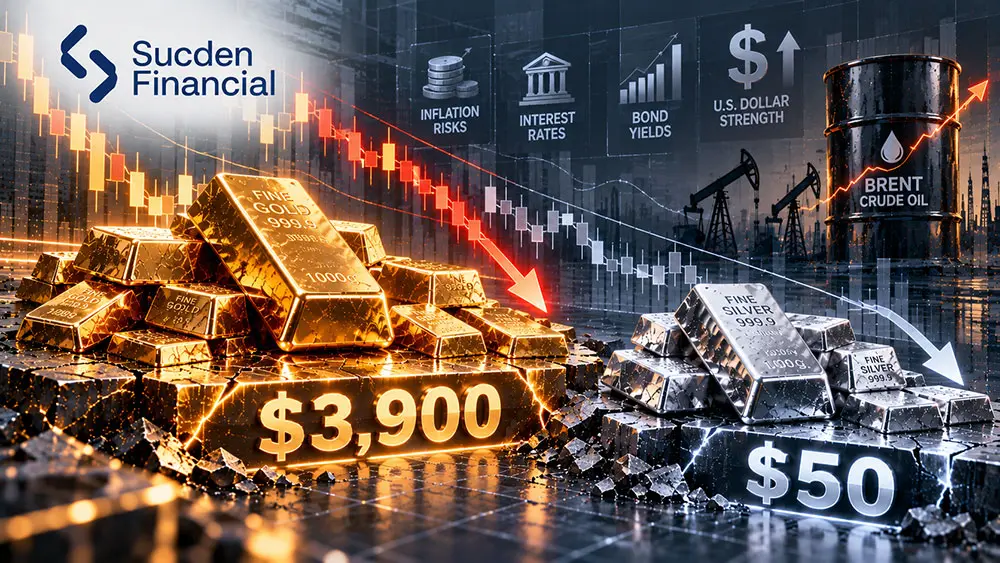
(Kitco News) - Gold prices continue to hold critical support above $4,000 an ounce, but one investment firm expects prices to head lower by year-end as the Federal Reserve is expected to maintain its tightening bias, while silver faces even greater downside risks as weakening industrial demand adds to the pressure from elevated interest rates.
In its latest quarterly metals report published Wednesday, analysts at Sucden Financial said they expect gold prices to test support around $3,900 an ounce ahead of the Federal Reserve's December monetary policy meeting. Meanwhile, silver prices could fall to between $50 and $53 an ounce as tighter monetary conditions continue to weigh on investment demand.
Although the Federal Reserve is expected to leave interest rates unchanged Wednesday, markets see a nearly 80% chance of a rate hike in December.
Despite the bearish near-term outlook, the firm expects both precious metals to stabilize in early 2027 as the Federal Reserve approaches the end of its tightening cycle. Sucden sees gold recovering to between $4,200 and $4,300 an ounce by mid-January, while silver could rebound to between $57 and $60 an ounce.
The analysts noted that the ongoing conflict in Iran continues to create a challenging environment for precious metals, as higher energy prices fuel inflation pressures, keeping U.S. Treasury yields and the U.S. dollar elevated.(Kitco Global Index shows how much of today's gold move is the dollar versus the gold market itself.)
Rather than benefiting from traditional safe-haven demand, gold has struggled as investors focus on the inflationary consequences of the Middle East conflict and the implications for U.S. monetary policy.
"The final quarter of 2026 has brought renewed macro pressure to commodity markets, with the Iran conflict pushing energy costs higher and complicating the outlook for monetary policy," the analysts said in the report.
The firm noted that Brent crude oil prices above $110 a barrel have increased the opportunity cost of holding non-yielding assets like gold and silver. Although geopolitical uncertainty would traditionally support safe-haven demand, the inflationary impact of the conflict has become the dominant influence on precious metals.
The analysts warned that persistently high energy prices could force the central bank to tighten monetary policy further.
The outlook comes as the U.S. economy continues to demonstrate resilience despite emerging signs of weakness in the labor market. Sucden estimates that economic growth reached approximately 3.5% in the third quarter, supported by artificial intelligence investment and relatively healthy consumer spending.
At the same time, headline inflation increased to 3.7% in September, while producer prices recorded their largest monthly increase since 2022.
For gold and silver, the combination of slowing employment growth and persistent inflation creates a difficult environment. While weaker economic activity would normally support expectations for lower interest rates, the energy-driven inflation shock is limiting the Federal Reserve's ability to ease monetary conditions.
Despite the near-term headwinds, Sucden said gold continues to benefit from relatively strong underlying investment demand, particularly from central banks and exchange-traded funds.
The analysts noted that central banks purchased an estimated 289 tonnes of gold in the second quarter, including unreported transactions. Although first-half purchases were the weakest since 2022, official-sector demand has strengthened in recent months.
“Official-sector demand continues to provide the clearest fundamental floor,” the analysts said.
China remains a dominant buyer, with the People's Bank of China adding 23 tonnes of gold to its reserves in September. The purchases brought its year-to-date accumulation to 103 tonnes and extended its buying streak to 23 consecutive months.
Poland also remains an important source of demand, although the analysts warned that purchases could slow as the country's gold reserves approach its 700-tonne target.
Investment demand has also remained resilient. According to Sucden, global gold-backed ETF holdings reached a record 101.55 million ounces in mid-October and have remained close to 101 million ounces despite the recent decline in prices.
However, speculative investors have become increasingly cautious, with managed-money net-long positioning falling to a four-month low.
The analysts said this divergence suggests that longer-term investors continue to accumulate gold during periods of weakness, while short-term traders remain reluctant to establish significant bullish positions.
Although central bank and ETF buying should help cushion further declines, Sucden warned that neither source of demand is likely to overcome another hawkish repricing of U.S. monetary policy.
The firm added that a sustained recovery above $4,300 an ounce would likely require a more pronounced decline in oil prices, Treasury yields and the U.S. dollar.
Silver faces greater downside risks as industrial demand weakens
While gold continues to benefit from central bank accumulation, Sucden said silver faces a more challenging outlook because of its greater sensitivity to interest rates and weakening industrial consumption.
Silver prices have already fallen sharply from their January record high of $121.62 an ounce. The precious metal entered the final week of October trading near $54 an ounce, roughly 55% below its peak.
During the week ending October 23, silver futures declined nearly 6%, compared with a roughly 4% drop in gold, highlighting the white metal's greater vulnerability to changes in monetary policy expectations.
The gold-to-silver ratio has subsequently widened to approximately 74, reflecting gold's relative outperformance.
Sucden noted that silver rallied 15.6% in August after weaker U.S. employment data reduced expectations for additional monetary tightening. However, prices subsequently declined around 8% following Federal Reserve Chair Kevin Warsh's hawkish Jackson Hole speech and the central bank's September rate increase.
Beyond monetary policy, the firm warned that weakening industrial demand is reducing support from the physical market.
Citing data from the Silver Institute’s World Silver Survey 2026, the analysts noted that industrial silver fabrication is expected to decline 3% this year to 639.6 million ounces, representing approximately 57% of total demand.
The biggest weakness is expected in the solar sector, where silver consumption is forecast to fall 19% to approximately 151 million ounces as manufacturers reduce the amount of silver used in photovoltaic cells and increasingly adopt copper-based technologies.
Although demand from electric vehicles, power grids and data centres continues to expand, Sucden said these sectors are unlikely to fully offset declining solar consumption and weaker demand for jewellery and silverware.
The global silver market is expected to record its sixth consecutive annual deficit, with demand exceeding supply by approximately 46 million ounces.
While silver's underlying supply-and-demand fundamentals remain relatively supportive, Sucden said the relatively modest shortfall is unlikely to be enough to offset the near-term impact of restrictive monetary policy.
The investment firm also noted that investment demand remains mixed heading into year-end. Silver-backed ETFs hold approximately 805.8 million ounces following net selling this year, contrasting with continued accumulation in the gold market.
However, hedge funds remain only modestly net long, while declining COMEX registered inventories and limited freely available silver in London could leave the market vulnerable to renewed physical tightness.
The analysts said relatively light speculative positioning could create the conditions for a sharp short-covering rally if the Federal Reserve adopts a less hawkish stance. Ultimately, though, similar to gold, Sucden said that a sustainable recovery will likely depend on investors becoming more confident that the central bank has completed its tightening cycle.
See live precious metals prices for gold, silver, platinum and palladium — in USD, CAD and 12 more currencies.
