
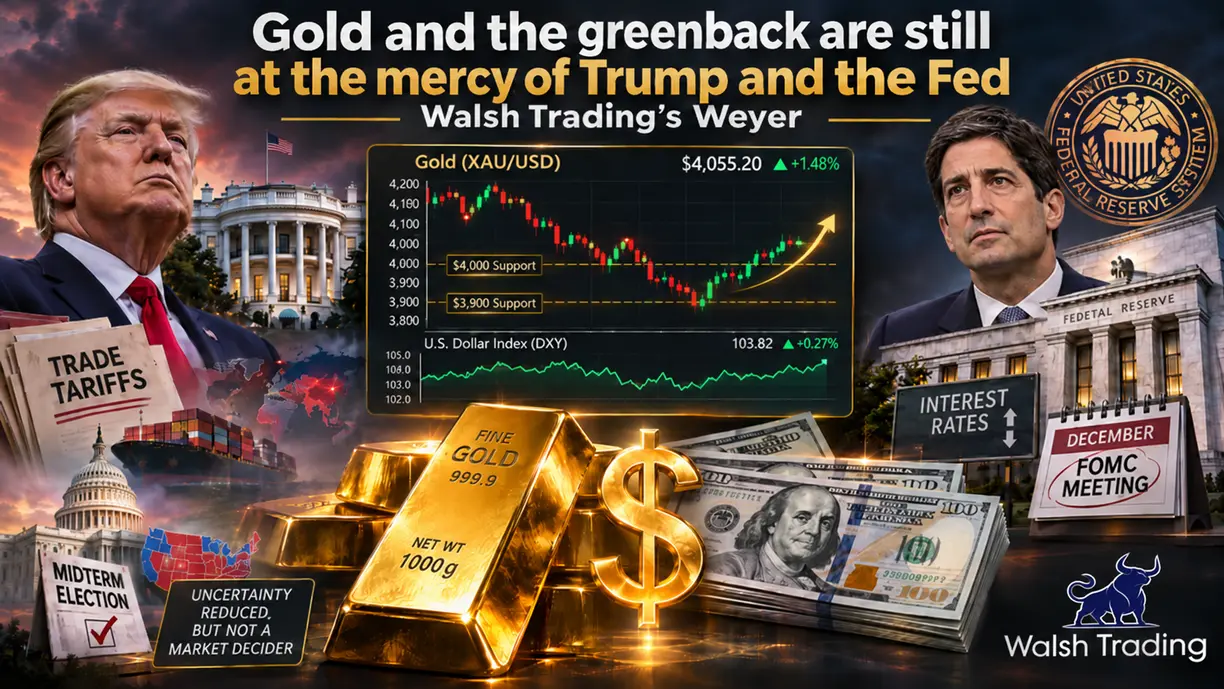
(Kitco News) – The results of the midterm elections were decisive, but the future path of the dollar and gold still remains largely in the hands of the Federal Reserve and the President, according to John Weyer, co-director of commercial hedging at Walsh Trading.
Weyer said that while the election removes some uncertainty from the market, it has no impact on the Federal Reserve, and precious metals traders will have to wait and see what the central bank does in December.
“The Fed operates differently than we do as participants in the markets,” he said. “They're slow and steady when it comes to data and seeing what happens, and patient. We want to make trades, so we want to play it one way or the other – what does this data mean, what does the election mean? – and I think they’re more inclined to stay on the path they were; they’re going to take in the latest data, the election, digest it as they will and just keep plodding along, boringly, day to day.”
“I think, after the last meeting, I won't say a majority, but a lot were looking for December action, and there were a few who were kicking it towards March of next year,” Weyer said. “Whatever the decision they're at, I don't think anything changed it one way or the other. If I was somebody who was thinking we were going to get [a hike] in December, I don't think this data changed it. I think they're just on their path.”
Weyer conceded that one thing the election could change is the outlook for the dollar – which would have clear implications for gold – but here again, Trump still holds many of the cards, particularly with trade and foreign policy.
“The executive branch hasn't changed,” he said. “When we talk about, let's say, the tariff front, which I think has a big effect on the dollar.” He said Trump could cut a face-saving deal with Iran, but he could also keep fighting for the next two years.
Weyer thinks there’s also a chance that Trump decides to go with the flow, and instead of exercising his presidential veto powers, he instead gets on board with some of the Democrats’ spending priorities over the next two years.
“One thing about the current president, he's predictably unpredictable,” he said. “If he feels the tide turning on perception, he might decide to go with the tide. He's done that before. I don't think there won’t be more spending. There'll be spending in different ways.”
Weyer still expects market participants will want to be in gold over the next two years, because nobody can be sure what the president will do.
“I think gold and silver of recent vintage are still a flight to quality,” he said. “They've also become a real speculator's market. The next two years, with somebody who can decide, ‘Hey, we're going after Greenland after all,’ there's still going to be reasons for being gold and silver. As long as he's there, I think they're going to be a safe-haven play because of what he may do next. There is a fundamental uncertainty with Trump in the White House.”
In the near term, Weyer believes the path of least resistance for gold is higher.
“I think [the $3,900 and $4,000 levels] are going to hold,” he said. “We were so much higher recently that these are going to become attractive levels for buyers, and people who have been forced out or gotten out and want to get back in. I'm not saying they're a foundation, but I think they’ve got a good shot at holding.”
“Particularly on the upside, it's always easier to go somewhere you’ve already been when it comes to markets,” he added. “Finding new prices, new highs, it's a little bit harder than just going back to where we were three weeks ago, three months ago, a year ago. It's just easier to do; we've been there.”
See live precious metals prices for gold, silver, platinum and palladium — in USD, CAD and 12 more currencies.
