

(Kitco News) - The gold market is coming off its post-payrolls lows after the latest data showed consumer sentiment in the U.S. improving beyond expectations, while inflation expectations ticked lower.
The University of Michigan announced on Friday that the preliminary reading of its Consumer Sentiment survey for November was 51. The data was better than expectations, as the consensus forecast of economists called for a reading of 48, the same as October’s final reading.
“Consumer sentiment ticked up about 6% in the preliminary read,” said Surveys of Consumers Director Joanne Hsu in the report. “Modest improvements in multiple domains, including expected personal finances and business conditions, were concentrated primarily among independents. While sentiment lifted for lower- and middle-wealth consumers, it fell 5% for those with the largest stock portfolios in the wake of a relatively turbulent period in stock markets.”
Hsu noted consumers’ growing anxiety over the possibility of an AI bubble. “AI worries, however, were dwarfed by cost of living concerns, which continue to be at the forefront of consumers’ minds across the population,” she wrote. “About 57% spontaneously mentioned that their living standards have been eroded by high prices, the highest seen since May and up from 46% in February, just prior to the Iran conflict. Despite this month’s improvement, sentiment is down 10% from February.”
The survey was conducted between October 20 and November 2, ending just before the midterm election. “In the two months leading into the election, more than two-thirds of consumers expected Democrats to win the House, and over half anticipated the same for the Senate,” she said.
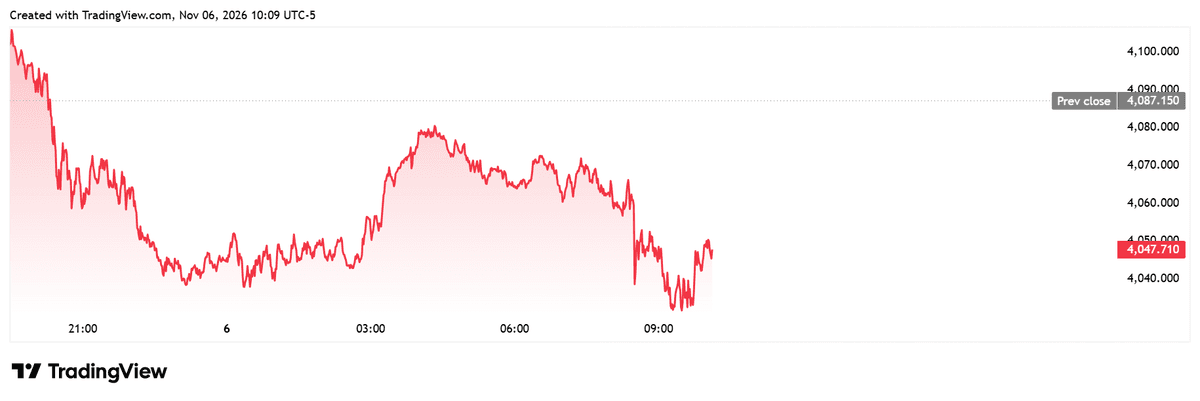
Spot gold was coming off its lows in the minutes following the 10 am ET data release, and last traded at $4,047.71 per ounce for a loss of 0.96% on the day.
The preliminary November reading also showed a drop in both year-ahead and longer-run inflation expectations.
“Year-ahead inflation expectations declined from 4.7% last month to 4.3% this month,” Hsu noted. “Although the current reading is the lowest since August, it remains substantially above the 3.4% seen in February before the Iran conflict began, along with all 2024 readings. Long-run inflation expectations inched down from 3.5% in October to 3.4%, notably higher than their 2024 range of 2.8% to 3.2%.”
